

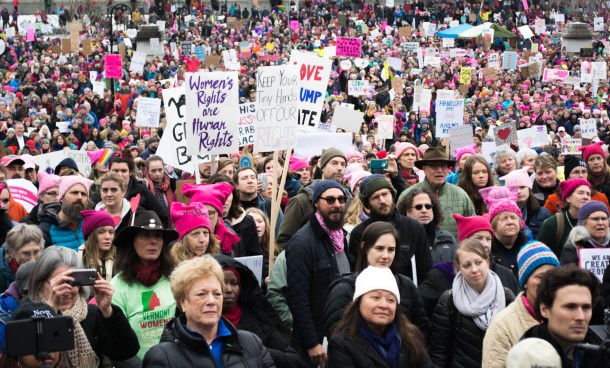

Many Vermonters remember Jan. 21, 2017. It was the day after the inauguration of Donald Trump, when the Women’s March became the largest day of protest in the nation’s history.
In Montpelier, as many as 15,000 people gathered in front of the Statehouse and up and down State Street. It was a day of despair and exhilaration — despair because a new era of demagoguery and corruption had dawned, but exhilaration because of new solidarity among millions of people around the world who let it be known they were ready to defy Trump’s promised abuses.
I didn’t know what to expect. On my way there, I turned onto I-89 at Middlesex, where traffic was at a standstill 6 miles away from Montpelier. It was one of the largest gatherings the city had ever seen, and numerous speakers addressed the crowd in defiant tones from the steps of the Statehouse.
Trump’s repugnant attitudes and behavior toward women were a major motivation for the march, and one of the speakers was former governor Madeleine Kunin, a pioneer in politics for women. But it wasn’t only Trump’s crude sexism that had alarmed the crowd. He had long before established his racist and xenophobic credentials, and speakers young and old and of every race and gender expressed their opposition.
Six years later, it’s worth recalling that day. Now that President Joe Biden has officially launched his campaign for reelection, concern remains that Biden’s age and other shortcomings will make him vulnerable in the 2024 election, an especially worrisome prospect given the possibility that Trump will be his opponent.
Through all four years of Trump’s crimes and misdemeanors, memories of the Women’s March and other occasions of opposition were a constant reminder that the people weren’t buying what Trump was selling. As the election of 2020 approached, I reminded friends that Trump had lost the popular vote in 2016 and won only in the Electoral College.
The Women’s March was an early indicator that opposition among ordinary Americans across most of the country was strong. If he lost by 3 million votes in 2016, as he did, it seemed that all of the people offended by his presidency since then would add to Trump’s margin of defeat in 2020. And that’s the way it turned out. The prospect of Trump’s reelection was so alarming that he lost in 2020 by 7 million.
The staying power of Trump’s popularity among what is called his base is a fact. But given the growing extremism of his base, it is likely that, within the general population, his base has been shrinking. If the Jan. 6 mob is representative of his base, then most Americans will want no part of it.
And that is one key to Joe Biden’s strength. Voters will fret over his maladroit speaking style, his old man’s stiff gait, his wispy voice. They will ask: Is he up to it? He’s been up to it so far. His record is not without flaws, but his presidency has been focused and steady. And it has been scandal-free, which is a relief following the nonstop scandals, self-dealing and corruption of the Trump era.
Age may slow a person down, but for Biden age has brought experience. He grew up in the shadow of World War II, and the lessons learned about the need to stand up to fascism are ingrained in him. Trump’s coziness with Vladimir Putin would have had devastating geo-political consequences were he in office. Biden knows how Washington works, and he has put in place an administration that values competence. Historic bills on infrastructure and climate change have been two results.
The despair felt by many in the wake of Trump’s election in 2016 returned in 2020 immediately following the election. For several days, results were close in Pennsylvania, Arizona and other states, raising the possibility that an Electoral College fluke could put Trump in office again. But it didn’t happen.
When Arizona tipped the tally of the Electoral College in Biden’s favor, the exhilaration of victory dwarfed the exhilaration of opposition felt during the Women’s March four years before.
Biden is strong, not just in Vermont and other progressive states. His strength has grown in those important swing states that turned the election toward Trump in 2016 — Wisconsin, Michigan, Pennsylvania, Georgia, Arizona.
It’s worth remembering that there was a Trump base long before Trump, and it has always been a minority. In the 1920s, the Ku Klux Klan enjoyed a resurgence. In the 1930s, pro-Nazi groups in America enjoyed considerable support with the public, even including some U.S. senators who were working for Nazi agents. Openly racist and antisemitic ranters of that era were precursors of Rush Limbaugh, Bill O’Reilly and Tucker Carlson.
After World War II, anti-Communist red-baiters like Joe McCarthy and Richard Nixon traded in fear and hatred. Racist violence in the South and open racism in the North flared in response to the civil rights movement. McCarthyite anti-government fervor bubbled beneath the surface, abetted by fringe groups such as the John Birch Society.
Always about a third of Americans were Trump-ish before Trump — anti-civil rights, anti-education, anti-government. They gravitated toward different standardbearers — Barry Goldwater, Ronald Reagan, Pat Buchanan, Newt Gingrich.
There were several through lines. Early in Trump’s career, Roy Cohn, the lawyer henchman for Joe McCarthy, was an adviser to a young Donald Trump. Roger Stone, Trump’s dirty trickster, was a dirty trickster for Richard Nixon.
During these years, Vermont went a different way, furthering a liberal tradition of tolerance and fairness that had characterized the party of Lincoln, but that eventually found a more suitable vehicle in the Democratic Party.
The video launching Biden’s campaign depicted him as a man of the people — featuring many union workers of varied races and ethnicity. The quick cuts of the video contained numerous meaningful images, including, in the blink of an eye, the 16th Street Baptist Church in Birmingham, Ala., where a bomb planted by KKK members killed four black girls in 1963. We can’t go back to that — that’s what Biden is saying. His positive message — “Let’s finish the job” — is a strong counter to the bitterness and division of the Trump-enthralled Republican Party.
As Vermonters surged into Montpelier six years ago to join the Women’s March, hope may have seemed like a distant prospect. But the march was a first step toward a win for Biden in 2020 and toward building the movement for a people’s democracy now heading toward 2024.
