

A Michigan company is seeking approval from Vermont regulators to build a manure digester at one of the state’s largest dairy farms, alongside a new 8-mile pipeline that would transport the natural gas produced by the digester to a regional energy grid.
Novilla RNG’s 2.5 million-gallon digester would be located at Pleasant Valley Farms in the northern Franklin County town of Berkshire. Plans are for the digester to produce about 105,000 dekatherms of natural gas per year, Novilla RNG told Vermont’s Public Utility Commission — the equivalent, it said, of the energy derived from 860,000 gallons of gasoline.
The digester would heat manure from Pleasant Valley’s dairy operation into a gas and then separate the gas into different components, including methane. The methane would then be compressed and injected into the new natural gas pipeline.
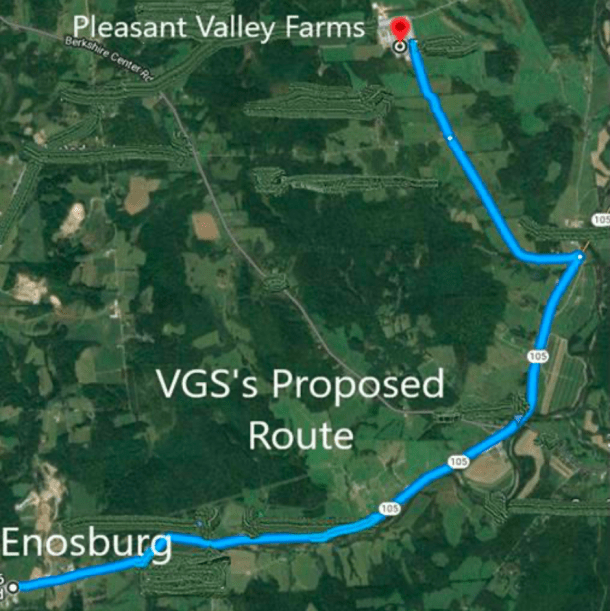
Vermont Gas Systems — which has about 55,000 customers in northwestern Vermont — would install the pipeline and distribute the gas, according to regulatory filings. The pipeline would head south from Pleasant Valley Farms to Route 105, then follow the highway west until it reached an existing Vermont Gas pipeline in Enosburg Falls.
Project filings show the company wants to link approximately 55 homes and 15 businesses along the pipeline route into its existing gas network.
Pleasant Valley has operated a smaller digester on the farm since 2006, though it’s largely used to produce electricity, not natural gas.
Mark Hill, Novilla RNG’s co-CEO, said he hopes construction will begin later this year.
“We’re excited,” said Jamie St. Pierre, whose family owns Pleasant Valley Farms.
“We don’t really produce natural gas in Vermont, so to have a source right here I think could be great for our local economy and energy structure,” St. Pierre said.
Regulatory filings say the methane digester would produce “renewable natural gas” — so-called because it does not come from fossil sources but rather from biological waste. Renewable natural gas is also known as biogas.
The renewable natural fuel would displace some fossil gas in Vermont Gas’ existing supply and reduce the amount of methane released from the farm into the atmosphere, project filings describe, creating “a significant positive impact on the environment.”
Renewable natural gas makes up less than 2% of Vermont Gas sales today, according to Dylan Giambatista, a company spokesperson, though it has contracts in place that could bring that figure to 12% in the future. Most of what Vermont Gas sells today is fossil fuel from Canada that’s imported to the state via a cross-border pipeline.
Vermont Gas “is committed to making progress and welcomes collaborations, such as this project, to help Vermont reach its climate goals,” Giambatista said in an email.
Some environmental groups take issue with labeling natural gas as “renewable,” though, noting the methane that largely makes up biogas is a potent greenhouse gas.
Elena Mihaly, Vermont director for the Conservation Law Foundation, said it can be misleading to customers when the natural gas industry describes new digester projects as climate solutions, even as their networks continue to rely largely on fossil fuels.
“It’s potentially going to make people believe that their choice has a better climate impact than it does,” she said. Mihaly also said it’s all but certain that methane would leak into the atmosphere throughout the biogas production and distribution process.
In regulatory filings earlier this year, Berkshire and Enosburgh officials expressed support for the proposed digester and pipeline. Enosburgh’s planning commission, for its part, “fully supports the project and has no objections to it,” the body wrote in a February memo. Members of the Northwest Regional Planning Commission are set to discuss the project at a meeting April 24.
Pleasant Valley has about 4,000 cows, St. Pierre said. He said he thinks the farm’s scale makes new, innovative projects possible.
The farm came under scrutiny in 2020 when the Vermont Attorney General’s Office sued its owners over an expansion officials said violated state agricultural laws. The lawsuit is still being pursued, a spokesperson for the office said in an email this week.
“The best businesses that can handle heavy regulations are the larger ones, because they have more resources to deal with heavy regulations,” St. Pierre said. “Because our farm is of scale, it makes it interesting for digester companies to work with us.”
Correction: The caption in a photo that appeared in an earlier version of this story inaccurately characterized the composition of Pleasant Valley Farms.
