

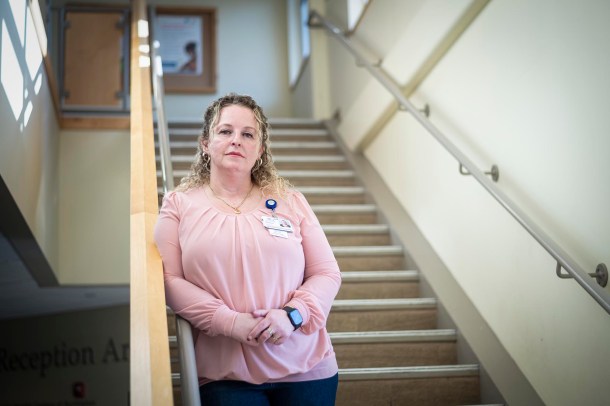
Medina Loncarevic’s advice about health insurance is always in demand, but even for her the last few weeks have been busy. Many days, a line backs up into the hallway of people waiting for a chance to speak with her about a piece of mail they just received.
A bright red stripe runs across both sides of the envelope along with phrases in big, bold letters: “Action Needed” and “Open Right Away.” But the dark green mountain silhouette is also eye-catching.
“What will prompt people to seek my help is the Vermont Health Connect logo, which is a good thing,” said Loncarevic. “Oh, there’s a series of things from Vermont Health Connect. Let’s go see Medina.”
Vermont Health Connect is the state’s name for a complex variety of federally subsidized health insurance.
Loncarevic is a patient support case manager at Community Health Centers, which runs primary care, mental health and dental clinics in Chittenden and Grand Isle counties. Around 40% of the federally qualified health center’s 32,000 patients are covered by Vermont’s Medicaid health insurance.
Starting this month, after a three-year Covid-19 pandemic-related hiatus, all of them will need to reapply over the next year.
Across the country, agencies are restarting a practice as old as the Medicaid program itself, 58 years and counting: requiring people to prove that they don’t make too much money to qualify for America’s only version of comprehensive free health care.
To qualify for coverage in Vermont, healthy adults must make no more than 138% of the federal poverty rate — that’s around $20,500 of annual income for individuals and $41,400 if you are part of a family of four.
The Medicaid program for children under 19, called Dr. Dynasaur, is open to a larger group of households, those making up to around $95,000 for a four-person family this year, though small monthly premiums are required at the higher range. (Premiums have been suspended until mid-2024.)
For those just above the adult coverage income threshold, highly subsidized private insurance plans are available through Vermont Health Connect — for the lowest earners, available at no monthly cost. Starting last year and through 2025, even higher-earning households can get some help there.
More than a dozen permutations
That may sound somewhat straightforward. But there are actually more than a dozen permutations of the Medicaid program, not counting the ones available to people with disabilities and those over age 65.
To figure out whether you or members of your family qualify for one of them is complicated.
Completing the reenrollment form is akin to doing your taxes. For each household member, you need to fill out immigration status, age and Social Security number, a list of every job they hold that brings income, and for each of those an employer contact number and the income it provides before taxes. Not responding leads to being automatically disenrolled. You may be asked to provide pay stubs or tax forms.
Maybe you got divorced or there’s a new pregnancy. Or a spouse is about to turn 65 and become eligible for the other major federal health insurance program, Medicare.
Do you have student loans? You can deduct that from your income to qualify. Do you own property? That normally doesn’t count unless you rent it out, but it does matter if you need long-term care. Do you live in Chittenden County? For some programs, that means a slightly higher income threshold.
If you have children and make a little bit too much, you might be ineligible for adult Medicaid for a few months. But if you keep track of your health care costs and show receipts, you can subtract that from your income and rejoin if that spending brings it far enough back down.
The different contingencies go on. That is where advisers like Loncarevic come in.
Federally qualified health centers like Community Health Centers also operate on a sliding fee scale based on a different set of income thresholds, which she can offer when other programs fail.
Some of the patients she has helped with reenrollment during her eight years on the job have, like herself, learned English as a second, or seventh, language. But even native speakers can be overwhelmed by the multipage document. Others simply wonder whether the effort is worth it.
When state governments were rolling out insurance marketplaces created by the 2010 Affordable Care Act, also known as Obamacare, there were plentiful grants to fund insurance “navigators” or “assisters” like Loncarevic. Now hospitals and health care clinics have to fund the positions themselves and there are fewer around.
There is no question about keeping Loncarevic and her two colleagues’ positions at the Community Health Centers clinics, said Kim Anderson, the organization’s director of development and communications.
“For folks who don’t already have barriers, it’s challenging,” Anderson said. “When you add in a language barrier and other socioeconomic barriers, that sort of access to an expert is beyond valuable.”
‘Medicaid is everything’
The rhythm of visits and calls to Loncarevic’s office would come at a regular clip throughout the year. Until March 2020, that is, when the country began to respond to the threat of Covid-19.
Congress wanted to keep everyone insured during a time of uncertainty. State governments were offered a significant bump in cost-sharing if they maintained continuous health coverage for everyone enrolled at that time through the end of the public health emergency.
In effect, for three years, there were no more forms. You could voluntarily leave for employer-sponsored insurance, but you didn’t have to. You wouldn’t be kicked out of a program for turning 19 or 65, or for getting a small raise.
Loncarevic still helped patients get enrolled, and reminded them when they needed to inform the Department of Vermont Health Access, which operates Vermont Health Connect, of a job or life change. But her greatest source of anxiety for them went away.
“To most people, Medicaid is everything. There are people who do not understand what (other) insurance is,” Loncarevic said. “People are so unfamiliar with it and they will ask why.”
She and her colleagues do their best to give quick tutorials on the U.S. private insurance system. Monthly premiums aren’t hard to understand, and are often free or very inexpensive through the state marketplace. But for many, the idea of a deductible and the fact of a copayment and the difference between them is confusing or simply seems unaffordable.
“My biggest concern always, considering that we work with a diverse population, is people not seeking help to find some coverage after they lose Medicaid,” Loncarevic said.
Trying to slow the churn
As many as 15 million people may lose Medicaid coverage during the reenrollment process over the next 12 to 14 months, around 17% of the total enrolled, the U.S. Department of Health and Human Services estimates, based on historic patterns. Almost 7 million are likely still eligible, but will be dropped nonetheless, mostly for not providing the necessary information.
Regardless of the reason, as many as 65% of those who leave the program are likely to experience a period of time when they’re uninsured, according to an analysis of survey data by the Kaiser Family Foundation.
The Department of Vermont Health Access recently reported a record 212,133 people were participating in a Medicaid program at the end of 2022, roughly one in every three Vermonters. If the nationwide pattern applies, that would mean around 37,000 people would lose coverage, though almost 17,000 shouldn’t have to.
That’s a number that DVHA Deputy Commissioner Addie Strumolo and her colleagues are trying hard to reduce. They have launched a sustained effort for the last six months to alert people of the coming renewal restart, and plan to continue extensive outreach.
“Even though we are just going back to normal, we know that this is a change for people,” Strumolo said. “We are going to give people ample warning.”
The people who are still eligible but are regularly lost to the system due to a change in address or missed deadline are one group they are focused on. Medicaid administrators call it “churn.” It occurs when someone leaves the program but reenrolls within a few months, usually when health care is needed.
What groups are most affected by administrative hurdles, who most frequently cycle in and out of the program and insurance coverage, can be seen in the growth in the enrollment figures that DVHA reports quarterly to the Legislature.
“The absence of that churn rate is why our enrollment is so high,” Strumolo said.
The biggest increase in enrollment numerically is in adults who became newly eligible for Medicaid through the Affordable Care Act, almost 24,500 people, or about 43% more than were enrolled before the beginning of the pandemic.
But the greatest percentage increase is among caregiver adults who are eligible for cash assistance programs, and as a result were covered by traditional Medicaid. Their numbers more than doubled to over 11,000. The number of children enrolled overall increased by about 6,500, around 10%
To reach them, DVHA has sent text messages and emails and postcards to every enrollee, reminding them to update their contact information. The result has been a 50% increase in the number of address updates from the previous year, the department said.
Every household will receive a letter with the red stripe a month before their reenrollment is due. A month later, there will be a second letter, equally blaring, which warns that the household will be disenrolled in two weeks if no action is taken.
Every month, DVHA staff will be alerting around 16,500 new households of reenrollment, starting with those they already know are likely ineligible due to notifications during the pandemic. The first group being contacted this month will not be removed from the program for nonrenewal before May 31, the department said.
States pay a portion of Medicaid costs and have some leeway to tailor the program. In 2022, Vermont’s Medicaid expenditures totaled $1.9 billion —- a close second to public education as the biggest part of the state’s $7.6 billion budget. Around 70% of the money spent came from the federal government. That percentage will decrease some once the special pandemic incentive to maintain coverage goes away.
Vermont policymakers and health care administrators have made a number of choices that should mean a lower percentage of people lose coverage during the reenrollment period than nationally. They adopted higher income-eligibility thresholds for both adults and children under 19. They ask for renewal just once a year, while some other states do every six months. Also, they have made progress in automating the process.
Strides forward in connecting various government databases now allow at least 40% of all renewals in Vermont to occur automatically. The department can find the information needed by checking against what has been received from applicants to the 3 Squares food assistance program or from employers to the Vermont Department of Labor. Someone who has been automatically reenrolled will still receive a letter alerting them to that, but they won’t have to struggle through the form.
That automatic procedure is one reason the department thinks it can run reenrollment with the same number of staff it has always used, despite the record numbers.
“A major, major part of our plans is to maximize automatic renewals,” said Strumolo, who is aiming for 50 percent.
Stress worsens the symptoms
Erin Kellar, 31, has lived most of her life with chronic disease and is careful to maintain insurance. But in 2020, knowing she would be able to join Medicaid for several years running gave her the freedom to leave her job as a case manager at a methadone clinic and finish a mental health counseling degree.
Soon after graduating early last year, she got sick enough to need an overnight stay in the hospital, where she was diagnosed with Type I diabetes. She paid nothing for that, or for insulin treatments she now needs.
“I was still kind of rebuilding my financial stability and was able to get the care I needed in that moment without the financial burden,” Kellar said. The assurance she would not have the large deductibles and copayments that come with private insurance reduced her stress levels and helped her get well.
“Something people don’t always understand about autoimmune disorders is that stress in general, like the financial burden and uncertainty, exacerbates the symptoms,” she said.

Now Kellar works as a therapist at the Vermont Center for Resiliency in Burlington and expects to lose Medicaid coverage when she is scheduled for reenrollment this summer. She can get insurance through her employer at a cost of about $300 per month if she increases her work hours, but she worries that could put her health at risk.
She also is concerned about her clients, many of whom are in more challenging circumstances and use Medicaid to pay for their time with her. “I’ve got great coping skills. I’ve got a strong community and support, and I’m stressed,” she said.
A disruption in coverage can mean people stop therapy for several months or more. “People who have been doing really important mental health work are going to have that care disrupted,” she said, which she thinks will have “rippling profound impacts on our communities.”
Health care as a human right
Leah Duckett, 25, has used Medicaid as her insurance since she was a child growing up in the Northeast Kingdom. She got a job last fall as a paraeducator at a Burlington elementary school, and now is “hovering around the cutoff” for eligibility.
She likes the position, and it gives her the option to get private insurance. But the change will be a big financial hit. “Paying premiums and paying co-pays on what is basically poverty wages, you know, is going to make my budget really hard, for sure,” Duckett said.
Both Kellar and Duckett have connected with the Vermont Workers’ Center after reflecting on their experiences. The statewide organization advocates for universal health care, under the banners of “Medicaid for all” and “health care as a human right.”
The latter at least is a cause shared by some 59 state legislators who cosponsored H.156 this session. They want to restart a conversation that has faded into the background in recent years, despite being part of Vermont law. Why can’t we provide basic affordable health care for everyone? And, for our most vulnerable citizens, why do we make obtaining it so hard? (In large part, the Medicaid program subdivisions and annual enrollment requirements are set at the federal level.)
Duckett has been spending nights and weekends with the Workers’ Center campaign. They are going door-to-door and setting up tables at events to raise awareness about how badly our complicated patchwork of insurance is failing us. She also makes sure to remind people to look out for the red-striped letter. She’s looking out for hers.
“It’s been hard, you know, having this specter looming over me,” she said. “There are just so many people in my life right now that have this hanging over them.”
