


Kae Ravichandran, a medical student at the University of Vermont, won the nonbinary division of the 2023 Boston Marathon on Monday, running the 26.2-mile course in a time of 2:38:57 and finishing more than 10 minutes ahead the second- and third-place finishers in the division.
Leading up to the race, Ravichandran, who is originally from Massachusetts, said they had been running 70 to 80 miles per week, often training on hilly dirt roads near Bolton to practice for the Boston Marathon’s infamous Heartbreak Hill.
“This time around, I just didn’t feel like I was taking the race as seriously, even though I was definitely running pretty fast,” they said. “It just felt a lot more lighthearted. Just like the weight of everything was a lot less.”
While Monday was the first time Ravichandran had finished the Boston Marathon, it wasn’t the first time they attempted it. Last year, Ravichandran said, they entered the race before dropping out partway through, disheartened by the race’s lack of gender inclusivity.
“I was just so mentally overwhelmed with a bunch of things, including not being able to sign up as the gender that I wanted,” Ravichandran said.
The Boston Athletic Association announced last September that it was adding a nonbinary division for runners. Now, five out of the six World Marathon Majors include a nonbinary division, with the Tokyo Marathon being the only holdout restricting runners to male or female divisions.
According to Ravichandran, the Boston association’s recognition of a nonbinary category is an important step toward greater inclusion in the sport, though there is still work to be done to ensure equity for runners of all genders.
Cal Calamia, the second-place winner in the nonbinary division, and Jake Fedorowski, who took 11th place, played key roles in pushing the Boston Athletic Association to add the nonbinary division this year, according to Runner’s World Magazine.
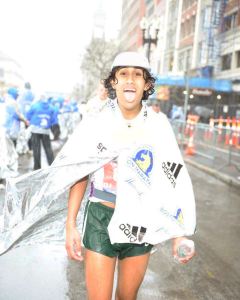
Despite the implementation of the division, Ravichandran said race day this year “was definitely very nerve-wracking. It was really weird to be the only brown-presenting person in that first corral. Like, everyone around me was just white. But then a few miles into the race, I kind of settled in and was able to sort of tell myself, hey, you’re able to compete as yourself, and that’s gonna be really fun.”
While the Boston Marathon awarded trophies to first-, second-, and third-place winners, nonbinary runners were not offered the same monetary awards that male and female racers received.
“The money isn’t being equally distributed,” Ravichandran said, “And I know that like, less than 50 years ago, cis women didn’t get prize money for running the Boston Marathon either. I think it was only in the late ‘80s when the (distribution of) prize money became equitable. I think that there should be some sort of monetary prize for nonbinary people.”
Ravichandran said they have experienced inequitable allocation of prize money in the past, when they won the Green Mountain Marathon in Vermont and received no award.
“It was like, well, it was great that I was able to run as myself,” Ravichandran said, “But at the same time, if I’m faster than everybody else, why didn’t I get anything?”
Ravichandran — who is a member of the Green Mountain Athletic Association, the leader of the association’s inclusion committee and a frequent participant in association races — said that particular incident led to productive conversations around inclusion in Vermont running.
“We did end up talking,” Ravichandran said. “I think we’re making progress in having equitable race prizes for races in Vermont. I think that did really start a discussion here, which I think is really cool.”
Nik Ponzio, board president of the Green Mountain Athletic Association, said Ravichandran has been a “great asset” to the association as it strives to become “more welcoming to athletes of all genders and identities.”
“As the coordinator of our recently formed Inclusivity Committee, Kae has spearheaded an educational campaign for our members and race directors, and helped us modernize our club policies around transgender and non-binary athletes,” Ponzio wrote in an email to VTDigger. “We feel very lucky to have such an engaged and talented club member bringing awareness to these issues in our area and around the greater New England region.”
“All nonbinary runners are really trying their best to just exist in a very binary world,” Ravichandran said, “Keep being strong and keep doing what you’re doing because it’s making the world a much better place.”
Correction: An earlier version of this story incorrectly stated the distance of the race.
