

This article by Nora Doyle-Burr was first published in the Valley News on Feb. 18.
WHITE RIVER JUNCTION — People in Hartford generally agree that substance use is the top safety concern in town, according to an assessment conducted by the Hartford Community Coalition.
Now, the coalition is trying to figure out what to do about it.
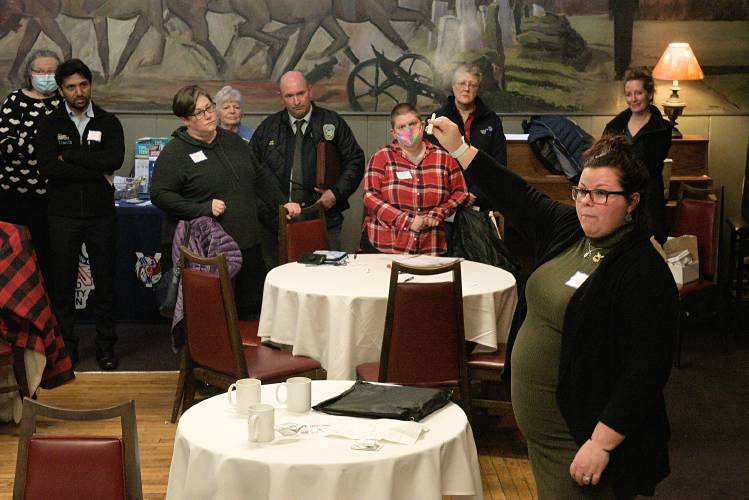
“We’re all here with the shared goal of improving the quality of life here in Hartford,” Amie Wunderlich, the coalition’s projects director, said during a community forum the coalition held Thursday evening at Hotel Coolidge in White River Junction.
The coalition’s assessment found that 76% of respondents to an online survey in January 2022 were “worried that this is a drug-heavy area,” according to slides shown to the roughly 40 people who attended Thursday’s forum. That concern ranked above concerns about the safety of youth, which 57% of respondents reported, and concerns about physical safety shared by 29% of respondents. Respondents were asked to provide their top three concerns; 28 people responded to the survey.
“Our fear is stemming primarily from substance use (and) mental health issues in the community, real or perceived,” Wunderlich said.
Mental health also is a serious concern among the community’s youth, with 27% of Hartford Memorial Middle School students reporting that they had thought seriously about killing themselves on the 2019 youth risk behavior survey, the most recent available data. That’s significantly above the state average for middle school students of 18%. Substance use was among the root causes middle schoolers identified for the suicidal thoughts.
Now that the coalition, which was formed following the deaths by suicide of three Hartford High School students in 2013, has collected this information, it is moving on to determine the community’s capacity for addressing it. Both Hartford Fire Chief Scott Cooney and Police Chief Gregory Sheldon, in his ninth day on the job, attended Thursday’s forum and spoke about their work to address substance use in town.

Using an example from a call the day before, Cooney described how the department responds to an opioid overdose, which represent about 15% of the calls the department receives. A 911 call came in, police and an ambulance were dispatched. Once on scene, first responders found a person in a chair who was not responsive and another person trying to give the patient chest compressions.
The police officer, who was first on scene, administered the first dose of the opioid reversal drug naloxone, also known by the brand name Narcan. The fire department arrived and paramedics began CPR. The naloxone worked, and the person began to come to. First responders administered a second dose, before bringing the patient to the hospital.
“Then their story starts with treatment and recovery,” Cooney said.
The department then provides information to Kelsi Nanatovich, the social worker who is embedded in the police department, so she can provide resources the person may need to recover.
But, “there’s only one of her,” Cooney said. “It is an overwhelming position for her for sure.”
Nanatovich was initially scheduled to speak at Thursday’s event, but she was needed elsewhere, Wunderlich told the gathering.
The Fire Department also has kits, including naloxone, that paramedics can leave behind at a call if it seems like someone there might be using opioids.
While violent crimes get a lot of attention, they represent only a small portion of the calls requiring police response, Sheldon said. In Rutland, where he previously served, just 7% of crimes were violent, and the city, known to some as “RutVegas” had about 50 “chaos creators” causing most of the problems.
“Don’t label yourself as a violent, unsafe place to live,” he told the gathering.
The department is currently short seven officers. One person had quit earlier on Thursday. Instead of having police officers respond to non-violent situations, Sheldon said he’d like to hire a community resource specialist to meet people and help direct them to the resources they need, such as recovery support.
“Why send officers out on drug calls unless it’s a violent call?” he said. “I’m not a recovery coach.”
Hartford resident Gwen Tuson, who said she and her husband are landlords in town, said they have struggled to evict tenants who are using drugs even when other tenants complain.
“We’ve really struggled with the police’s ability to help us because of the way hands have been tied,” Tuson said. “How do we create safety here? Put aside all the problems with the money.”
Sheldon expressed sympathy with the challenges landlords face. It’s “not easy to be a landlord in the state of Vermont,” he said.
But, he said, police officers can knock on the doors of people who they suspect are using drugs. They can suggest that people either move or stop using and offer assistance getting treatment.
Communities are “not going to solve the drug problem,” he said. Instead, “what we can do is push it out of our community.”
If someone has been arrested and is out on conditions, police officers can help them meet the terms of their release, Sheldon said.
Sarah Mekos, executive assistant at Upper Valley Turning Point, a community center for people in recovery from substance use disorder and other addictive behaviors located off Route 5 near the Wilder/Norwich border, welcomed the new chief to Hartford.
“I’m really excited for you to be a part of our town,” Mekos said, pointing to Sheldon’s work in Rutland with Project Vision, a coalition that works to address public health issues in conjunction with a Turning Point center there.
“We are small, but we are mighty,” Mekos said of the Upper Valley Turning Point, which sends peers to non-fatal overdoses to provide support to people struggling with addiction.
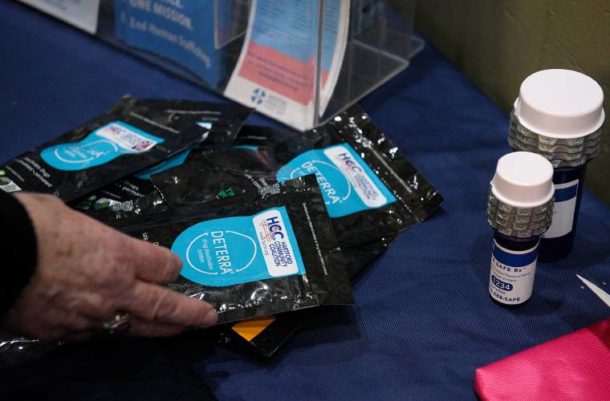
At the end of the event, Mekos offered a training in the use of naloxone, as well as free bags containing two doses of the nasal form of naloxone, fentanyl test strips and information about recovery resources.
It’s “not an injection,” Mekos said. It’s “not anything that’s going to hurt a person.”

If people suspect that someone has overdosed on an opioid, Mekos said that people should check the expiration date of the naloxone and be sure it’s not frozen. They should call 911. They should check to make sure the person is lying on the floor with their head tilted upward, open the naloxone, shove it in the person’s nose and plunge it.
The person administering the naloxone should then step back, as people can be agitated after they’ve overdosed. The naloxone puts them into immediate withdrawal. If one dose doesn’t work, Mekos said to use all the naloxone available.
“You can never use too much,” she said.
She also told those gathered to turn the person on their side, so they don’t asphyxiate should they throw up, and wait for emergency responders.
“It’s not hard,” Emily Zanleoni, executive director of the Hartford Community Coalition, said of the process of administering naloxone. “What’s hard is actually doing it.”
The coalition is slated to hold another forum in the first week of April. Suggestions or ideas can be sent to Wunderlich at amiew@hccvt.org.
