

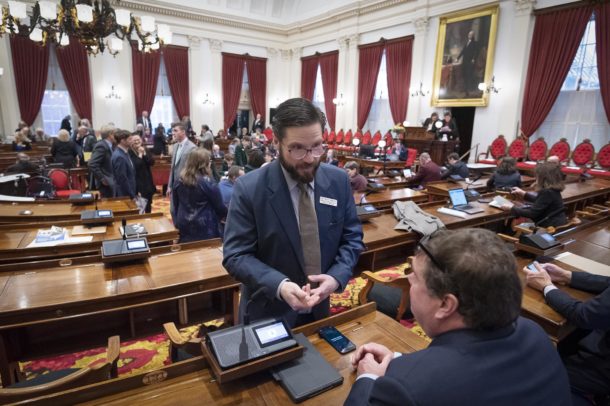
As Vermont lawmakers debate a bill that would legalize sports betting in the state, they are focusing on what it would take to regulate the companies that operate betting platforms and provide users with the resources needed to address problem gambling.
The bill, H.127, would allow two to six companies to operate a mobile sports betting platform in Vermont under the supervision of the state’s Department of Liquor and Lottery, according to the latest draft of the legislation. Sports betting — as well as participation in fantasy sports — would be restricted to people ages 21 and older.
In recent years, sports betting apps like DraftKings and FanDuel have boomed in popularity. The revenue Vermont collects from services like those would be deposited into the state’s general fund, according to the bill, including a new pot of money for the Department of Mental Health to create and manage services and campaigns to combat problem gambling.
Proponents of the bill say that illegal sports betting is already commonplace online here, and a state-controlled, legal market could enact guardrails and offer Vermont a new, though modest, revenue source. That was the conclusion of a highly anticipated report issued in December by a committee of nine lawmakers and state officials.
Rep. Matt Birong, a Vergennes Democrat and the bill’s lead sponsor, said he was at a Super Bowl party last weekend where people were betting on unregulated websites that, unlike DraftKings or FanDuel, offer little or no user protections. Birong said he does not support or oppose sports betting, but believes that the activity would be safer if regulated, comparing it to recreational cannabis.
His colleague Rep. Mike McCarthy, a St. Albans Democrat who chairs the committee that’s currently marking up the bill, agrees.
“The horse is out of the barn,” McCarthy said. “We’re trying to bring a black market into the light and put some protections on it.”
Data shared with the House Committee on Government Operations and Military Affairs last week by the cybersecurity company GeoComply showed that between September 2022 and early February 2023 — which spans most of the National Football League season — about 17,000 people in Vermont tried to access legal sports betting platforms based in other states.
If legal sports betting goes live in Vermont, the state Department of Mental Health estimates 140,000 people will sign up within the first year. Advocates for problem gambling prevention told lawmakers last week that also means the state could see an increase in people developing unhealthy gambling behaviors.
Kelley Klein, the mental health department’s medical director, said sports betting can be a fun, recreational activity for a majority of Vermonters who try it. But data shows one in four people who start sports betting develop gambling problems such as addiction, she said in an interview. Sports bets can be placed on smartphone apps, which is far more accessible than traditional betting that might require driving to a casino, Klein said.
Legislators and health professionals agree that Vermont needs to greatly bolster its resources for people with gambling problems before sports betting is legalized. The state “will basically have to build a system from scratch,” Keith Whyte, executive director of the National Council on Problem Gambling, told lawmakers last week.
Currently, the Liquor and Lottery department partially funds a single clinician to provide problem gambling treatment, according to Klein. The clinician works at the Howard Center, a Burlington-based nonprofit, and is intended to help people who gamble via the Vermont lottery.
There is also “very little” public messaging about that Howard Center program, Klein said, noting data shows less than a dozen people used it last year, even as estimates from the Center for Addiction Recognition Treatment Education Recovery in Stowe — which also provides some treatment services — show some 10,000 Vermonters have gambling problems.
The new bill would shift the state’s anti-problem gambling resources from the liquor and lottery department to the Department of Mental Health, Birong said. The latter would be provided a “problem gambling special fund” supported annually by 2.5% of the state’s sports betting revenue, though no less than $500,000, according to a draft of the bill.
The fund would pay for addiction counselors, a helpline, and public education campaigns about gambling addiction and programming, the bill states. It would also require the mental health department to conduct an annual study of how the fund is used.
Klein said it’s too early to say whether $500,000 will be enough to meet Vermonters’ needs, in part because there isn’t much legalized betting in the state today. While Vermont allows scratch tickets and horse betting, for instance, it has no casinos. Two challenges, Klein said, will likely be recruiting enough clinicians to staff the new resources and busting the stigma often associated with gambling addiction.
“We are hoping to flip that script,” Klein said in an interview, “and really make sure that Vermonters know that this is an addiction that can occur just like any other addiction, and we’re here to support them and provide treatment.”
The bill also includes a ban on advertisements for sports betting that target people under age 21, or target “the area (surrounding) a college or university campus.” Birong pointed to reporting by The New York Times last fall that detailed multimillion-dollar advertising deals between sports betting operators and some U.S. universities — which the newspaper said raised questions about whether promoting gambling to a demographic known to be vulnerable to gambling disorders fits the mission of higher education.
“We’re not allowing that,” Birong said in an interview.
According to the American Gaming Association, sports betting is legal and operational in 33 states, as well as Washington, D.C. The practice has been legalized, but is not yet up and running in an additional three states. Sports betting has been legalized in every state in New England except Vermont.
Nationally and locally, gambling operators have mounted significant lobbying efforts to legalize sports betting. DraftKings, FanDuel and BetMGM — all major nationwide sports betting platforms — spent roughly $65,000 to represent their interests in Montpelier during the most recent legislative biennium, according to lobbying disclosures filed with the Vermont Secretary of State’s Office.
Lawmakers are still discussing specific penalties the state should impose on sports betting operators that violate Vermont’s rules. The draft bill grants Department of Liquor and Lottery officials the authority to impose sanctions on an operator, including “monetary penalties” and suspension or termination of the company’s license to operate in the state.
Revoking a license “is the biggest stick that we have,” McCarthy said.
At a hearing last week, Whyte, of the National Council on Problem Gambling, urged the House government operations committee to adopt fines for violations that would be more than “a slap on the wrist” for the large, multibillion-dollar companies that run sports betting platforms. In most states right now, Whyte told lawmakers, “the fines do not appear to be truly ensuring compliance.”
The committee plans to hear more testimony on the bill this week, McCarthy said, and he expects the bill to be voted out of the committee by Friday.
Its likely next stop would be the House Committee on Ways and Means, he said, which would take a deeper look at how it might impact the state’s finances.
