

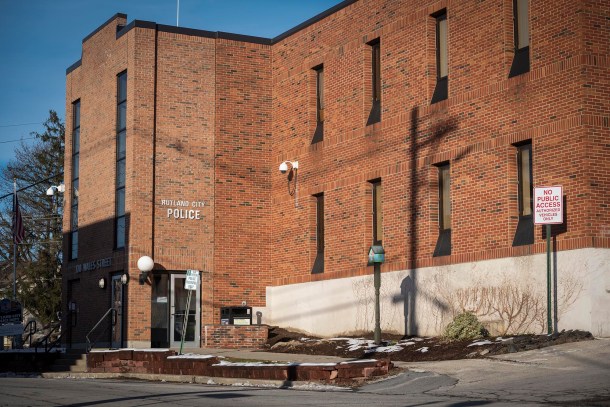
Property crimes in Rutland have risen dramatically in 2022 compared to recent years, according to Rutland City Police Department data.
The data, updated earlier this month, shows that this year’s 305 reported thefts from motor vehicles represent a 400% increase over the previous five-year average of 76. Reports of stolen cars (71 compared to an average of 18), thefts from buildings (161 to 42), and retail thefts (343 to 110) are all at least three times higher than their five-year averages.
Nathan Thibodeau, Rutland City’s crime/data analyst, said the year-over-year comparisons are susceptible to minor discrepancies because the department’s record management software classifies some cases differently than its previous provider.
“These are incredible numbers that drive some of the frustration from everybody down here in Rutland,” said Sean Sargeant, chair of the Rutland City Police Commission.
But the causes and solutions, especially related to property crime, remain a matter of debate. Some citizens have responded by taking matters into their own hands.
Sargeant, meanwhile, contended that the problem is that police “can’t get anybody lodged” because defendants may be held without bail only if they are deemed a flight risk, are charged with a crime punishable by life in prison or have committed a violent felony — none of which often apply for property crimes.
About a third of retail theft suspects are alleged to have stolen multiple times, according to data provided by the Rutland City Police Department.
Robert Sand, founding director of the Center for Justice Reform at Vermont Law and Graduate School and former Windsor County state’s attorney, pushed back against the notion that bail reform is to blame for a rise in crime.
“Locking people up increases the likelihood that they’re going to reoffend,” he said. “Jail, incarceration, is by and large, not a rehabilitative experience. And that includes pretrial detention.”
Studies on the relationship between imprisonment and recidivism vary. Some suggest incarceration might lead to increased crime. Others have suggested that long sentences deter crime while short sentences have no effect on future crime.
The data compiled by the Rutland City Police Department also points to a relationship between drug use and crime in the city.
Of the people suspected of retail theft, 75% are known narcotics users, according to Rutland City police. That assessment, referred to as the “narcotics nexus,” is made when a person has acknowledged to police that they use narcotics, has been previously found in the presence of narcotics, or has been convicted of a drug-related crime, Thibodeau said. So-called “known users” make up 64% of automobile theft suspects, and 100% of robbery suspects.
Tracie Hauck, executive director of Turning Point Center of Rutland, which works with people who have substance use disorders, acknowledged the role drug users play in the city’s crime.
“Many of the individuals that are committing crimes are individuals with known substance use disorder (many of them are people we know through our work at our center),” she said in an email. “Many of them are committing thefts to support their substance use.”
More transitional and affordable housing, longer rehab stays and increased mental health resources all need to be prioritized, Hauck said.
Overdoses have risen alongside crime. As of Dec. 8, Rutland City police had responded to 100 overdoses, 12 of which were confirmed as fatal overdoses. By comparison, Rutland City police had responded to 80 overdoses as of this time in 2020, which was more than any other year since at least 2017.
Pat Hunter co-chairs the community policing committee as part of Project Vision, a coalition of organizations, government, businesses and individuals formed in 2013 with the goal of building a better future for Rutland. She said the committee and Rutland City police have worked to address the root causes of Rutland’s rising crime, including opioid use driven by substance use disorder, and pointed to the work of the city’s new community support specialist, who responds to noncriminal calls and connects residents to social services, as an example of progress.
“Navigating (social) services can be a challenge,” Hunter said. “To have that coordinated to help someone follow through the various steps can be helpful.”
