


The wolves of Vermont were probably doomed from the moment Europeans began settling here. Wolves — like Vermont’s more celebrated large predator, the catamount — probably inhabited the state’s forests well into the 19th century, according to wildlife biologists.
Both predators saw their habitats restricted as settlers cleared forests to make room for farms. With their natural prey limited, both species began attacking livestock, which drew a predictable and violent response from farmers, who believed that the only good catamount or wolf was a dead one.
Historians cite 1881 as the year the last catamount was shot in Vermont. No one knows when the last wolf was killed, but an event in 1803 suggested the animal’s eventual extirpation from the state was inevitable.
The episode was triggered by the most mundane of events: a boy walking home from school.
Eleven-year-old Daniel Baldwin attended school about 3 or 4 miles from his home, so he often boarded at the school. One Saturday in February, he decided to make the trek along the Dog River to his home, which was near the border between Berlin and Northfield.
His experiences that day were described in a newspaper account that reads like a folktale.
Baldwin first sensed danger when he passed the cabin of Seth Johnston, the last homestead before the trail headed into the forest. Johnston, who was working outside, was alarmed at seeing the boy walking alone.
“Daniel, you must not try to go through the long woods to your old house to-night,” Johnston said, “for the varmints will catch you.” He was referring to wolves. Baldwin said he wasn’t afraid of wolves. It was Johnston’s wife’s turn to be alarmed. “Now, Seth Johnson, if that boy will go, you must go with him, or the varmints will certainly have him,” she said. “They have been prowling in the woods every night for a week.”
But Seth Johnston either was afraid of the wolves himself or couldn’t be bothered to escort the boy. Instead, he went into his cabin and returned with a firebrand, a burning piece of wood. If Baldwin encountered any wolves, Johnston told him, he should just wave the “sapling club” around “like fury, and run the gauntlet, and I’ll warrant they won’t dare to touch you.”
The image of having to run from a wolf pack frightened the boy, but he bravely, or perhaps foolishly, walked on carrying his firebrand. About a half-mile into the woods, Baldwin heard the first howl, a short distance to his left. A chorus of perhaps a dozen wolves howled in reply. He decided there was no point retreating, because the howls were coming from every direction. Baldwin imagined the wolves closing in a circle around him. He began walking faster and swinging the firebrand. Soon his walk became a run.
A dark, yowling figure blocked the road ahead. He sensed more wolves behind him and on each side. Swinging his firebrand, Baldwin raced toward home, yelling as he went. The wolves kept pace, but the hot, bright firebrand kept them at bay.
“(T)hus for the next half mile he ran the fearful gauntlet through this terrible troop of infuriated brutes, till, almost dead with fright and exhaustion, he at length reached his old home with a joy and gratitude for his preservation from a terrible death which no words could describe,” the newspaper reported.
The wolves of Irish Hill, where the incident occurred, would be less fortunate.
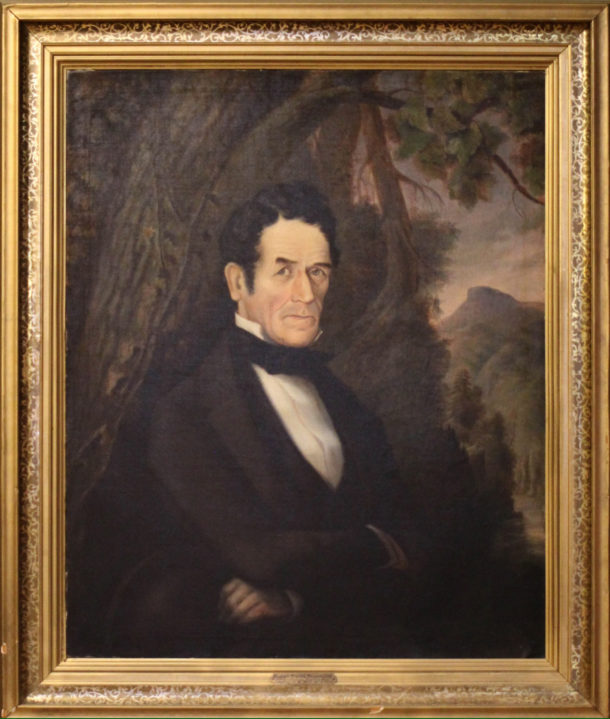
The account of young Daniel Baldwin’s run through the woods wasn’t published until 64 years after the fact, when Daniel Thompson wrote it for the Argus and Patriot newspaper of Montpelier. Thompson was a successful novelist, so perhaps he invented or embellished some of the details. But the gist of the story rings true, given the aftermath of that fateful walk.
Back in 1803, the story of Baldwin’s run-in with the wolves spread quickly. Area farmers had been losing sheep to predators and this incident convinced them that wolves, perhaps in a pack of as many as 20, were the culprits. Nearby settlers gathered the next Tuesday and formed a small hunting party on Irish Hill. They killed two wolves, but sent out word to surrounding towns that a larger expedition would be launched on Saturday.
That day, 400 to 500 men gathered outside the home of Town Clerk Abel Knapp, according to Thompson. The number seems high in proportion to the region’s population at the time, but suffice it to say that a large group gathered for the hunt.
The settlers had devised a plan: They carefully fanned out into an enormous circle. Once the circle was completed, word was passed down the line for each man to start walking toward the center, where they believed the wolves were located.
“(I)t was soon announced that there were enclosed several wolves in the (circle), which ran galloping round the centre, as if looking for a chance to escape through the ring now become a continuous line of men,” Thompson wrote. “The frightened animals could find no outlets, and were shot down at every attempt to escape.”
Through this method two wolves (and a couple of foxes) were killed, but eventually the circle became dangerously small, given that the men were firing into the center of it.
At this point, a skilled local hunter, Thomas Davis, was asked to finish the job. Davis ranged within the circle, tracking down the trapped wolves. He killed five more wolves and perhaps eight foxes.
The men set to scalping the wolves to claim the state bounty on the animals. By statute, each adult wolf scalp was worth $20 (roughly $850 today); a whelp’s brought half as much.
After the hunt, local residents prepared supper for the hunters, but many never got a chance to eat. A keg of rum was opened for the hunters, who had grown hungry and thirsty during the day. They drank freely and when the rum hit their empty stomachs, many were in no fit condition when the food was ready.
Thompson wrote: “(I)t was said Esquire Knapp’s hay mow that night lodged a larger number of disabled men than were ever before or since collected in Washington County.”
The Great Wolf Hunt of Irish Hill was over and, according to Thompson, wolves, for better or worse, have never been known since in that part of Vermont.
