

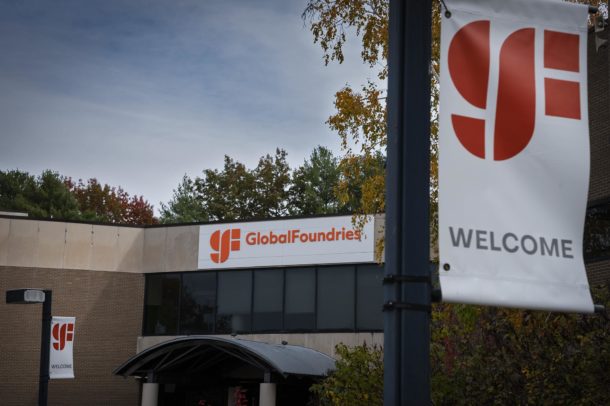
GlobalFoundries, the semiconductor company that owns the giant chip plant in Essex Junction, announced this week that it is cutting costs by $100 million in 2023 and another $100 million after that in anticipation of a worldwide decline in demand for semiconductors as the global economy slows down.
“We are paying close attention to uncertain economic conditions and to our customers’ recent commentary regarding 2023 demand,” David Reeder, the company’s chief financial officer, told Wall Street analysts this week.
Among those customers are smartphone manufacturers, who, in particular, are expecting a decline in sales. Reeder did predict that high-end smartphones would continue to be in demand. He also expected a strong demand for semiconductors for 5G smartphones.
Reeder thought that for the remainder of 2022, the fastest growing market for GlobalFoundries would remain makers of home and industrial devices connected to the internet, sometimes called the internet of things.
But Tom Caulfield, the company’s chief executive officer, warned that the growth the company has seen in that market — more than 80% this year — is not sustainable.
Caulfield said he thought that the automobile market would provide the company’s greatest growth through next year and beyond.
The company also reported a decline in sales of semiconductors for personal computers.
Reeder predicted that demand for GlobalFoundries’s semiconductors would probably decline during the first half of 2023, most likely in the first three months, before recovering. He said the company would cut travel and entertainment, among other costs, in response to the expected decline.
Matt Bryson, senior vice president for research at Wedbush Securities, was among the analysts who follow GlobalFoundries and listened in on Tuesday’s call.
“Things get more difficult into (the last quarter of this year) and first half of next year, because the demand for electronics slowed,” Bryson said. ”There’s need to work down inventories in segments like mobile and PCs.”
But even with the downturn, “they think they can grow revenues” because the company expects to benefit from higher prices for semiconductors, Bryson said.
According to Reeder, GlobalFoundries’ plants around the world were operating at “high nineties” percent capacity for the first nine months of 2022. He predicted that in the final three months of the year, the company’s factories would be operating “in the low-to-mid nineties” range.
But Caulfield, the CEO, hoped that GlobalFoundries would end up with slightly higher revenues overall in 2023 than it did this year.
This week’s announcement came as GlobalFoundries posted $2 billion in revenue in the third quarter, a 22 percent increase over the same period last year, which led the company to deliver earnings of 67 cents per share, higher than the company had estimated.
Caulfield said that as the U.S. government restricts sales of high-end semiconductors to China, GlobalFoundries is relatively unaffected compared to other semiconductor manufacturers, as customers in China represent only 10% of the company’s business.
Caulfield said the CHIPS Act signed by President Joe Biden this year, which provides $52 billion in funds to U.S. semiconductor factories, would eventually lead GlobalFoundries to expand production in the United States as the company secures government and private contracts.
First, he said, the company will expand production at its existing facility in Malta, New York. Next, it would expand the capacity of the plant in Essex Junction to take on new technology, and finally, it would build new factory space in Malta.
How fast the company expands its U.S. manufacturing capacity, Caulfield said, depends on how quickly its customers shift their demand from foreign semiconductor makers to ones based in the U.S.
“I call it the $52 billion question,” Caulfield said. “No one wants to see capacity built and not being used.”
