


In a way, John Little is taking the local housing crisis into his own hands.
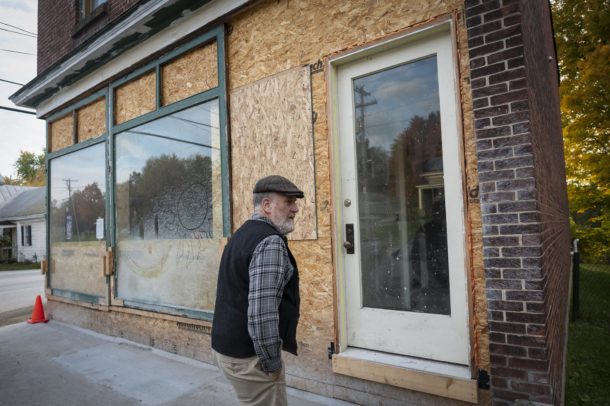
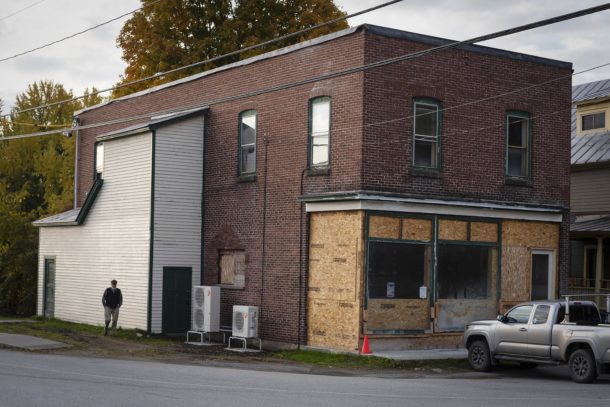
The president and longtime member of the Missisquoi River Basin Association has purchased and is renovating a building in Berkshire that houses the organization’s office. He wants to improve the water-quality nonprofit’s workspace — and put in an apartment.
Little hopes the apartment will be an affordable housing option for the association’s staff members who are part of a service program called ECO AmeriCorps. Program members do essential environmental conservation work, Little said. But they’re paid just $21,335 over 11 months of service, making it challenging to afford rent and other living costs.
Another challenge, Little said, is that rental units in eastern Franklin County towns such as Berkshire and Montgomery are in short supply, limited by the prevalence of short-term rentals in the region, many of which cater to visitors to the nearby Jay Peak Resort.
“For an ECO AmeriCorps member, there ain’t nothing there,” he said.
Little said the basin association’s program members haven’t been able to find housing in the local area for years, and instead live in places that often require a long commute, such as Swanton (about a half-hour drive from Berkshire) or Burlington (closer to an hour-long trip). Other members have lived with family during their employment.
Lindsey Wight, the association’s executive director, said no one has ever turned down an ECO AmeriCorps position with the Berkshire nonprofit because they could not find housing, but having an apartment on-site will make the position more attractive.
“We’re obviously excited,” Wight said of Little’s project. “If we’re going to keep bringing talented young folks into Vermont for these positions — or keeping Vermonters here — we definitely need to figure out how to help them afford to do it.”
Dustin Bowman, coordinator of the ECO AmeriCorps program at the Vermont Agency of Natural Resources, said finding housing is a perennial challenge for program members. The $21,335 stipend matches Vermont’s minimum wage, he said, but it’s “not enough” to meet the cost of living here, noting that most program members also use food stamps.
Bowman said the program operates “on a shoestring.” At the same time, it has full enrollment, which he said shows there is a demand for the types of jobs that members fill in state government, environmental conservation and regional planning, among other fields.
ECO AmeriCorps has used online platforms such as Front Porch Forum, along with word of mouth, to develop a network for members to find affordable housing, he said, but the program is still “relying far too much on luck right now.”
Little’s project will help make the Missisquoi River Basin Association’s position more sustainable, Bowman said: “Having a member who’s 21, 22, 23 live in East Berkshire — it’s a hard sell. But if you can offer onsite housing, it’s much more attractive.”
Sarah Lunn, the basin association’s current ECO AmeriCorps member, said she pays about $500 a month for rent and utilities to live with her partner, her brother and her brother’s fiance in the Chittenden County town of Westford. Lunn said she also uses food stamps. She was lucky, she said, to know people in Vermont she could live with, which is unlikely to be the case for members who didn’t grow up in the state.
“The work that we’re doing up there is just so crucial to ensuring that our lake is cleaner,” Lunn said. “And the only way I can do it is through this program.”
Little has already started construction work on the century-old building on Route 105 in Berkshire. The building has been essentially gutted, he said, and he plans to install new windows and doors as well as insulate the two-story structure for the first time.
The bottom level of the building will continue to house the basin association’s office, as well as an office for the Upper Missisquoi and Trout Rivers Wild and Scenic Committee, another nonprofit where both Wight and Lunn work. The apartment will be a studio and located upstairs, and Little is considering putting a coworking space up there as well.
In a recent interview, Little said he hadn’t figured out how much he’ll charge in rent for the apartment. He wants to include the cost of utilities, but may ask the tenant to shovel the building’s driveway and steps when it snows.
Little is financing the project with money he got from selling half of his parents’ estate to his brother. Little bought the ailing building in May for $75,000 and plans to spend about $250,000 on the renovations, he said.


Catherine Dimitruk, executive director of the St. Albans-based Northwest Regional Planning Commission, said she has also heard concerns that short-term rentals limit the options for long-term renters across Franklin and Grand Isle counties.
Still, short-term rentals alone are not the issue, according to both Dimitruk and PJ Poquette, a St. Albans-based realtor. Rather, they said the region is experiencing high demand for all types of rentals — catering to people ranging from tourists to traveling nurses.
Poquette has noticed an increase over the past several years in the number of people buying second houses in the area with the intent of turning them into short-term rentals — “buyers saying, ‘hey, this is a kind of profit I want,’” he said.
Wight, of the basin association, said she’s seen that happen firsthand.
“I have friends that are not able to purchase homes because the homes are being purchased by second-home owners that utilize them for income,” Wight said. “That is definitely a challenge in our communities.”
