

Knitting can seem like a constant work in progress. Montpelier artist Eve Jacobs-Carnahan thinks democracy is no different.
That’s what led her to start Knit Democracy Together, a collaborative knitting and discussion project. Since 2020, Jacobs-Carnahan, who served for 27 years as an assistant attorney general specializing in election law, has hosted knitting circles in which participants discuss democratic concepts.
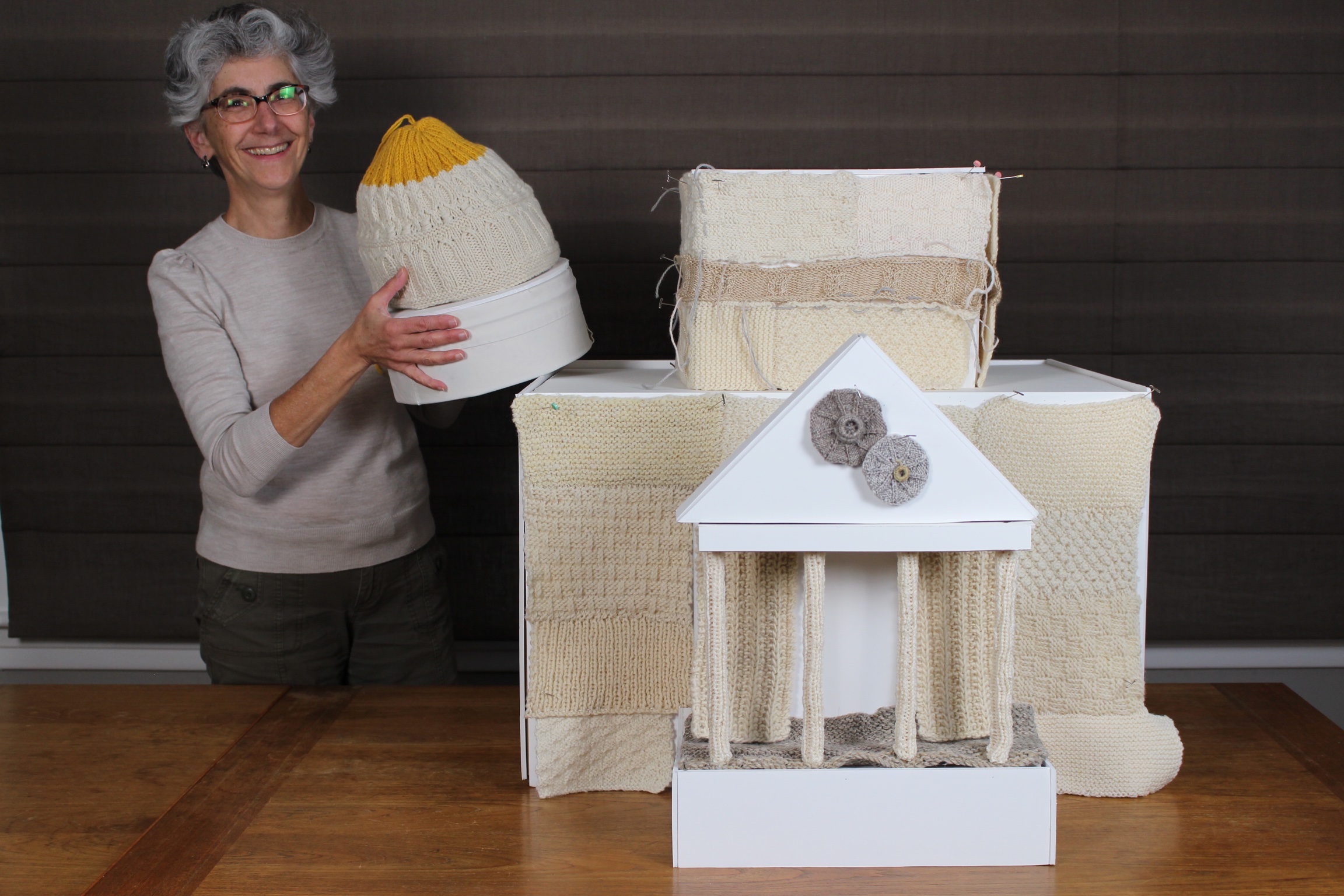
Visitors to the Vermont Statehouse this fall can see one product of that work: a three-dimensional, hand-knitted model of the state capitol, designed by Jacobs-Carnahan and constructed with the help of her knitting circle participants.
To build the sculpture, Jacobs-Carnahan first constructed the building’s core shape using materials like cardboard, foam board and dowels. She then glued rectangular cloth segments, each of which was crafted by knitting circle participants, to the outside.
Jacobs-Carnahan views the process as a metaphor for participatory government.
“That’s also the way democracy works, right?” she said. “These different pieces get put together to make something that is greater than your individual piece.”
The model will be on display in the Statehouse Card Room through Oct. 30. An event to complete the segments that will make up the model’s colorful garden and lawn is scheduled to take place on Sept. 17.

Jacobs-Carnahan invites anyone to attend the knitting circles. While the attendees stitch, she discusses how elections work. Topics can include methods of voting, auditing elections, ranked-choice voting and campaign financing, according to the Knit Democracy Together website.
“Her point is to get people talking, to get people thinking, to get people paying attention and voting,” said Heather Katz, one of the project’s participants. “That’s really what she’s about.”
Jacobs-Carnahan’s knitting circles typically last an hour and have taken place in person and online, according to her website. She stressed that the events are light-hearted.
“It’s not like showing up at a protest or something,” she said.
Jacobs-Carnahan explained that the link between knitting and democracy dates as far back as the American Revolutionary War, when colonists boycotted British textiles and made their own.
“It was a patriotic demonstration to show that we were gathering people together and spinning wool and turning it into garments of cloth by using our own labor,” she said.
She characterized her project as craftivism, a practice in which artists advance social issues or raise awareness about certain topics through craft. Using knitting as a medium to talk about civics can be very effective, she said.
“Knitting is very disarming, it’s very comfortable,” Jacobs-Carnahan said. “You can break down barriers a little bit, and then you can talk about a really important and complicated topic like democracy.”
Jacobs-Carnahan started knitting at age seven, and in the early 1990s she discovered knitting for sculpture. “That just blew me away,” she said.
At first, she began to craft knitted sculptures that carried messages about the environment. Then, in 2019, “it sort of gelled for me,” she said. “It was like, oh, this is my issue. I have all this background in election knowledge. That’s what I’m really passionate about and can really communicate in my artwork.”
She began the project by teaching knitting circle attendees about the impact of money in politics. After the 2020 election, she began discussing how misinformation was undermining the electoral process and causing widespread confusion about basic democratic concepts. Now, she also tackles gerrymandering and the restricting of ballot access by certain state legislatures.
“All of those things really offended me to my core,” Jacobs-Carnahan said. “They were just cutting away the basis of so much of the way our democratic system works.”
Though she aims to reach a diverse group of participants, most of the participants in the knitting circles have been women who craft, Jacobs-Carnahan said. She intends to broaden the appeal at an upcoming session at The Sharon Academy on Sept. 29.
“I’m doing outreach with people at that school to really try to include students,” she said. “That will broaden the ages of people.”
She emphasized that there is no prior knowledge of knitting required at her events.
“I always have activities for people to do to make pieces of sculpture that do not involve knitting,” she said. “They still involve yarn, but they don’t involve knitting.”
