


The Vermont Agency of Transportation plans to change the traffic pattern around its culvert replacement project on Interstate 89 in Richmond as a result of driver feedback about long back-ups.
Message boards and traffic barriers currently direct drivers to use an “early merge” strategy. But starting Wednesday, VTrans will promote a different strategy to improve traffic flow: the “zipper merge.”
The change comes as a result of public feedback regarding the backups caused by the project, said Douglas Bonneau, the agency’s northwest regional construction engineer.
“They’re encouraging us to go this route,” he said.
The zipper merge pattern allows motorists to utilize both lanes up until the merge point, Bonneau said. Motorists then take turns merging into the correct lane to create the zipper effect.
“If both lanes are traveling at the same speed, they can merge really easily and keep right on going,” he said.
The construction has been underway since late May after a depression formed in the roadway earlier the same month. VTrans began an emergency $12.1 million culvert replacement project, creating a mile-long lane closure south of Exit 11.
The depression indicated potential for a sinkhole, causing the need for the emergency project, Project Manager James LaCroix said. “We noticed that it was getting worse and it wasn’t stabilizing,” he said.
In response to a recent Facebook post by VTDigger, some commenters expressed optimism about the zipper method.
“If you use both lanes at lower speeds and take turns merging, everyone wins,” user Mare Tilton commented.
Others argued that the method would not work.
“Cars traveling in the left lane DO NOT drive at lower speeds….they go as fast as they can to get to the flashing arrow sign and then try to merge at the last minute,” user George Goodrich III commented. “When multiple cars do this, it causes major backups for EVERYONE.”
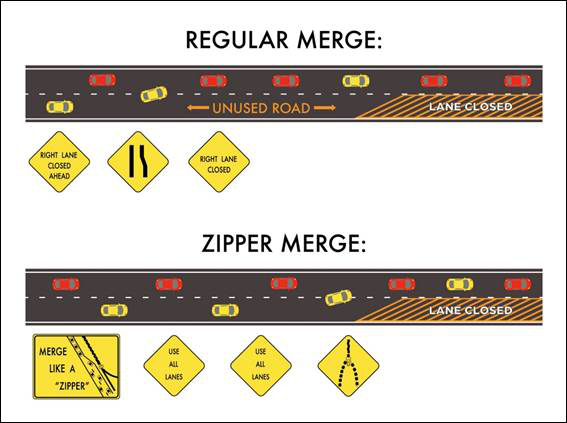
Bonneau said the “zipper merge” strategy is relatively new in Vermont, so public education will be important to its success. He said messaging boards will urge drivers to take turns merging and leave gaps between cars.
“What we have to get past is the sharing the road piece and the road rage piece,” he said. “That would ruin it.”
The state expects the new traffic pattern to be in place until the project’s expected completion in early November, Bonneau said.
