


Updated at 1:24 a.m.
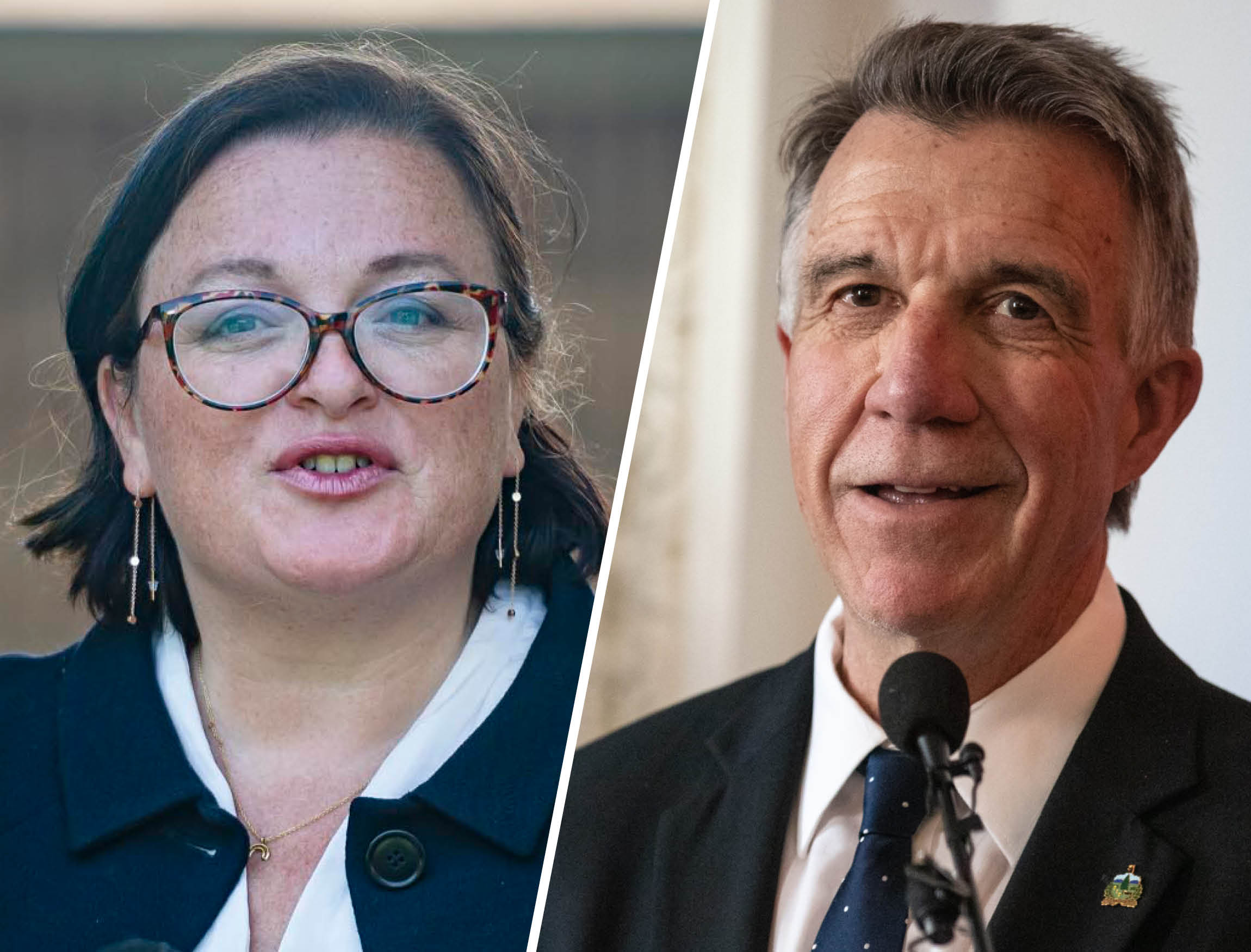
Incumbent Republican Gov. Phil Scott and Democratic challenger Brenda Siegel are set to face off in the November gubernatorial election.
NBC News called the race for Siegel moments after polls closed on Tuesday and projected Scott’s win less than an hour later. The Associated Press called the Republican race for Scott at 8:00 p.m.
Less than an hour after his own victory was declared, Scott told VTDigger he wasn’t paying close attention to his own election; his eyes were on the trickling results for Vermont’s Republican primaries for the U.S. Senate and lieutenant governor. But knowing that he will appear on the ballot in November, he made an appeal to voters: “We still have a lot of work to do.”
“We started six years ago down a path of trying to make Vermont more affordable, growing the economy, protecting the most vulnerable. And we’ll continue to do that,” Scott said.
Scott, who is seeking a fourth two-year term in office, easily defeated two Republican primary challengers — Stephen Bellows of Grand Isle and Peter Duval of Underhill. As of 1:23 a.m., with all but one of the precincts reporting, Scott had earned 66% of the vote, with nearly 18% for Bellows and about 12% for Duval.
Siegel, a housing and drug policy advocate and two-time statewide candidate, did not face any Democratic primary challengers. She is set to face Scott in the general election as he seeks a fourth two-year term in office.
Siegel ran and lost in two previous statewide Democratic primaries, for governor in 2018 and lieutenant governor in 2020. But when Siegel announced her candidacy in May, she told reporters this year would be different.
She said she has built name recognition over several years working with advocacy organizations and in the Statehouse to press for housing and drug policy reforms. Last fall, she and other activists made headlines for sleeping on the Statehouse steps in order to pressure the Scott administration to extend the state’s motel voucher program for Vermonters without permanent housing. After Siegel’s cohort camped for 27 cold nights, officials extended the program through the winter.
In challenging Scott, Siegel is signing up to battle the nation’s second-most popular governor. In her campaign thus far, she has zeroed in on Scott’s track record on climate, housing and drug reform policies, as well as his reputation for delivering the highest number of gubernatorial vetoes in state history.
“First of all, no one is unbeatable,” Siegel told VTDigger Tuesday night. “I have been told that I am not going to succeed at many things, as have Vermonters all across the state. When we don’t try is when we don’t win. But if we actually step up and work together, it is possible. Anytime someone says it’s impossible, that’s when you know something’s doable.”
According to Morning Consult, 72% of Vermonters surveyed this spring approved of Scott’s job performance, and poll after poll has shown that much of his popularity comes from Democratic and independent voters. Scott has taken pride in his reputation as a moderate Republican, and has repeatedly said he has no plans to stray from his party, even though he has been a vocal critic of former President Donald Trump and rising radicalization on the right.
On Tuesday night, he made the case for continuity in the governor’s office. He pointed to Vermont’s massive and ever-growing influx of federal cash, and said Vermont should keep his “seasoned team” in place to appropriate that money to Vermont’s most pressing needs.
“When you get me, you get the whole team,” he told VTDigger. “And I think that’s important in this day and age, in this time when there’s so much uncertainty, with inflation and the polarization we’re seeing across the country, that you get a steady hand at the wheel.”
Siegel, on the other hand, made the case for change in Montpelier. She again cited Scott’s veto record again, and said she would do things differently if elected.
“We need a governor that’s willing to sit at the table until the work is done. We have a Legislature that will work with the governor, including the governor we have, and so there’s no reason to have a veto in the end,” she said. “The work can be done if we come together and have a collaborative outcome. I’ve been able to do that.”
With more than five years in office, Scott so far does not seem to be planning to fight hard to keep his seat. No incumbent Vermont governor has lost reelection since 1962. In May, he told reporters that he plans to focus on his official duties as governor instead of hitting the campaign trail. Any campaigning will kick off after Labor Day, he said at the time.
On Tuesday night, he said that’s still his plan. But he did commit to facing off with Siegel and any third-party candidates on the debate stage before November.

Pieciak declares victory for treasurer
Mike Pieciak, former commissioner of the Vermont Department of Financial Regulation, declared victory in the uncontested Democratic primary for state treasurer at 7:26 p.m., when no precincts had yet reported results.
In a written statement, Pieciak said he was honored to receive the nomination. “I am humbled voters have put their trust in me, and I look forward to building a broad coalition to win in November and tackle the issues facing all Vermonters,” he wrote.
Pieciak has received substantial backing from Democratic state leaders, including retiring treasurer Beth Pearce.
Perennial candidate H. Brooke Paige was the only Republican contender in the race, and Progressive Don Schramm was also unchallenged.
The race for state auditor also saw no primary contests. Incumbent Democrat Doug Hoffer faced no primary challengers, and Paige also ran uncontested in the Republican primary for the office. Marielle Blais won the Progressive nomination.
Correction: An earlier version of this story misspelled Peter Duval’s surname.
