

This commentary is by Darren Springer, general manager of Burlington Electric Department, and Betsy Lesnikoski, chief forester for the McNeil Generating Station.
Last year, we wrote a commentary discussing the benefits of the McNeil Generating Station in Burlington, including its contribution to the Vermont economy, its support for sustainable forestry, and its importance as a renewable generator from a climate and reliability perspective.
As policymakers continue to consider how to support renewable energy in Vermont, we write today to share two new important data points — one economic and one environmental — relative to McNeil that should inform discussions.
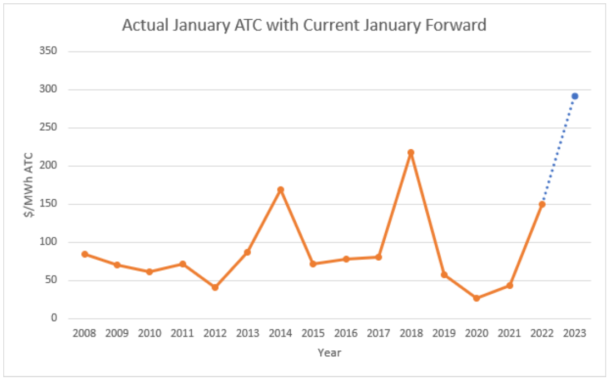
The first new data point is the historically high energy pricing (particularly during winter months) we are seeing in the ISO-New England electricity market. The winter of 2021-22 was the second most expensive in the region’s history, despite the fact that last winter was slightly warmer than normal.
Oil-fired generation comprised 11 percent of electricity produced in New England during an expensive January 2022, compared to just 0.2 percent in January 2021. Looking ahead, as the chart below indicates on the dotted blue line, around the clock (ATC) forward pricing, the coming winter is dramatically higher than last year — in fact, at all-time record levels — with continued high inflation and global pressures adding to volatility in the energy markets.
During the challenging winter of 2021-22, the McNeil Generating Station was able to inventory sufficient wood fuel to operate nearly 24/7 starting in early December and ending in March, providing support for regional reliability and reducing the region’s reliance on fossil fuels.
This local renewable energy resource also provided an important economic shield against volatile regional market prices for many Vermont electric customers because McNeil is jointly owned by Burlington Electric Department, Green Mountain Power and the Vermont Public Power Supply Authority.
The second new data point comes from third-party lifecycle emissions analysis on McNeil from the local energy experts at the Vermont Energy Investment Corp. Lifecycle analysis nationally — for example, from the National Renewable Energy Laboratory — continues to show that wood energy generation has a far lower carbon footprint than fossil fuel generation.
While McNeil is a wood energy plant, if we consider lifecycle analysis, there are some upstream fossil fuel inputs in the wood supply chain, including the transportation of wood to the plant. VEIC’s analysis accounted for all the upstream emissions from fossil fuel use in the procurement and operations of the plant.
It then estimated McNeil’s net emissions impact by comparing the plant’s carbon footprint to the ISO-New England system mix during similar operating times (reflecting the sources that would have operated had McNeil not produced electricity). The analysis did not account for the upstream emissions associated with the fossil fuel generation resources in the ISO-NE system mix, including drilling, mining, transport and pipeline leakage.
Even with these constraints that may underestimate the ISO-NE system mix’s emissions, VEIC’s analysis found “continuing to source electricity from the McNeil Station reduces (greenhouse gas) emissions 85% compared to the most probable option of buying power from the ISO-NE grid.” The chart below is from the VEIC report.

The VEIC analysis demonstrates that McNeil contributes significantly to reducing greenhouse gas emissions in the New England region relative to alternative electricity-generating resources that operate during similar times, including the winter.
This speaks to the benefits of diverse renewable energy sources, including solar, wind, hydropower, and sustainably harvested wood energy production from McNeil. Of these sources, McNeil is uniquely able to plan for and control its output in response to demand.
Evaluating the emissions benefits of wood energy includes understanding the environmental benefits of sustainable forest management, and understanding that McNeil contributes economically to keeping forest lands as working lands, instead of facing development pressure that would eliminate their carbon sequestration.
Forestry professionals speak to these benefits. Addison Kasmarek and Scott Moreau (both of whom are licensed professional foresters in Vermont and New Hampshire) from Greenleaf Forestry, based in Westford, Vermont, say the McNeil wood chip market “makes possible our job of responsible and sustainable ecological forest management” and “helps keep our forest products local and helps keep our rural economy alive.”
Joseph Nelson, Vermont licensed professional forester from Ferrisburgh, Vermont, notes that the McNeil wood chip market “will play an increasing role in the viability of forest management in the years to come as we tackle increases in exotic pests, invasive plants, increased fire danger and climate change.”
Andy McGovern, Vermont licensed professional forester from East Thetford, says McNeil’s purchase of wood chips “makes it economically feasible for landowners to practice sustainable forestry” and “allows them to keep their forests intact, minimizing forest parcelization, development and unsustainable management, which benefits us all.“
McNeil plays a vital role in supporting Vermont’s economy and sustainable forestry. It plays an important role in reducing regional reliance on fossil fuel generation, protecting Vermont electricity consumers against volatile energy price spikes, and contributing to regional reliability.
Going forward, work continues at McNeil to advance district energy and to add a new solar research center on-site in partnership with UVM. We hope the data presented here is helpful as Vermont looks to make data-driven policy around renewable energy and climate mitigation.
