

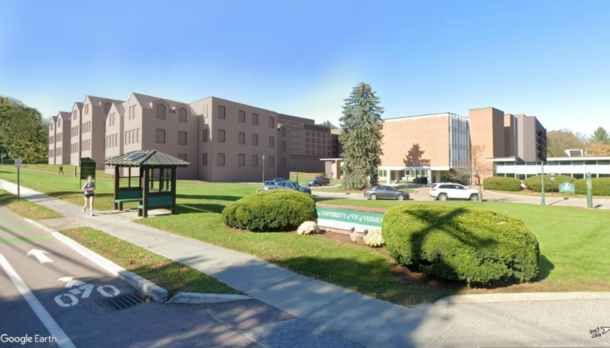
The academic year may be over, but the University of Vermont’s plan to build more dormitories on Trinity Campus is just taking off.
The proposal — which is part of Burlington Mayor Miro Weinberger’s 10-point plan to boost the city’s housing stock — would rezone the Colchester Avenue property to allow for more buildings at a taller height and closer to the road. It’s being proposed by the university but also has been endorsed by City Hall.
The plan’s design earned a mostly positive reception from the Planning Commission during a Wednesday night meeting. But the school’s overall strategy for housing students — as Burlington battles a less-than-1% vacancy rate for long-term rental units — faced more scrutiny.
Purchased by the university in 2002, Trinity Campus is the former site of Trinity College, a Roman Catholic women’s college that closed in 2000. It now houses a mixture of academic, administrative and residential buildings for UVM.
If the zoning changes passed, the university’s immediate plans would entail building two new residence halls: one for graduate students, the other for undergraduates, school officials said.
Commissioners saluted the proposed addition of graduate housing, which the university does not currently have. But as UVM’s undergraduate population increases — causing school officials to institute “forced triples,” where three students crowd into a dorm room meant for two people — some commissioners questioned whether the plan is geared toward addressing Burlington’s housing crisis, or the one at UVM.
“Historically, it seems to me that the university is just not a very good partner in the city of Burlington,” Commissioner Alexander Friend said.
Lisa Kingsbury, the university’s associate director for planning, acknowledged that the new dorm would give UVM “some wiggle room to withstand fluctuations in enrollment.”
But that flexibility doesn’t mean the university is trying to create more buildings for the same number of students to live in, Kingsbury told the commission, pointing to demographic data that show the number of students from the Northeast enrolling in college will decline over the coming years.
Kingsbury also said that — while the university plans to construct the building for first- and second-year students, who are required to live on campus — juniors and seniors could opt to live in the dorm, too.
Some members of the commission asked the city’s director of planning Meagan Tuttle whether the body could approve the zoning changes on the condition that UVM houses a certain proportion of its students on campus, freeing up more rentals around the city for non-students.
“Do we have any mechanism to ensure that this is actually going to be an increase in housing to UVM?” asked Commissioner Emily Lee. “And not just a transfer of location or relieving their current overdensity in the dorms?”
While Tuttle did not give a firm “no,” she suggested that any agreements between city officials and the university about housing would likely stem from the City Council or mayor’s office, as a similar bargain between the two parties did in 2009.
“Ultimately, setting a kind of agreement about a certain percentage of housing on campus or students on campus has historically been handled through agreements outside of the zoning ordinance,” Tuttle said.
The Trinity Campus proposal is one of three major zoning reforms envisioned in the mayor’s housing plan. The plan also calls for commercially-zoned parts of the South End to accommodate residential development, and for swaths of the city that accept only single-family homes to allow for the creation of multi-family buildings, such as duplexes and triplexes.
Any changes to the city’s Comprehensive Zoning Ordinance must first be approved by the Planning Commission in a three-part process: a vote that advances the measure to a public hearing, the public hearing itself, and then a final vote recommending the change to the City Council. Upon arrival before the City Council, the zoning amendment undergoes at least two more votes and another public hearing.
Wednesday’s meeting featured a discussion about the Trinity Campus proposal. The commission could set a public hearing for the zoning changes at the next meeting that addresses the issue, which Tuttle said is scheduled for late June.
In addition to their critiques of UVM’s impact on the city’s housing market, commissioners weighed in on multiple technical aspects of the proposed zoning changes. Of particular concern was a change that would allow buildings to sit as close as 25 feet back from the property line (about 40 feet from the Colchester Avenue sidewalk).
Though former Ward 1 city councilor Sharon Bushor criticized that detail for not allowing enough green space in comments during the meeting’s public forum, Commissioner Michael Gaughan contended that the setback measurement was not far off from what buildings at other colleges adhered to. And to solve the city’s housing crisis, he argued, the campus would have to squeeze more buildings on its land.
“Everyone wants UVM to build more housing,” Gaughan said. “Some portion of the campus is going to have to look pretty urban for that to happen.”

