

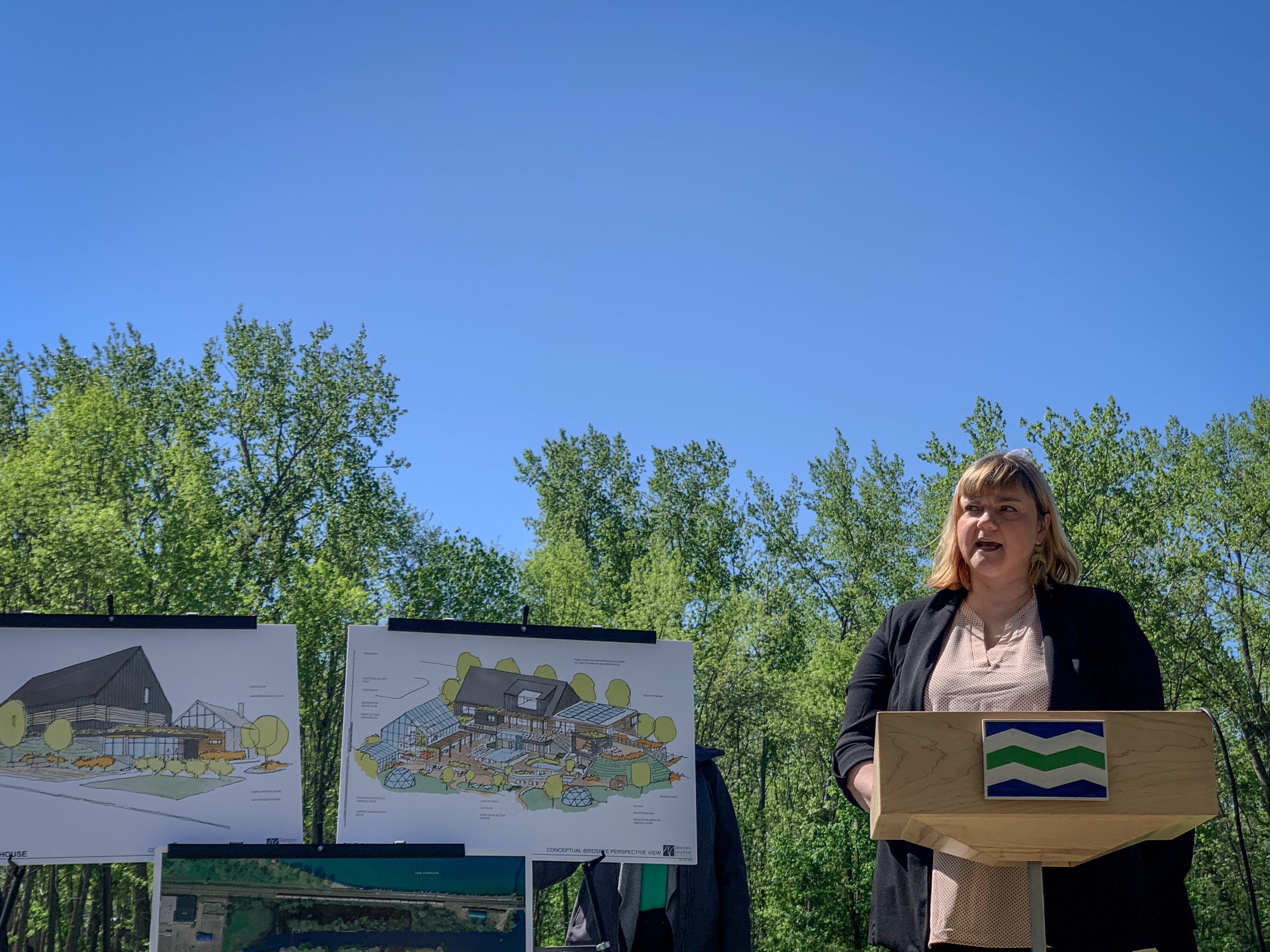
BURLINGTON — With the infusion of $6 million in state funds, two local business owners are launching an effort to clean up the South End’s infamously polluted “Barge Canal” and construct two buildings on the site.
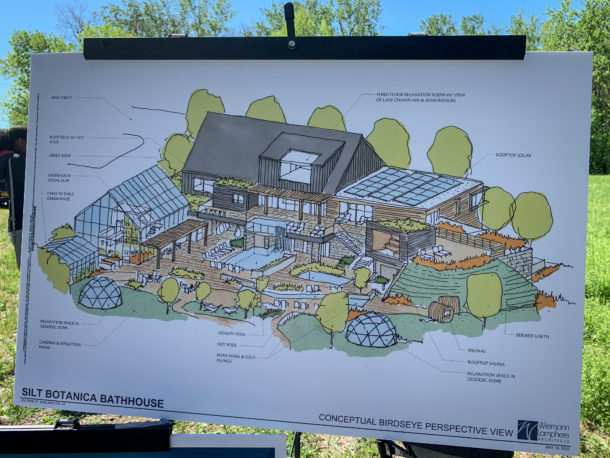
Silt Botanica, a planned European-style bathhouse, and Backside Bowl, a proposed duckpin bowling alley, would share the parcel at 453 Pine St. once it is decontaminated. Funding for the cleanup would come through the state’s Brownfield Economic Revitalization Alliance, a program designed to clear the way for development on tracts polluted by past industrial use.
The project could break ground as soon as next spring, according to its website.
Preliminary designs leave room on the property for walking trails and art installations — features that are supported by a group of activists who have advocated for conserving the site.
The project is led by Alex Crothers, a co-owner of the South Burlington performance venue Higher Ground, and Jovial King, founder of the herbal product brand Urban Moonshine. King announced the duo’s plans alongside a gaggle of state officials and business leaders Wednesday at a press conference on the site.
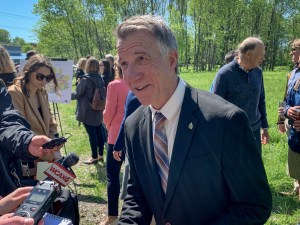
Among the speakers was Republican Gov. Phil Scott, who touted his administration’s commitment to funding the remediation of brownfields around the state.
“This money will help create jobs, housing and new businesses,” Scott said. “This is a big deal for cities like Burlington.”
But while the program might fund housing development at other brownfields, that’s not in the cards for the Barge Canal site because of two main obstacles, state and city officials said.
First, the U.S. Environmental Protection Agency ruled in 1998 that the site was not safe for housing or child care facilities. The Barge Canal once hosted a coal gasification plant, which extracted gas from coal to light the city’s streetlamps, and toxic byproducts were dumped into the ground.
The federal government’s decision is still on the books, though EPA administrators have shown an appetite for relaxing the ban in recent years, according to Scott Mapes, an engineer and lawyer who’s a consultant for the property owner, Rick Davis.
But even if a housing proposal were to clear the first obstacle, it would still face another: Burlington’s own zoning map does not allow for housing at 453 Pine St.
An effort to remove that obstacle sprang up late last year, when Democratic Mayor Miro Weinberger released his plan to dramatically increase the city’s housing stock in a five-year period. As part of the plan, the city would have rezoned swaths of the South End to allow the construction of housing.
Yet now, according to city development chief Brian Pine, the mayor has narrowed the scope of his plan.
“The vision was to focus on either undeveloped or underutilized parcels of land. And now I’d say our real emphasis is not on the undeveloped as much as underutilized,” Pine told VTDigger after the press conference. “Think of surface parking lots as the focus area.”
Weinberger did not attend Wednesday’s press conference, though a press release from Scott’s office said he would speak there. Dan MacLean, the mayor’s spokesperson, said in an email to VTDigger that Weinberger “had another commitment.”
Scott — who at a press conference with Weinberger last week pushed state legislators not to pass a law that he said would discourage residential development — did not opine on the city’s decision to keep the Barge Canal zoned for commercial use.
“From our standpoint, it really is about cleaning up the site and creating some development,” Scott told reporters Wednesday. “And whether it’s economic development or residential housing, that’s for the municipality to come to grips with and debate.”
Scott’s top environmental adviser, meanwhile, pointed to the city and federal restrictions against housing at the site as a reason not to develop residential buildings there.
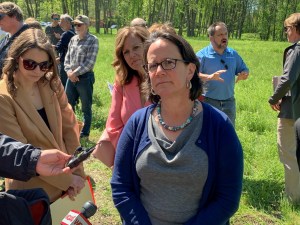
“While there’s been some interest expressed in this site as a potential location for housing, it would be inconsistent with current requirements,” said Julie Moore, secretary of the state Agency of Natural Resources.
With the Barge Canal off limits, the city is eyeing a massive parking lot between Lakeside Avenue and Sears Lane to help fulfill its housing goals. The lot is owned by Russ Scully, whose other South End ventures include two restaurants, a surf shop and the coworking facility Hula.
Scully also attended Wednesday’s press conference. In an interview, the entrepreneur said he wants to put as many residential units on the market as possible, but is still waiting for the city to rezone the parking lot before he can begin building.
“The ball’s in their court,” Scully said.
As the clamor for more housing in Burlington intensifies, some are urging the city to prioritize the conservation of natural areas alongside new developments. Members of the group Friends of the Barge Canal attended Wednesday’s press conference wearing pieces of paper that read “Do the Right Thing” and “Conserve It Now.”
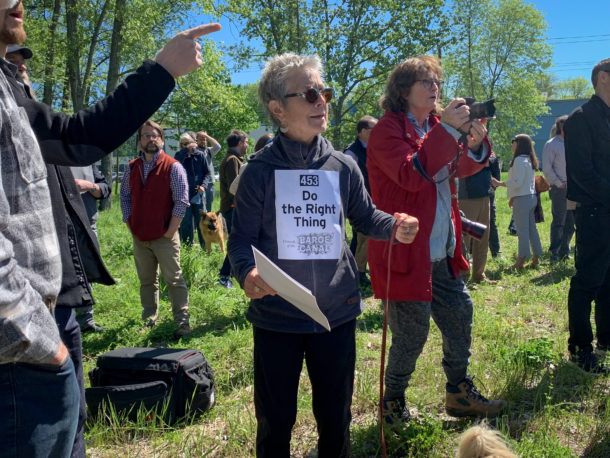
Still, the group was not protesting the event, said Andy Simon, its leader.
“I know that when you come with signs or stickers, it reads as a protest. But really, it’s more nuanced than that,” Simon told VTDigger after the press conference. “It’s trying to speak for the voiceless, which is the animals, the plants, the various inhabitants … of this land that will be impacted by any development that goes on.”
Because the project’s design integrates the natural landscape, Simon said, his group is supporting the project.
“Baseline, I would rather not have any buildings on this. But we are not opposing this development as a development,” he said. “We’re still working with the developers to make sure that it’s done right.”
