



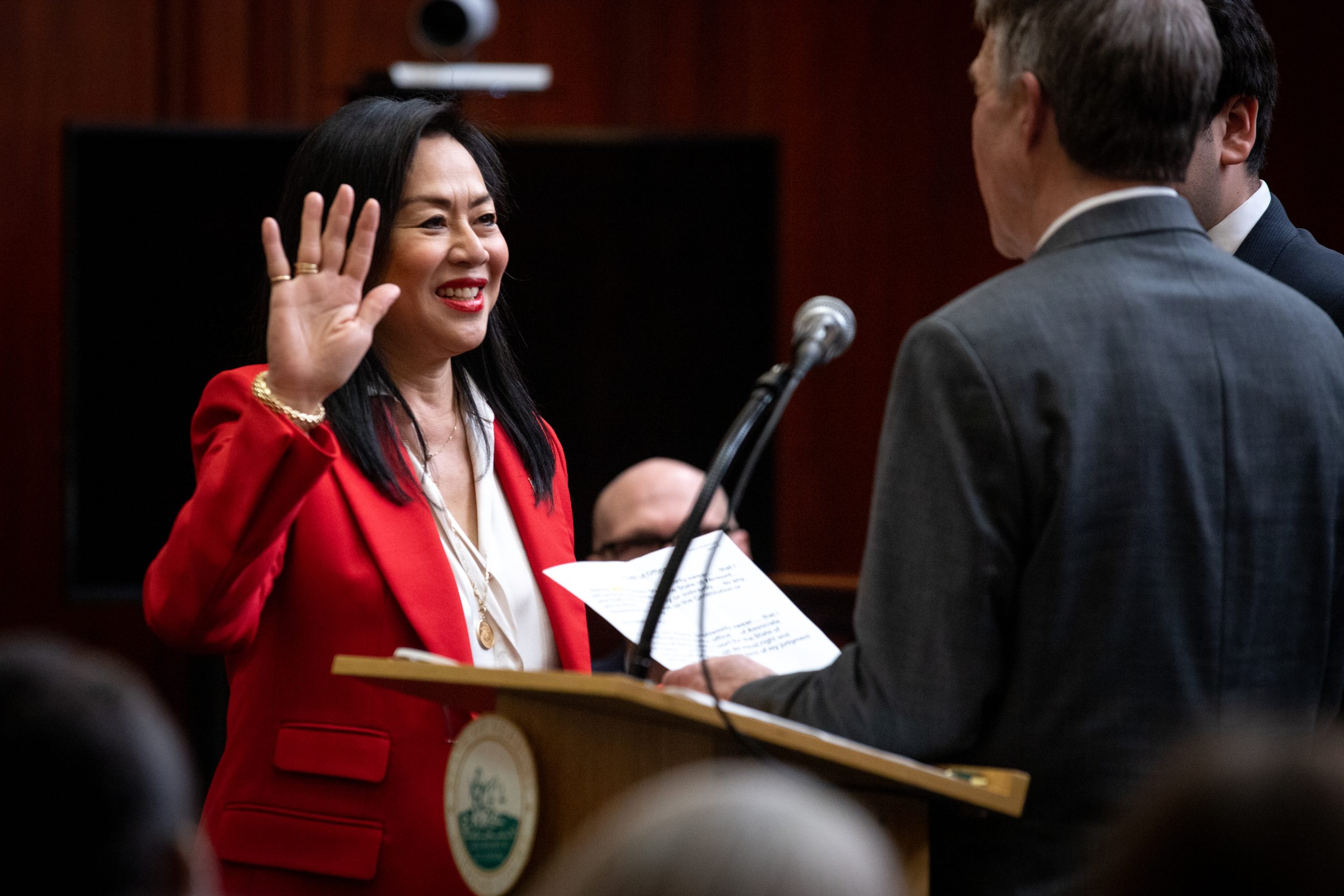
Nancy Waples was sworn in Friday afternoon as Vermont’s newest Supreme Court Justice, making her the first woman of color to serve on the state’s highest court.
And despite the weight of the historic moment, the mood was light.
Every speaker at Friday’s ceremony celebrated Waples not just as an accomplished jurist, but as a whole person, sketching out various pieces of her personality — her warm relationships with her colleagues, but also her penchant for “lots and lots of shoes,” noted Vermont Chief Superior Court Judge Thomas Zonay.
“I watched my mom learn and master both family and civil dockets in Vermont,” said her son, Lane Waples. “I also watched her learn how to use Microsoft Teams during the pandemic.”
The crowd of masked attendees were there to celebrate three people, in the words of Xusana Davis, Vermont’s executive director of racial equity: Judge Waples, Justice Waples and Nancy.
“Today, and every day, she remains Nancy,” Davis said.
After taking the oath, Waples told some of her own story: how her parents fled the Communist revolution in China, and she grew up working in their restaurant, open 364 days a year — just not Thanksgiving, which became her favorite holiday, she said.
“I grew up with the dust of honest labor on my hands,” Waples said.
After earning her law degree from St. John’s University of Law in New York, Waples worked as a prosecutor in the Manhattan District Attorney’s Office, an assistant U.S. attorney in the criminal division of the Vermont U.S. Attorney’s Office and as a defense attorney.
“Every case I had against Nancy — I was a federal prosecutor and she was a defense attorney in federal court — she beat me,” said former U.S. Attorney Christina Nolan, who is now running for U.S. Senate as a Republican, at the ceremony Friday. “It started to get a little old after a while.”
Waples has served in eight of Vermont’s 14 counties, she said.
Several of the speeches on Friday also drew parallels to the historic confirmation of Supreme Court Justice Ketanji Brown Jackson, the first Black woman to serve on the country’s highest court.
“The nominations and appointments and confirmations of people in the judiciary have been cascading firsts in Washington the district, and in Washington County,” Davis said. “We are seeing impressive firsts, and they’re happening in the year of 2022. It has taken so long, but like the poet said, ‘slow motion is better than no motion.’”
But the Chief Justice of the Vermont Supreme Court, Paul Reiber, noted the difference in tone between Waples’ confirmation process and what Jackson faced from some Republican senators on Capitol Hill.
“Their behavior, frankly, was appalling,” Reiber said.
Reiber lauded the “collaborative effort” of Waples’ confirmation, which the Vermont Senate consented to last month in a unanimous vote, 27-0.
— Riley Robinson


IN THE KNOW
The future of legislation that would put limits on public money in religious schools is in question, after a key House committee declined to take up the bill as written.
S.219, which prohibits private schools from discriminating and limits what religious schools can do with taxpayer dollars, passed the Vermont Senate last month with little opposition. But the chair of a key committee said Friday that lawmakers in the House are not planning to take up the full bill.
Senate lawmakers “worked incredibly hard on this (bill), and they did really good work,” said Rep. Kate Webb, D-Shelburne, the chair of the House Education Committee.
But as for key provisions of the bill, Webb said, “I think we have consensus that that should wait.”
Lawmakers are still considering a provision that would bar independent schools from discriminating, either on its own or as a part of another bill. But it’s not clear if there is a path forward for restrictions on public money in religious schools this session.
“I’m sorry the House didn’t get to that point. I’m disappointed,” said Sen. Brian Campion, D-Bennington, the chair of the Senate Education Committee and a driving force behind the bill. “But if that’s not where the House is, at the very least, we should be protecting LGBTQ+ (students).”
— Peter D’Auria
The House would like to spend a large portion of the education fund surplus on paying for universal school meals for another year. But the Senate may have its own ideas.
Senate Education chair Brian Campion, D-Bennington, said he’ll likely be pitching PCB remediation in schools, educator workforce shortages, and school construction as top priorities when the upper chamber’s tax-writing committee, Senate Finance, begins diving into the yield bill.
Lawmakers last year mandated that Vermont schools built before PCBs were phased out of construction materials begin testing for the toxic chemicals, and Campion said recent estimates from state officials pegged potential remediation costs at about $41 million.
Campion said he wasn’t outright opposed to universal meals, and still had to hear from advocates this session on the matter. But he didn’t sound entirely convinced.
“Do we want to put our first dollar toward paying for middle and upper middle class lunches?” he asked. “Is that really what we want to be doing?”
— Lola Duffort
ON THE MOVE
Lawmakers in the Senate Committee on Natural Resources and Energy passed H.715, a bill that would create a clean heat standard and transform Vermont’s thermal sector, out of committee on Friday. It was the top proposal from Vermont’s Climate Action Plan.
The legislation would use a performance standard to shift Vermont’s thermal sector away from fossil fuels. Parties that help install or distribute “clean heat” measures would receive incentives, called “clean heat credits,” and parties that import fossil fuels into the state would need to either generate or purchase those credits over time.
While many have urged the bill’s progress so that Vermont can meet its required emissions reductions, others have expressed concern and opposition to the measure. Some have worried heating fuel prices will rise while others have taken issue with the types of heat the bill considers “green,” such as biofuels.
Following a 4-1-0 vote in the committee, the bill is expected to hit the Senate floor next week.
— Emma Cotton
The Senate gave preliminary approval to its $100 million economic development bill, H.159. Some of the bill’s spending include $6 million to recruit workers to Vermont, $15 million in forgivable loans to businesses and $5 million for grants to “creative economy businesses.”
It also designates $26.9 million for workforce development. Those workforce development programs will be laid out in another workforce bill, H.703, according to an amendment from the Senate Appropriations Committee.
— Riley Robinson
The Senate Appropriations committee on Friday afternoon voted 7-0 to advance its version of Vermont’s $8 billion budget bill. This reporter was still figuring out what was in it as this newsletter went to press, so you’ll just have to keep refreshing the website for my story to post to find out more. Sorry!
— Lola Duffort
COVID CORNER
In its latest county-by-county Covid-19 report, the U.S. Centers for Disease Control and Prevention increased its tally of Vermont counties with “medium” Covid levels to nine: Addison, Bennington, Caledonia, Chittenden, Franklin, Lamoille, Orleans, Rutland and Washington. The state’s remaining five counties all had “low” levels, according to the CDC.
Last week, only four counties — Addison, Chittenden, Orleans and Washington — had “medium” Covid levels.
The health department reported that 32 people were hospitalized with Covid as of Friday, down from 35 on Thursday. That includes six people in intensive care, down from seven on Thursday.
— Natalie Williams
WHAT WE’RE READING
Whether friends or strangers, thousands mourn transgender woman killed in Vermont (VTDigger)
Vermont faith communities relax Covid rules in time for spring services (VTDigger)
Department of Corrections announces end of intake quarantine, reopening of in-person visitation (VTDigger)
