

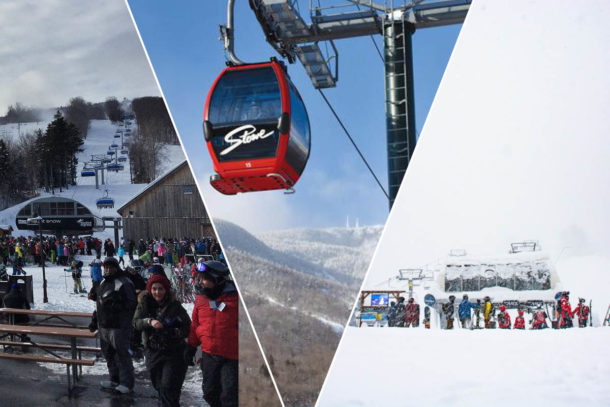
Tom Buchanan, who has taught skiing at Okemo Mountain Resort for 13 years, recalls the days when he would show up on the slopes waiting to be assigned to group or individual classes. On those days when he was not assigned, he would be paid only in five- to 15-minute intervals, the time he waited to see if he would be teaching, according to the Londonderry resident.
“So you could conceivably work for 15 minutes in the morning, five minutes in the afternoon, and be sent home with 20 minutes’ pay for a whole day of work,” Buchanan said.
But that changed, according to Buchanan, after three Colorado employees of Vail Resorts filed a federal lawsuit in December 2020. The suit was brought on behalf of all of Vail Resorts’ hourly employees under the federal Fair Labor Standards Act, and the laws of states where Vail Resorts operates, including Vermont. The employees in Colorado sought $100 million on behalf of all hourly Vail workers in the United States.
The Colorado suit claimed Vail Resorts does not pay hourly employees for all the hours they work. Ski and snowboard instructors said they were paid for up to seven hours and 15 minutes a day, but typically worked more than nine hours a day when considering time spent on company buses, putting on and taking off uniforms and training. The instructors also claim they are not paid for training time required to get certifications.
In a recent interview, Buchanan noted that the threat of the pending lawsuit seemed to change the way workers at Okemo were paid.
“We’re now paid from the time we put our boots on until we take them off,” he said.
But another instructor at Okemo, Jon Johnson, said that is not the case for part-time instructors. Johnson has been working as a ski instructor at Okemo since 2014. He was full-time until 2017 and has been part-time since then.
“We get paid 15 minutes to put on our gear and 20 minutes to take off our gear and do our timesheet at the end of the day, but the hours that you’re paid are only when you’re actually in a lesson,” Johnson said.
He said he still receives a full day’s pay because he has developed a clientele who request him and he fills up his days with bookings weeks ahead of time. He said instructors get an extra $20 an hour if clients request them.
Johnson said Vail Resorts pays for first- and second-year instructors’ training, and he points to other perks he said Vail Resorts has introduced: $5 lunches or 50% off food, 20% discounts in the ski shop and 60% discounts on some lines of clothing.
But Buchanan said the training compensation falls short for him as a full-time worker.
“Training time at Okemo, we’re reimbursed for a few hours at the beginning of the season, and then we’re required to do additional training through the season that’s not compensated,” he said.
Competing lawsuits
In April 2021, attorneys for the Colorado plaintiffs asked a judge to certify, for the purpose of the class action suit, all U.S. Vail Resorts’ hourly employees who since December 2017 had not been paid for off-the-clock work and not reimbursed for snow-sport equipment or cellphone costs. They also asked the court that notices be sent out to alert those who could join the lawsuit.
But before the federal judge in Colorado could rule, Vail Resorts informed the court in August 2021 that the company had reached a $13.1 million settlement in another class action lawsuit filed in a California federal court. Vail Resorts argued that the California case should extinguish the $100 million lawsuit brought in Colorado.
The Vail attorneys asked the Colorado federal judge to suspend the presentation of evidence in the Colorado case. They told the judge in Denver that the federal court in California would supervise the settlement.
The lawyers for the employees suing in Colorado are now asking the Denver federal judge to claim jurisdiction, in part because Vail Resorts is a Colorado-based company.
Buchanan is among thousands of current and former Vermont employees of Vail Resorts, including workers at Okemo, Mount Snow and Stowe Mountain Resort, who were recently notified in writing that they are now eligible for damages resulting from the proposed California settlement.
What is not clear in the letter, issued by a settlement administrator, is that those employees have an alternative to join the Colorado lawsuit, which is asking for much greater compensation for workers than the California lawsuit.
If they sign onto the California settlement, it would be binding on their claims that Vail Resorts violated federal and state law, including Vermont’s, and they would be excluded from taking part in the Colorado case. If they do not sign, they would still get a settlement check. If they cashed it, they’d still be bound by the California settlement and would forfeit their right to sue under the Colorado case, according to the settlement terms. Only by completing an “opt out” form would they be clear from entanglement in the California case.
Vail Resorts did not respond to a request for an interview, but Adam White, the company’s senior manager of resort communications for the Northeast Region, said Vail Resorts was “committed to treating its employees fairly and in compliance with all applicable laws.”
“We dispute the accuracy of the claims raised by the plaintiffs and deny the allegations; however, to avoid the time-consuming and costly nature of further litigation, the parties involved have negotiated a settlement,” White said in his emailed response. “ We believe the settlement agreement is appropriate and fair.”
Buchanan, the Okemo instructor, said he worries that once the case against Vail Resorts settles in California, Vail will go back to paying all instructors in five- to 15-minute increments, because that settlement does not require that Vail change its practices, as the Colorado case would attempt to do.
Buchanan calculates that he would be paid $45 if he agrees to the California settlement, but guesses that he is owed $3,000 to $4,500 in back pay for the three years that the Colorado case covers.
So why would anyone cash that check from the California settlement if they could keep going with the Colorado case?
“Most people don’t know about the Colorado case,” Buchanan said. “All the paperwork we’ve received from California just says, “This is free money. It’s yours. Just sign on the dotted line and you can have a check.’”
The lawyers for the employees in the Colorado case, who have declined to comment, have objected, but the California settlement is proceeding.
Buchanan said he would like to see Vermont’s attorney general enter the case to represent the thousands of Vermonters who were employed by Vail over the course of the years addressed in the lawsuits. But that does not appear to be happening.
“This is a private lawsuit between a class of Vail employees and the Vail Corporation,” said Attorney General TJ Donovan’s spokesperson, Charity Clark, in a statement. “The State of Vermont is not a party. It would be premature to be involved. There is ongoing litigation in Colorado and California, which includes Vermont class members.“
“If Vermont class members have questions, they should contact the claims administrator’s website,” said Clark, who also referred VTDigger to the Vermont Department of Labor, which did not respond to a question asking whether it would weigh in on the lawsuit.
Buchanan points out that Vail was not alone in paying instructors in five-to 15-minute intervals. He worries that if Vail, the biggest ski operator in the country, goes back to paying instructors that way, other resorts will continue to pay employees for only part of the time they work.
“Whereas if the Colorado case were to settle, it’s quite likely that other resorts would be forced to follow suit and pay all of the time that we work,” Buchanan said. “The Colorado case looks like it’s designed to support workers to get a fair compensation for back wages and a requirement that they’ll change policy officially and pay us or compensate us adequately in the future.”
Buchanan said the California case “looks like it’s a quick settlement to hijack the Colorado case. It looks like a workaround for Vail.”
Buchanan said besides changing over to paying instructors for a full days’ work last year, Vail has raised wages, a practice followed by the rest of the industry.
Employees say starting pay went up from $12 an hour last year to $15 an hour this year, with a $2-an-hour bonus starting Jan. 1 this year for all employees who complete the season. Vail Resorts recently announced that it is increasing its minimum wage to $20 an hour next year.
Both Johnson and Buchanan point out that they love working at Okemo despite the frustrations.
“I do it so I get a pass and I ski with people that I like,” Johnson said. “If I don’t have a request, typically, I’m skiing with advanced-level kids, which is super fun, halfpipe and going through the woods and tearing around the mountain and not waiting in line. With the kids’ program, the mountain buys you lunch.”
Buchanan said he probably will work at Okemo next year.
“I like the supervisors I work for,” he said. ‘I like the managers I work for. I like the mountain and I like my guests. It’s a good job and a good place to work in general. I’d just like for there to be a better corporate culture, and I’d like to be assured that I’ll be paid for all the time that I actually work.”
