

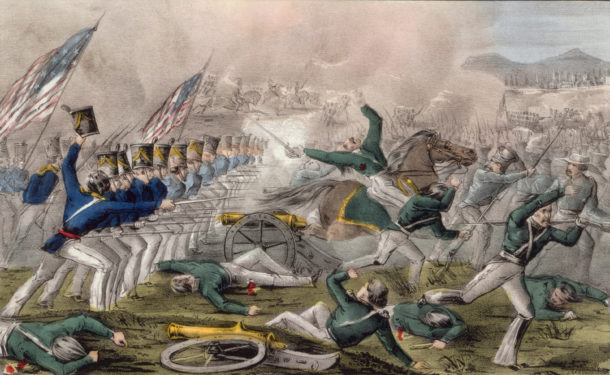
Joining the Army was his father’s idea. But George Stevens quickly took to military life. And when war came, he was all for it.
But by that time his father, Henry, felt differently. He still thought the military was the right place for George, but the Mexican-American War was the wrong war; this one was not honorable. It wasn’t a fight for freedom, like the one Henry Stevens’ beloved Green Mountain Boys had waged 70 years earlier. It was a fight over land and a veiled effort to extend slavery.
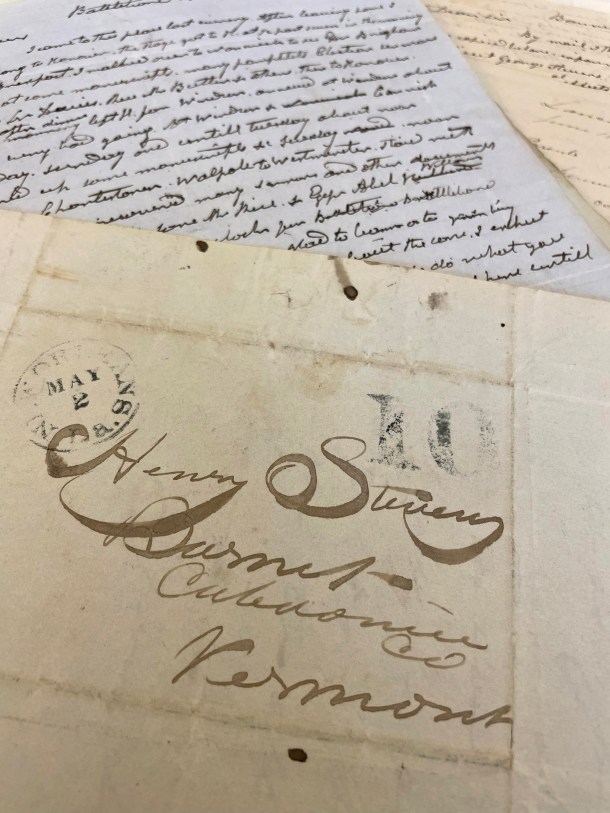
Over the course of several years, Henry and George Stevens engaged in a spirited correspondence that delved into questions of what it meant to be a Vermonter, an American and a member of the military. Their letters are preserved in the collections of the Vermont Historical Society.
George Stevens entered military college in 1839 at the urging of his father and with his considerable help. Henry Stevens used his connections to get his son into West Point. Henry got former Vermont Gov. William Palmer to write a letter of reference, calling George “a full blooded Green mountain boy – (who) will do honor to the appointment.”
Throughout George’s time at West Point, and later while serving in the Army, his father kept lecturing him about honor. But rather than urging him to do honor to his appointment, Henry was more concerned that his son do honor to the sacred memory of the Green Mountain Boys.
In Henry Stevens’ mind, no one stood higher than Ethan Allen and his fellow Vermont rebels. “Had it not been for the Green mountain boys the United States of America would to this day (have) remained a British Colony,” he once wrote.
Henry Stevens was a businessman from Barnet who oversaw the family enterprises, including a farm, an inn and mills, and was also director of the Passumpsic Turnpike Corp. But his real passion was collecting books and documents about Vermont’s early days. In 1838, he had been the principal founder of the Vermont Historical and Antiquarian Society, later the Vermont Historical Society. For nearly two decades, the society was based in Barnet and Stevens provided virtually its entire collection.
Henry Stevens’ collecting frenzy and his devotion to the Green Mountain Boys may have grown out of his family experience, according to an essay by historian David Narrett, who wrote on the subject for the society’s journal. During the Revolution, Stevens’ father, Enos, had sided with the British and fled to Nova Scotia. With peace, Enos returned to Vermont and apparently experienced a warm welcome in Barnet, where he became a leading citizen.
Henry also seems to have forgiven his father. He is said to have kept his father’s wig in his library. He even named his first son after him.
A geopolitical fault line
Henry believed his son George’s actions in the military reflected on the state. He wrote George at West Point, with his idiosyncratic spelling and grammar: “Stick snug to your Books and see if you can go ahead of all the New England cadats.”
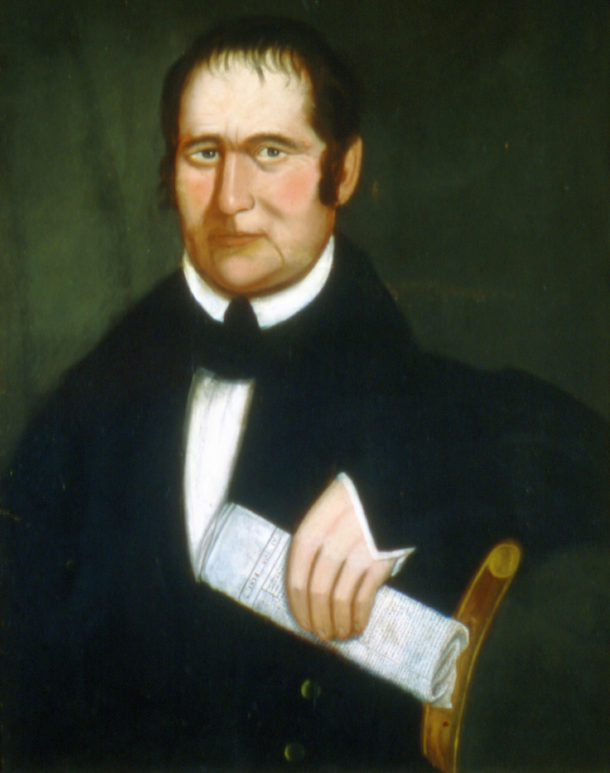
Upon learning that a cadet from South Carolina, the son of Senator John C. Calhoun, had the fewest demerits in the class, Henry wrote: “Is it possible that a Vermont Yankee is to be out done by a southern cadat(?)” George graduated in the middle of his class, in 18th position, three spots ahead of fellow northern classmate Ulysses S. Grant.
After graduating, George was assigned to the Regiment of Riflemen, which was dispatched to Fort Jesup, Louisiana, in December 1843. The mission in what was then the southwestern corner of the United States put George and his regiment on a geopolitical fault line. The United States and Mexico were in the midst of an escalating dispute over their mutual border.
After Mexico won independence from Spain in 1821, American settlers had flooded into the Mexican territory of Texas. Once those Americans declared their independence in 1836, it seemed likely Texas would someday join the United States.
Mexico and the United States had previously accepted the Nueces River as their boundary. Now the settlers in Texas were claiming land all the way to Rio Grande, in effect moving the Mexican border south by 150 miles. Predictably, tensions between the United States and Mexico rose.
Texas and slavery
As a member of the Whig political party, Henry believed that slave interests wanted to spark a war with Mexico and use it as an excuse to have Texas enter the union as a slave state. “We Vermonters in general are opposed to Slavery as well as annexing Texas,” he wrote to George.
(Henry understood Vermonters well. When war eventually came, only one Vermont company, consisting of 84 men, volunteered.)
George downplayed concerns about slavery and wrote that he hated the abolitionists. Slaves in the South, he claimed in one letter, “live more comfortably than a great portion of the Sons of freedom in the north.” George was eager for war, which he thought would be an adventure.
Henry Stevens braced himself for the possibility of war, and hoped his son would act admirably if it erupted. “I long to have you distinguish yourself as an American officer,” he wrote George. “Above all do not dishonor the name of the Green Mountain Boys.”
The boundary became an escalating issue between Mexico and the United States. In 1845, President James Polk offered the people of Texas a deal engineered during the administration of his predecessor, John Tyler: The United States would annex Texas. Texans approved the annexation and Texas became the 28th state in December of that year.
Mexico, however, never recognized the existence of an independent Texas and viewed Texas statehood as an illegal land grab. To make the annexation a reality on the ground, Polk claimed unprecedented war powers in March 1846.
Acting without congressional approval, he ordered troops under Gen. Zachary Taylor to defend the Rio Grande boundary. (Polk would later be censured by Congress for the ensuing war, which had been “unnecessarily and unconstitutionally begun.”)
Border fighting escalates
George Stevens was among the troops dispatched with Taylor. He saddled his horse, which he had named Ethan Allen, and rode south. After reaching the Rio Grande, George’s unit was ordered to cross the river and set up camp near Matamoras, Mexico.
When Mexican troops responded by advancing, his unit returned to the north side of the Rio Grande. A Mexican general warned that war would start if the American Army kept taking such provocative actions.
On April 25, Mexican cavalry attacked a mounted American patrol north of the Rio Grande, killing five, wounding 11 and capturing 47.
On May 9, still unaware that fighting had started, Polk told his Cabinet members that he would soon ask Congress to declare war. That night, word of the April battle arrived and he rewrote his message to Congress, declaring that Mexican troops had shed “American blood upon America’s soil.” On May 13, Congress declared war.
Five days later, George Stevens was riding across the Rio Grande when something spooked Ethan Allen. The horse bolted and knocked George from the saddle. His foot became trapped in one of his stirrups. Unable to free himself, George drowned. He was buried at Fort Brown in Brownsville, Texas.
Stevens’ death cast a pall over his unit. Gen. Taylor wrote in his official report: “I deeply regret to report that Lieut. George Stevens, a very promising young officer of the Second Dragoons, was accidentally drowned this morning while attempting to swim the river with his squadron.”
Devastating blow
The Vermont Watchman and State Journal newspaper criticized the decision to bury Stevens in Texas, rather than transport his body home. “Is it too much for the Government to restore the remains of those who perish faithfully serving it, to their kindred? Such an act would be gratefully received by all who have given their sons to their country, and the hope of such a favor would serve to solace the dying moments of the soldier.”
The newspaper went on to note that “(h)is loss will be very severely felt by a large circle of relatives and friends.”
Indeed, when news of his son’s death reached Henry Stevens in June, the blow was devastating. Stevens confided in a friend that “my staff on which I so much relied is broken.” He felt more than ever that the country was wrong to fight this war.
The United States, he later said, had failed to heed the warning the Green Mountain Boys had issued to their enemies: “Thou shalt not covet thy Neighbor’s possessions.”
Despite his grief, Henry Stevens didn’t lose interest in the history of Vermont — and he saw that his son was now part of that history. The day he learned of George’s death, he wrote the War Department, requesting his son’s belongings, including any papers and items he might have collected, so they might become part of the Vermont Historical Society, where they remain to this day.

