



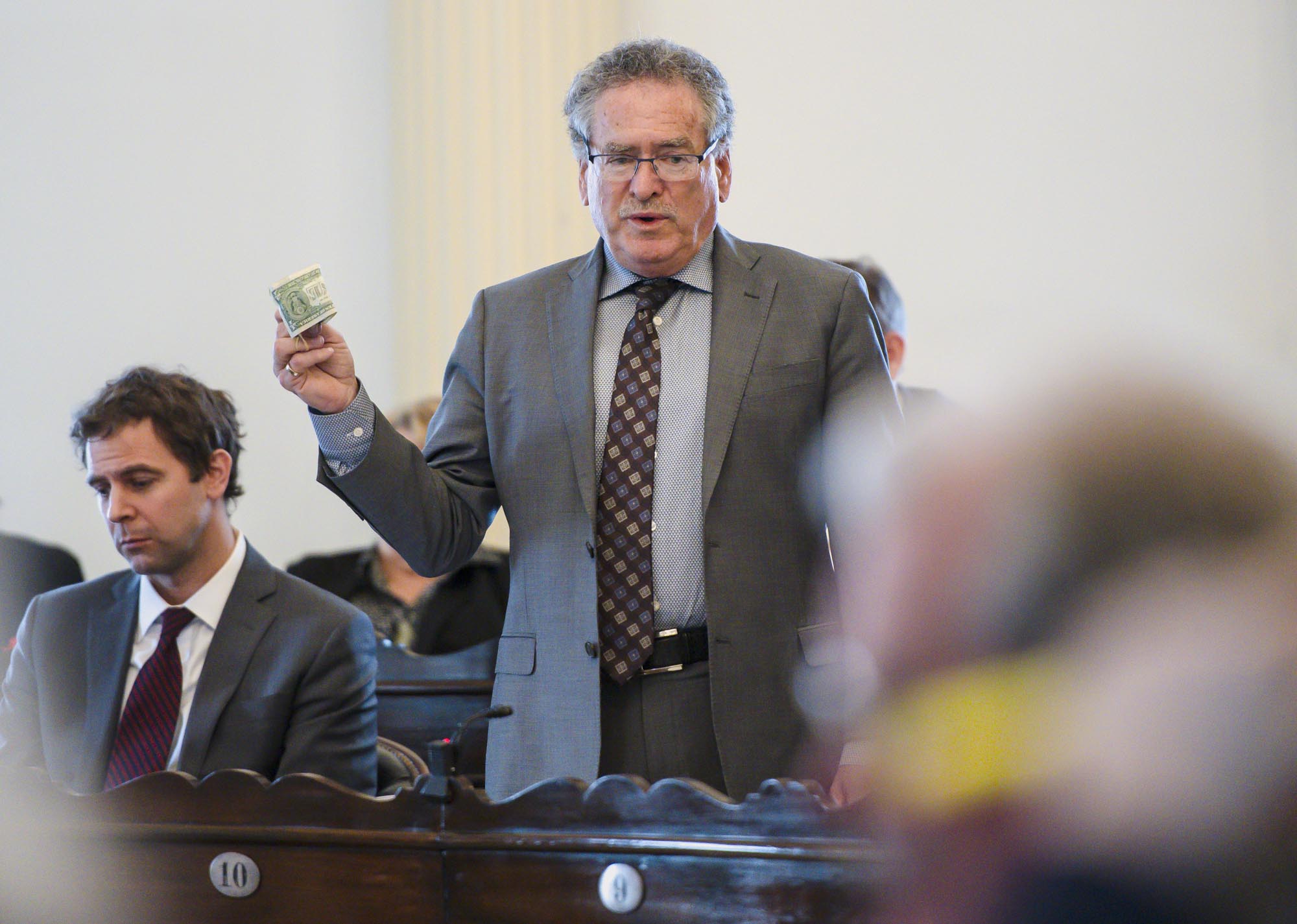

The budget-writing process is known for being a little bit of a dance. The House puts their left foot in, the Senate takes their right foot out, and then everyone does the hokey pokey and eventually the governor signs the thing.
This year, they will likely need to hokey pokey (cough: negotiate) a lot more, because the Senate Finance Committee just voted out a $100 million bill that the House didn’t leave a placeholder for.
Gov. Phil Scott’s administration saw this coming. At his weekly press conference on Tuesday, Scott came out swinging at the House’s budget draft. Much of the critique was on how the House spent federal Covid relief funds. But the governor also called the House’s budget “out of balance.”
Rep. Mary Hooper, D-Montpelier, chair of the House Appropriations Committee, disagreed with that characterization.
“I wish they would point out to me where it is unbalanced. It is balanced, ” Hooper said. “We did not spend more revenue than was available, which, by my definition, is balanced.”
To be clear, there are always differences between the House and Senate versions before the budget gets ironed out. What’s different this year is the magnitude, with all the extra federal money.
“The stakes are higher with the amounts of money they’re dealing with, for sure,” said Downs Rachlin Martin lobbyist Patti Komline, who formerly served in the Vermont House for more than a decade. “You’re not gonna find a little outlier tax that’s going to make up the difference.”
At the heart of Scott’s concerns is the Senate’s economic development bill. It lays out grants for businesses, includes incentives for people to move to Vermont, backfills Covid-related leave for workers, and raises the minimum wage to $15 an hour by 2024. It uses about $16 million from the general fund and about $85 million in federal dollars from the American Rescue Plan Act. Big pieces of it, namely the millions in grants to businesses, seem to align with the governor’s wishlist.
It’s proceeding to the floor as H.159, in a procedural twist — the real meat of H.159 went into last year’s budget, and the Senate is using the husk of that bill to get around the crossover deadline.
Sen. Michael Sirotkin, D-Chittenden, said he’s been working closely with the budget writers in the Senate Appropriations Committee.
“The Senate-passed budget will include 159,” Sirotkin said.
The House and Senate had a sort of divide-and-conquer plan for this session, according to Hooper and Sirotkin: The House would tackle workforce issues, while the Senate would take on other economic development measures. So the House put funds toward education, particularly nursing programs and the trades, Hooper said. Sirotkin worked on a package that, he said, seeks to balance the needs of employers and employees.
Now, “there are competing interests for the money,” Hooper said.
“There’s some big price ticket items that they have to find a meeting of the minds on,” Komline said.
— Riley Robinson
IN THE KNOW
A year ago, former residents of Burlington’s shuttered St. Joseph’s Orphanage successfully called on the Legislature to repeal Vermont’s former statute of limitations for civil lawsuits related to childhood physical abuse.
On Friday, they returned to Montpelier to commemorate their efforts.
Former residents started by receiving a House resolution of support before moving to the Vermont Historical Society’s nearby museum, which features an exhibit of photographs, documents, artifacts and oral history interviews titled “The Voices of St. Joseph’s Orphanage.”
Such events are the work of a St. Joseph’s Orphanage Restorative Inquiry sparked by a recent investigation that confirmed past abuse at the facility, which housed more than 13,000 children from 1854 to 1974.
Although the state can’t press criminal charges because the accusations are too old, it’s supporting the restorative inquiry — an initiative of the city of Burlington’s Community Justice Center — to collect and share stories to promote “accountability, amends-making, learning and change.”
— Kevin O’Connor
ON THE MOVE
The House gave preliminary approval Friday morning to a bill that increases penalties for criminal threatening, particularly for threats against public officials, election workers and other state and local employees.
“Ignoring these threats would be like ignoring a tumor until the cancer has spread,” said Rep. William Notte, D-Rutland City, while presenting the bill on the House floor.
The bill, S.265, makes it illegal to threaten an individual or group of people in a way that causes reasonable fear of death, serious injury or sexual assault.
There was “quite a bit of discussion” among legislators about whether to make criminal threatening a misdemeanor or a felony, Notte said in an interview.
— Riley Robinson
A bill that supports those who have been exposed to toxic chemicals has, for the third time, cleared both the Vermont House and Senate. This time, however, Gov. Phil Scott is planning to sign it.
The bill, S.113, would give Vermonters who have been exposed to toxic chemicals an explicit right to sue chemical companies for medical monitoring expenses. A number of Bennington residents who have been impacted by widespread PFAS contamination have long advocated for the bill’s passage.
Scott has vetoed two similar measures in the past, expressing concerns about potential impacts on the business community. But according to spokesperson Jason Maulucci, the governor does not intend to block the latest version. He said the bill has “come a long way towards meeting the concerns the Governor expressed with previous iterations, and it provides a good example of when the legislature chooses to work to find consensus instead of conflict.”
— Emma Cotton
ON THE CAMPAIGN TRAIL
Christina Nolan, a former U.S. attorney for Vermont running for the U.S. Senate as a Republican, has raised $156,842 thus far in her campaign, a figure that leaves her well behind the candidate she is most likely to face in the general election.
After spending $55,295, Nolan had $101,546 in her campaign account as of March 31, according to a filing submitted this week to the Federal Election Commission. Nolan is the first Senate or congressional candidate to have submitted filings so far this quarter.
Nolan was taking donations as early as Jan. 11, so the FEC reports reflect a little under three months of fundraising. It is not yet known how much U.S. Rep. Peter Welch, D-Vt., raised in that same period, but the figure he raised in the first six weeks of his campaign far outstrips Nolan’s total to date.
Welch, the front-runner in the Democratic Senate primary, had nearly $2.5 million in the bank at the close of 2021. He raised about $550,000 between announcing his candidacy on Nov. 22 and the end of the quarter on Dec. 31. At the time, he also transferred over a $2.1 million war chest from his House campaign account.
— Lola Duffort
WHAT’S FOR LUNCH
Ah, yes — what’s for lunch? Isn’t that always the question. What is lunch, really, but a concept? A social construct of our own manufacturing? What is it that binds us so strongly to the mythos of a midday meal? And who am I? Why am I here? More importantly, why are you here? Are you seriously still reading? It’s Friday night — or is it?
— Sarah Mearhoff
WHAT WE’RE READING
Mud season nightmare: A VPR host was stranded for 7 hours on a rural road. She barely survived. (VTDigger)
The Burlington School District hosted a workshop on gender identity. Fox News took note. (VTDigger)
Vermont Air National Guard set to deploy to Europe this spring (VTDigger)
Vermont regulators OK modest price hike for Burlington and Berlin hospitals but deny steeper increase (VTDigger)
