

BURLINGTON — A bowling trophy wrapped in felt, a plaque won in a spelling bee, a tattered Babar book — those are some things Rita Markley has seen people bring into shelters across Vermont, after months or even years of carrying them around, intact.
“It’s your memories,” said Markley, executive director of the Committee on Temporary Shelter, the largest service provider for people experiencing homelessness in Vermont. “Those are the things that people take in a moment when they have to leave in a hurry.”
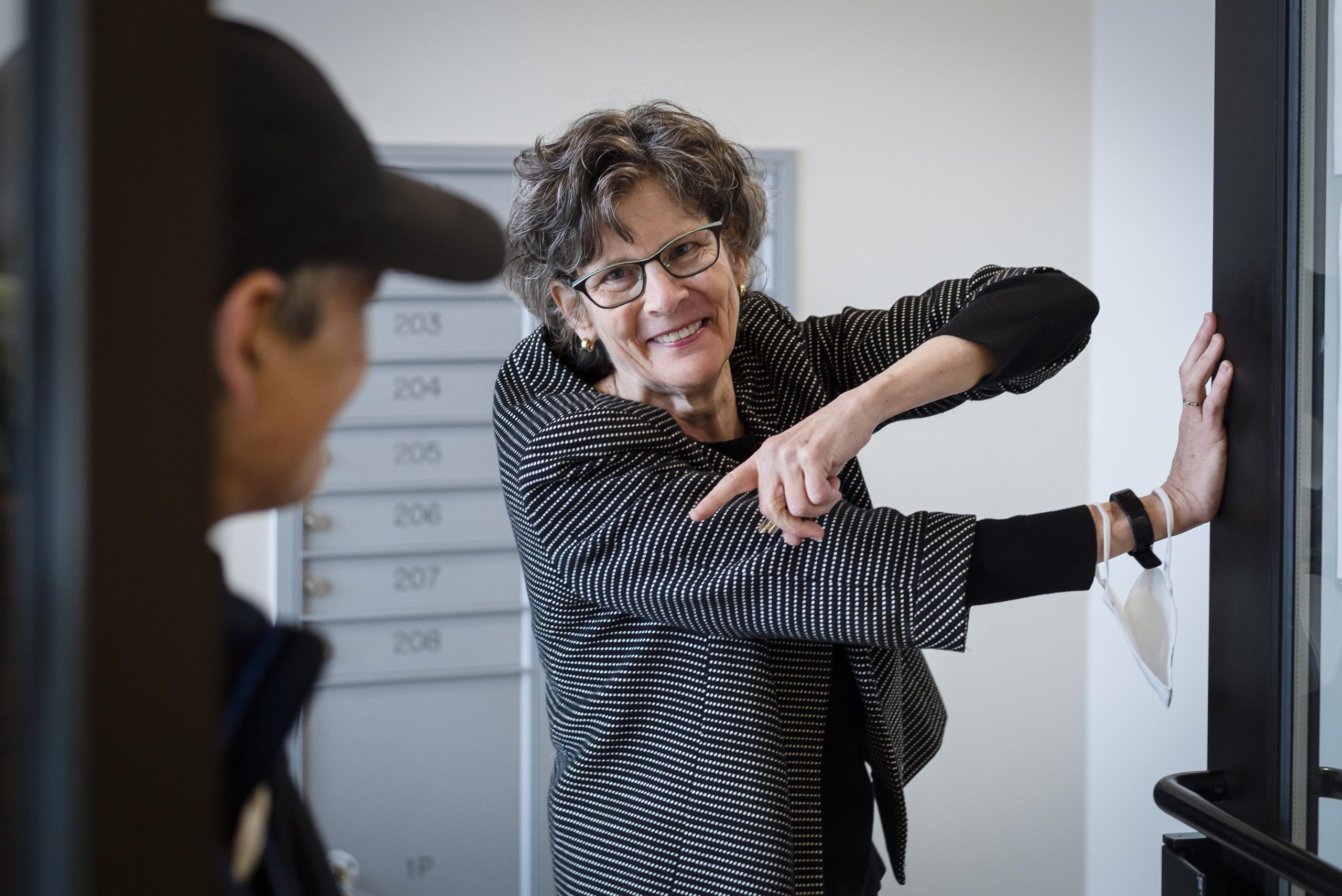
A passionate advocate for housing people in Vermont, Markley, 63, is set to retire at the end of September, after 30 years of working at the nonprofit organization in Burlington.
She talked about the work she continues to do from her third floor office at 95 North Ave., where the entire second floor is occupied by residents who were formerly unhoused.
The Committee on Temporary Shelter, known as COTS, renovated the 126-year-old building to create 14 units of permanent affordable housing. That work earned an award from the Preservation Trust of Vermont in 2018.
“I just think everyone, at minimum, deserves a home,” Markley said. “It’s a sanctuary where you keep everything that matters to you. Your family photos, your books, your music. It’s what gives you a sense of place and being.”
Early observations
Markley grew up in Washington, D.C. When she was in her mid-20s, she remembers she watched a man walking slowly late at night, with a shopping cart that was rattling noisily on the brick sidewalks of the older portion of Capitol Hill. He kept leaning down and saying, “Shh, shh.”
That’s when she saw he had a baby in it, she said.
“That man had grown up three blocks from where he was walking with a shopping cart and his baby,” Markley said. “But all around him, the neighborhood — Capitol Hill — became gentrified and more and more expensive. As property values went up, so did his taxes and he didn’t pay. He kept ignoring the bills. Eventually, they took his home from him. He didn’t know to go to a lawyer.”
She sighed, closed her eyes briefly, and shook her head.
“There was, in the 1980s and in the early ’90s, just this enormous displacement of people who used to be housed. And what happens to that child? Who knows where the mother was? What kind of life is that?”
But even earlier, Markley told VTDigger, she had spent the first six years of her life in an orphanage. “So I know what it’s like to not have a place that feels as though it’s really your own.”
While lucky to be adopted into a wonderful home by the Markleys, to go to college and graduate summa cum laude from the University of Maryland, she said she never forgot how easily it might have been that she didn’t have that chance.
When things were different
Markley remembers how things were different.
“There was a time in this world when somebody could be the cashier at the supermarket, or they could be a butcher in the meat department and they could afford a movie and popcorn on Saturday,” she said. “They weren’t living lavishly but they could afford a two-bedroom, three-bedroom home, which was fine to raise a family, and they retired there.”
But with rents skyrocketing, the chance to save enough money for the first down payment on a house has gotten away for too many people.

“That’s the biggest shift I’ve seen in 30 years — when we went from serving people who were between jobs or didn’t have a job to families where both parents were working and they still couldn’t afford” a home, she said.
When she visited her daughter, who is at Stanford University in California, Markley said she was struck by the lines of parked campers, trailers and station wagons and found out they were people who travel three to four hours to work but can’t afford to live anywhere near Palo Alto. “So it’s easier to just stay in your car for the week and go home on the weekend. It’s just unbelievable. But they have homes to go back to.”
Not so for countless others in tent cities across California, which has the highest number of unhoused people in the nation.
California had an estimated 161,500 unhoused people or a homelessness rate of about 41 people per every 10,000 people, according to the last point-in-time count in January 2020. In comparison, Vermont, a smaller and less populous state, had 1,110 people or about 18 people per 10,000 experiencing homelessness at that time.
Even in Vermont, the gap is stark and widening, with affordable housing almost impossible to find.
When the COTS staff works on family budgets during life skills training, Markley said they cannot make the numbers work when families are spending 65% to 70% of their income just to cover the rent in Burlington or other Chittenden County communities.
“There’s just not enough left over for food, transportation, so that (if) anything goes wrong — you miss a shift at work, the car breaks down — you have no buffer.”
Trying something new
Markley started volunteering in shelters in D.C. at an early age. She moved to Vermont in 1991 “mainly because I wanted to try living in a place completely different from where I’d grown up, and I loved everything I’d read about Vermont,” she said.
As soon as she got here, Markley said she went to the Volunteer Connection, run by United Way, and asked which group helped Vermonters experiencing homelessness or poverty. “A worker — Dolly Fleming — recommended COTS,” she said, “and the rest is history, as they say.”
She quickly found that she had an incredible mentor in COTS founder Sister Lucille Bonvouloir. A photograph of her predecessor hangs in her sunny North Avenue office — “my guardian angel,” Markley said. She hopes she can be a similar sort of mentor to the person who takes her place.

After joining as a volunteer, Markley became the development director — writing grant applications, organizing fundraisers and coordinating volunteers. When Sister Lucille went back to the Sisters of Mercy to serve in a leadership position in 1996, Markley became the executive director.
COTS today — with an annual operating budget of $3.8 million — is very different from the organization she walked into. It now provides year-round emergency shelter, 98 units of permanently affordable housing, homelessness prevention and rehousing support, and a day station providing meals, showers and laundry.
“I think one of the things I’m most proud of is, I shifted COTS from being just charity and focused on the emergency, to advocacy and fighting hard for solutions, for creating solutions that have spared hundreds, thousands of people the anguish of homelessness,” she said.
Beyond advancing COTS’ focus from charity to prevention and advocacy, Markley’s list of accomplishments and awards is long. Many credit her with a kind of determination and empathy for the work that’s rare.
“She really is smart and thoughtful and creative in her approach,” said Beth Anderson of Burlington, who was director of operations at COTS and worked with Markley 2009-11. Her favorite Markley quality is how she always approaches the issue of homelessness. “It’s always ‘We can solve this.’ Not ‘this is a problem.’”
Housing as a cure
After she joined COTS, Markley said for a year she looked at who was coming in for shelter and found that 70% were from Chittenden County, and a large number of those people came from Burlington. “And all of them had had an apartment or a trailer before they came to us,” she said.
So she came up with a plan to bridge the gap between nonpayment of bills or rent and homelessness.
Markley says it always comes down to a few hundred bucks that someone couldn’t afford to pay because they had a sick child, or couldn’t go to work. That can cascade into job loss, the inability to pay rent or mortgage — and eviction. And once they lose housing, they lose good references, good credit and trust. After that, it’s almost impossible for them to get a second chance, she said.
Add to that the trauma of moving out in trash bags and boxes, sheriff’s deputies putting up yellow tapes, losing your pets, books, stuffed animals — everything you had that you no longer have room for. “It has a devastating impact on kids and their education,” Markley said. “You just look through each piece of a life and wrap it all up, and where do you go? You go to a shelter.”
Under her leadership, COTS raised money for the largest homelessness prevention initiative in Vermont — the Housing Resource Center. “It’s right here in this building,” she said.
When the initiative launched in 2009, it helped keep 195 families with children from losing their homes that year because it paid three months of their rent. Businesses got it. Communities got it, and the success of the program helped net $1 million in initial funding for homelessness prevention.
Markley also founded the Chittenden County Continuum of Care and the Statewide Coalition to End Homelessness; helped create 54 units of housing that at permanently deeply affordable, with more on the way; launched an Innovation Fund to devise and test new ideas; and pioneered the Risk Guarantee Fund that gives people a shot at obtaining permanent housing, according to an announcement last month.
“Homelessness, it’s not like cancer where we don’t have a cure,” Markley said. “It’s not like some horrific disease where there is no medicine, there is no vaccine. We know what the answer is. It’s housing, and enough money to afford a place of your own.”
People talk about mental illness and a lot of other problems that contributed to lack of housing, and “it’s true,” she said. “But there was mental illness, there was racism, there were all the same issues 50 years ago, and we didn’t have millions of people wandering the streets and turning to shelter because they had no home.”
People who have worked with Markley talk about her passion for the cause, her dedication in addressing the systems of inequality that contribute to homelessness, her boundless enthusiasm and her sense of humor.
“She would light up the room and always had us in stitches,” said Ellen Kane, executive director of the Vermont Catholic Community Foundation; she worked at COTS with Markley from 2005 to 2008. “She would joke around with the clients and make them laugh too.”

Markley’s dedication has spurred many in the community to take action. Lucy Samara, for instance, helped organize the first COTS Walk more than three decades ago with friends and family to raise money and awareness, and has participated continuously since.
“The COTS Walk is a significant, positive way to invite the wider community to work together for people who are without housing or who are at risk of losing their housing,” she said.
When they started it, the goal was to find 10 communities that would each find 10 individuals to raise $100. They borrowed a Girl Scout button machine and made hundreds of buttons by hand. It started at the Burlington church with the lacrosse team from St. Michael’s College and several students serving as crossing guards around Burlington, she said.
Now an annual event scheduled on May 1 this year, the walk is a 3.6-mile route through downtown Burlington visiting COTS shelters and facilities. It draws more than 2,000 participants and this year has a goal of raising $205,000.
Time for rest
Asked about her plans, Markley said, “I’m going to rest.”
“The last two years of Covid have been the most exhausting, stressful of my entire time at COTS,” she said. “I just need to rest up, get my health back, and then when I’m better, think about what I want my next chapter to be.”
For her, this hasn’t been a job, it’s been a calling.
“I’ve had joy in the work,” Markley said, citing examples: “When you can change the trajectory of an entire family’s life from becoming destitute to having a place of their own where their children can thrive. Or, you can talk someone reluctant to get health care into taking care of the foot that has severe soft frostbite, and suddenly they’re not in pain anymore.”
Even simpler things can help, like installing free, heavy-duty washer-dryers in the North Avenue building so the residents don’t have to shell out $6.
“People put on clean clothes for the first time and they know they smell good and they feel good. And they’re willing to think not just about this crisis today, but to look up a little and believe something else might be possible ahead. That is the most … there’s no feeling better than that,” she said, with a catch in her throat.
