Updated at 10:49 a.m.
A burgeoning Vermont employer has threatened to pull out of a project that is expected to bring hundreds of jobs to South Burlington, after city officials said the company’s expansion plan did not meet a zoning requirement.
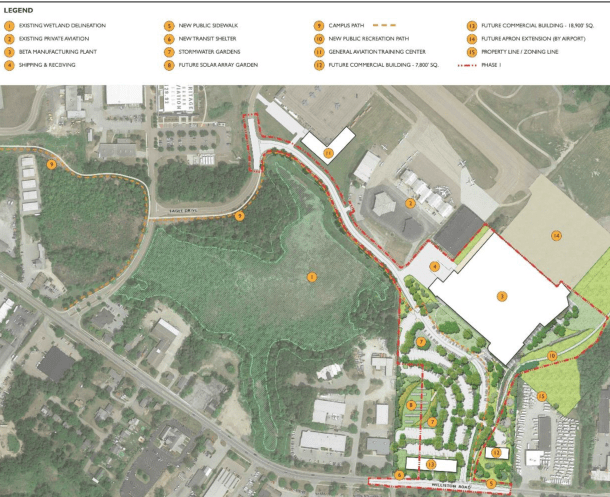
Electric aircraft maker Beta Technologies said the future of its proposed 40-acre campus off Route 2 at the southeast corner of Burlington International Airport “remains uncertain,” as it waits for the South Burlington Development Review Board to issue permits for the project.
The company’s other option would be Plattsburgh, New York, where it already has some aviation operations. But Beta officials insist they would rather be on the eastern side of Lake Champlain.
“This is an opportunity to bring hundreds of green, new jobs to the state and add to its legacy as a leader in clean energy,” Jake Goldman, a Beta spokesperson, said in a statement. “We want to stay here in Vermont so (we) are continuing to work with the City of South Burlington to find a quick resolution in hopes of keeping this site, and the jobs, here.”
The dispute centers on a piece of the city’s zoning code that bars new buildings from having parking lots at the front of their property. In this case, Beta’s immediate plans call for employee parking to sit between its planned 285,000-square-foot manufacturing facility and Route 2, also called Williston Road.
Beta officials argue that the parking lots have to be located there because their property abuts the airport. In addition to flirting with federal rules that limit construction near an airfield, a parking lot behind the manufacturing facility would interfere with Beta’s intentions to move its electric aircraft directly from the assembly line to an airport taxiway.
Beta’s long-range plans eventually call for a building between the parking lot and Route 2, documents filed with the city show. But for now, the company is asking for an exemption so it can start building the factory first.
After hearing proposals about how Beta could get around the zoning restriction — including a plan to designate the area between the road and the parking lot as a public green space — the Development Review Board approved the campus’s master plan — but declined to offer an exemption on the parking issue.
In an unusual move, however, the board voted to reopen Beta’s application on Tuesday. It is now scheduled to hold another hearing on April 25 to hear more testimony from company officials on why they should get an exemption.
The South Burlington permits are not the only determinant preventing Beta from constructing its mammoth facility. The company is in negotiations with the city of Burlington, which owns and operates the airport, to lease the site of the proposed building.
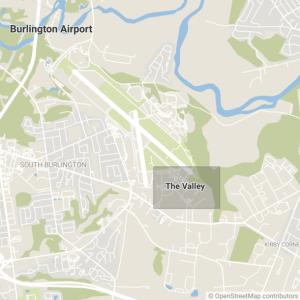
Beta’s expansion in the southeast corner of the airport — known as “the Valley” — stirred pushback from some nearby aviation companies, which expressed concern that the airport’s embrace of Beta came at the expense of their businesses. Airport officials and some of the proposed facility’s neighbors rejected those claims.
Beta already has its headquarters in South Burlington, at a new building it constructed next to the airport’s passenger terminal.
The company, founded in 2017, and its promise of “green aviation” have won over big-name partners such as Amazon, UPS Inc. and the U.S. military. It’s also become the darling of local and state leaders, who see the manufacturing facility’s anticipated 500 jobs as a boon for Vermont’s economy.
At his weekly press conference on Tuesday, Gov. Phil Scott implored South Burlington officials to approve Beta’s permits, comparing the aircraft maker’s expansion in Vermont to the establishment of IBM’s Essex Junction plant — a facility that is now run by GlobalFoundries, another electronic chip manufacturer.
If South Burlington does not let Beta through, Scott said, he would ask the Legislature to step in.
“This is too important for Vermont,” Scott said. “This is not just about jobs for Chittenden County. This is going to have a ripple effect across the entire state.”
Scott said he took seriously the company’s claim that it could pick up and move to Plattsburgh.
“They have an airport there. They have space available. They have everything that they need. And they could quickly, quickly change course, and go to Plattsburgh,” the governor said. “I just can’t let that happen. We can’t let that happen.”
Beta founder Kyle Clark said the close connection to Scott and other leaders is a key reason he located the company in his home state of Vermont.
“Having direct access to the governor, the senators and our congressman is incredibly helpful in a highly regulated environment,” Clark told Vermont Business Magazine last year. “The airport and the state have been phenomenal to us. … We want to put a charging system in Rutland? The state gives us a high five and says, ‘Go do it!’”
“We go into these other states and you have friction upon bureaucracy upon whatever,” Clark told the magazine. “But I said to the airport, ‘We want to build this thing out right here.’ They unblocked everything.”