

Great wealth often hinges on luck, the luck to be born into the right family, know the right people or go into the right line of work at the right time. Perhaps it’s no coincidence that fortune can mean either luck or money.
But often the recipients of great fortune — both kinds — don’t see the role luck plays and feel no compunction to share the wealth. That was certainly the case with many of the super wealthy during the Gilded Age of the late 1800s, an era of great financial inequality. It was a time when financiers and industrialists amassed stunning riches and there was no federal income tax.
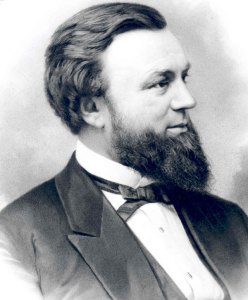
Yet there were some in Vermont during this era who saw that their great fortunes had given them tremendous power to help others. Take, for example, Frederick Billings. Born in Royalton in 1823, Billings grew up there and later in Woodstock. After attending the University of Vermont, Billings studied law and was admitted to the bar in Woodstock. But he wasn’t ready to settle down.
He traveled to California, arriving in San Francisco in the spring of 1849 just as the first wave of the gold rush hit, bringing thousands of prospectors to the region. Rather than pan for gold, Billings set up a law practice, said to be San Francisco’s first, and had as an early client John Sutter, on whose property that first gold was discovered.
Billings returned to Woodstock in 1861, at the start of the Civil War, and brought with him an interest in the growing field of railroads. He purchased one-twelfth of the Northern Pacific Railway, which was cutting a route to the Pacific, and later served as its president. His law practice had made him wealthy; his railroading investment made him fabulously so.
But Billings maintained an interest in Vermont. As a boy in Woodstock, he had lived near the mansion of George Perkins Marsh, the pioneering environmentalist. Having read Marsh’s groundbreaking book “Man and Nature,” Billings accepted its thesis that humankind was having a devastating effect on the land. How could he not? Billings saw the impact when he looked at the surrounding hillsides that since his childhood had been denuded of trees, the soil left to erode. The degradation reminded him of mining towns out West. Billings purchased the former Marsh homestead and began practicing principles Marsh preached.
Billings worked to reforest Mount Tom, which looms over Woodstock, and introduced European tree species — Norway spruce, European larch, and Scots pine — to the mix of trees that eventually spread across the hillside. He also sought to find ways to help move Vermont agriculture away from sheep farming, which was in steep decline. Vermont farmers couldn’t compete with Western farmers, who could produce wool more cheaply on their larger, more fertile properties. Billings bought Jersey milk cows and established a scientifically managed herd on his land. He saw dairy farming as the future of Vermont agriculture.
Billings also thought of his alma mater and his hometown. He built UVM a library and donated Marsh’s personal library to its collections. In Woodstock, he paid for reconstruction of the old Congregational Church. He also funded the building of a new church in Billings, Montana, which had been named in the railroad man’s honor.
His Woodstock home eventually passed to his granddaughter, Mary French. It is now the site of Vermont’s first and only National Park, which honors the conservation ethic of its previous owners, Marsh, Billings, and Mary and her husband, Laurance Rockefeller.
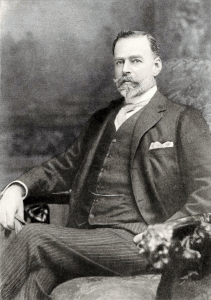
William Seward Webb left a similar legacy in Vermont, though that might not have been his intention. Webb was interested in horses and, like Billings, wanted to show Vermont farmers a better way. It’s just that those farmers didn’t agree that his way was better.
Webb believed the Hackney’s versatility made it a winner. Farmers could use the horses by day to pull their plows or by night and on Sundays to draw their carriages in style. On his vast Shelburne estate, Webb built a magnificent horse-breeding barn; it was large enough to hold nearly four football fields. But it was no good; Vermonters were wedded to their Morgan horses and saw no reason to switch.
Perhaps it’s no surprise that Vermonters cast a wary eye on Webb’s grand agricultural experiment. He wasn’t like them. Not by a long shot. Born in 1851 into a wealthy New York City family, Webb was educated by private tutors and later at a military school and at Columbia College. He went on to study medicine in Vienna, Paris and Berlin. Upon his return to the United States, however, he only practiced medicine for a few years before forming a Wall Street brokerage with one of his brothers.
Webb married the heiress Lila Vanderbilt, whose father asked him to quit the brokerage to run the Wagner Palace Car Company, which made train cars. Once in the world of railroading, Webb founded the Adirondack & St. Lawrence Railroad and later became president and principal shareholder of the Rutland Railroad.
Webb began amassing his estate in Shelburne during the mid-1880s. He bought up area farms and combined them to form his 3,800-acre property, which became known as Shelburne Farms. At the center of the property was that centerpiece of Gilded Age life, a grand mansion.
Webb eventually became interested in state politics. His wealth and station in society earned him respect. He won election to the state Legislature and announced plans to run for governor. But Republican leaders saw the move as presumptuous, feeling he hadn’t paid his dues. So Webb withdrew his candidacy.
Things went more smoothly on the farm, which the Webb family insisted promote the latest agricultural practices. Operating what was essentially an agricultural research center, the farm produced everything from eggs and meat to dairy products to fruits and vegetables.
The Hackney never caught on. Oh, well. Shelburne Farms continues today. Thanks to the leadership of Webb’s descendent, it is now an important nonprofit, environmental education center with a focus on sustainable agriculture.

Money came easily to Joseph Battell. Perhaps that’s why he was so generous with it. Battell, who was born in 1839 and grew up in Middlebury, inherited a fair fortune at a young age. The money apparently came from his grandfather, also named Joseph, who had been a wealthy merchant in Connecticut. The elder Joseph was said to be publicly minded, as was Battell’s father, Philip. Perhaps that partly explains Battell’s later openhandedness.
While a student at Middlebury College, Battell was diagnosed with weak lungs and sent to the nearby hilltown of Ripton to recuperate. He was so enraptured with the beauty of the hills surrounding his rented house that he decided to buy the home. He would later buy the hills as well.
Battell began inviting friends to visit him at his new farmhouse and eventually turned the home into a hotel, which he named the Breadloaf Inn.
Battell is said to have watched in horror one day as a logger cut trees in a nearby woodlot. The state was 80 percent deforested at the time and loggers were doing almost no replanting. Like Billings, Battell’s worldview had been transformed by Marsh’s book. He approached the logger and bought the woodlot on the spot. It was the beginning of a career in conservation. Battell used his great wealth to buy all the land visible from his inn, a swath running from Brandon to Waterbury. He would eventually amass more than 34,000 acres.
Late in life, Battell, who never married, began to give away his possessions. He gave the state the top of Camel’s Hump. And upon his death in 1915, Battell left Middlebury College the rest of his landholdings, roughly 30,000 acres, most of which are now part of the 629,000-acre Green Mountain National Forest.
Blessed with a fortune, Joseph Battell chose to spend it in a way that mystified some contemporaries.
“Some folks pay $10,000 for a painting and hang it on the wall where their friends can see it,” Battell explained, “while I buy a whole mountain for that much money and it is hung up by nature where everybody can see it and it is infinitely more handsome than any picture ever painted.”
