


Before Yana Walder would speak about her friends and family in Ukraine, she sent two videos, taken a day apart.
The first showed her friend, Yulia Korobchenko, a young woman, playing a somber yet hopeful song on the keyboard, singing to the camera, alone in a room. The video was recorded March 7.
The second showed the same room, the same piano. But the Russian army had bombed the building. The windowsill was ripped from the wall. Plaster and nails and dirt littered the floor. The keyboard sat in the same corner, still upright. It was March 8.

Since Russia invaded Ukraine in late February, Walder, 37, who grew up in Kharkiv and has lived in Vermont since 2011, has focused on little else.
The Montpelier resident is usually kept busy and social through her job in commercial real estate. She works with 300 tenants who know her face. Now, though, Walder feels isolated. Friends here cannot fully grasp what she’s going through. She hasn’t been leaving the house.
“I haven’t been able to work,” she said. “I can’t really eat. I also can’t sleep.”
Five of Walder’s family members — her mom, Olga; her sister, Irina, and Irina’s two kids; and her goddaughter, Anna Bozhenko — were all in Kharkiv (pronounced Har-kiv) when the bombings began. Roughly the size of San Diego and the second largest city in Ukraine, Kharkiv sits less than 30 miles from the Russian border in the northeastern corner of the country. It has been a primary military target of the Russians since the invasion began Feb. 24.
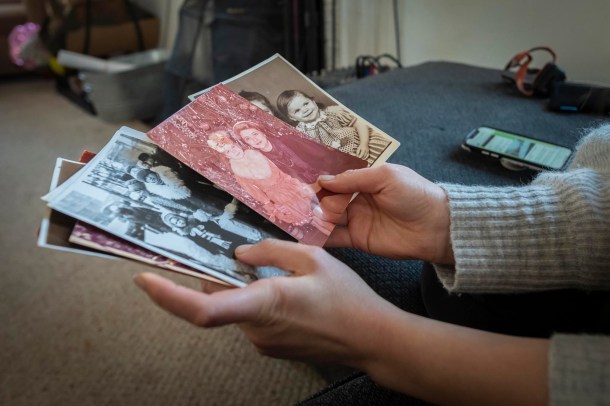
In the American media, the war in Ukraine is presented in a “bird’s eye view,” Walder said. It’s couched in terms of geopolitical struggle.
“But it goes so much deeper,” she said. “It’s like 100 levels down of slices of human pain.”
She wanted to tell some of those human stories, to describe some of the lives amid the unfathomable destruction.
For days, Walder’s family resisted leaving Kharkiv. Her mother had recently undergone hip surgery, and she had dogs to care for. Kharkiv was their home. They didn’t want to run.
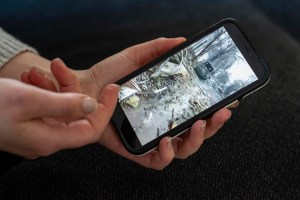
So Walder stayed on the phone with them all night, monitored news of air raids while they slept — some days the bombings never stopped — and tried to convince them to leave.
“I can’t even explain to you how traumatic it is to be on the phone with your mother as, like, this thing is hurtling towards her that sounds like a train is about to fly through the roof of the house,” she said.
After a night of shelling, Walder’s mom decided to leave. She couldn’t take the dogs, so she gave them to a friend to have them put down. After she fled the city, Walder’s mother learned the dogs had survived and been given a new home.
Walder’s goddaughter, Bozhenko, needed more convincing. But choosing to leave Kharkiv was only step one.
The first day after making that choice, she searched for gas — two gallons, which would get her to the train station.
“Then, they have the gas and the car, but no one is willing to risk their life to take them. So, they have to go from man to man, from house to house, asking them if he would drive them.”
She found a driver.
People swarmed trains headed out of the city, a sea of bodies fighting for a seat. Walder called a friend, who got her goddaughter on the train while it was being cleaned.
For 20 hours, the train traveled west.
Along the way, the crew made an announcement.
“They tell them to all turn off their cellphones, because what they’re afraid of is that a concentration of cellphone signals in one place will potentially be a target for the missiles, that the Russian military would specifically bomb them. So they have to turn off their cell phones.
“All the lights are off in the train, and it goes through the night, you know, just completely dark. For 20 hours, you don’t hear from her at all.”
At the Polish border, Walder’s goddaughter stood in line for another 20 hours. Every 20 minutes, she took one step forward. Temperatures fell below freezing.
“She has her little dog with her. It’s a pug. You know, it’s very small. And so the dog is freezing.
“A 5-year-old next to her, just a random kid, had a blanket with him, and he was covering the dog.”

‘One on one’
Now, Walder’s mother is safe in Poland, her goddaughter in Austria. Still, she focuses on Kharkiv.
“People in Kharkiv on the ground that I’m talking to, they’re like, ‘We don’t know, we don’t see it. We don’t see humanitarian aid,’” Walder said.
Through friends of friends, Walder has found four or five volunteers — “saints,” she calls them — who devote their days to solving human crises. Children need food, elderly people need medicine. The saints brave bombings to find necessities, scouring the country, even sourcing goods from Hungary and Romania.

“I’m trying to help with just one-on-one, small, just one person,” Walder said.
On Tuesday, Walder spent the day trying to find a bulletproof vest and helmet in Kharkiv.
She called someone with connections to the police. She called her brother-in-law, who has connections to a local university. The university connections sought military connections.
Ultimately, Walder could not find a vest. “There’s a huge shortage,” she said. “Our best bet is to order it from Georgia. And then, some weeks later, it will hopefully arrive in Ukraine.”
In less than two weeks, more than 2 million refugees have fled Ukraine. In Kharkiv, a city of 1.4 million, many who remain are the most vulnerable.
“We’ve got babies, pregnant women, elderly, disabled people, people who have mobility issues,” Walder said. “There’s whole nursing homes full of old folks and disabled people. So, like, right now I’m in touch with one that’s 189 people. And they haven’t gotten a delivery of food in two weeks, nor supplies, and they have a lot of people who are bedridden, so they need diapers and supplies and medications and injections and all that.”
Through her on-the-ground connections and an even deeper network developed through the messaging app Telegram, Walder hears what’s happening long before it reaches an American audience.
“A few hours ago, (the Russians) hit a hospital with a lot of pregnant women. It’s a birthing hospital. And, I mean, I have the pictures,” she said. “You’re gonna see the pictures. In a few hours, they’re gonna be all over the news.”
Thursday morning, those photos were everywhere.
What now?
“Ukrainians, Russians, none of them thought that this would ever happen. I mean, are you kidding me? Are we, like, in the 1940s? It’s unfathomable,” Walder said.
“My mom was born in Russia. My sister’s husband is Russian. Kharkiv is, like, the most Russian city.”
By the turn of the 19th century, Kharkiv had become a major industrial and cultural center. It was the first capital of Soviet Ukraine from 1919 to 1934, before Kyiv took that title.
But Kharkiv took a big hit during World War II. Much of it was rebuilt after the war. Its iconic Freedom Square, the second largest city-center square in Europe, was hit by Russian air strikes on March 1, the BBC reported.
Since Walder left in 2001, Kharkiv had revitalized its economy and become “Europeanized,” she said.
“For a few years, like, probably four or five years, I was sending money to even my girlfriends, like, people I went to school with who didn’t have money,” Walder said.
But now, most people she knows live a middle- or lower-middle-class life. Her mom traveled to Turkey and Egypt and built a savings. She declined an opportunity to move to the U.S. six years ago, saying life was going well at home.
No longer, though. And while Walder, unable to do anything else, spends near-every waking minute trying to help Ukrainians, she feels the U.S. is failing to live up to its words.
“It’s crazy that the U.S. positions itself like such a friend of Ukraine, and then they refuse (to give visas to) family of U.S. citizens,” Walder said.
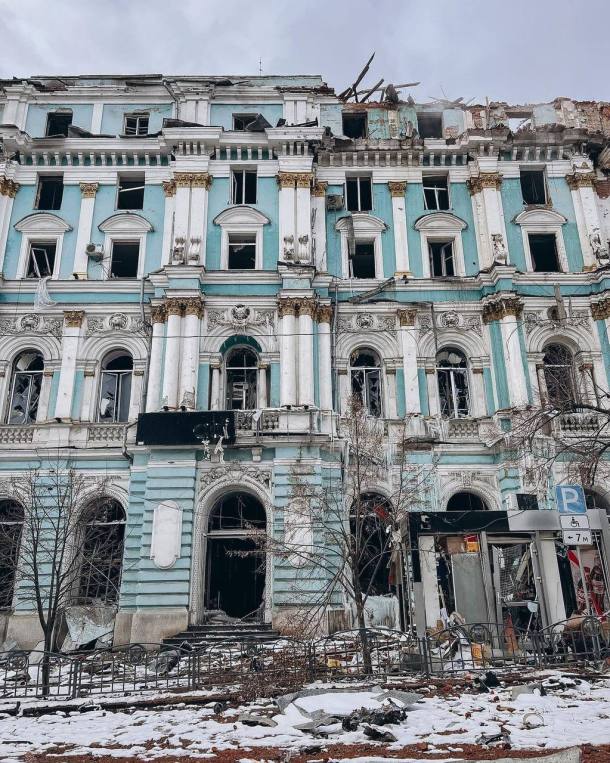
U.S. officials have recommended Ukrainians apply for tourist visas, as the refugee crisis and Covid-19 pandemic has caused a backlog of immigration applications. But White House press secretary Jen Psaki has insisted that the “vast majority” of Ukrainians want to be in Europe, and that the U.S. will support those efforts.
Walder’s mom has a U.S. visa appointment March 17, but Walder isn’t hopeful. Until then, her mom is staying with a friend of a friend in Poland.
In countries flush with Ukrainian refugees, such as Poland, Romania, Slovakia and Hungary, wait times at U.S. embassies for visa appointments have quickly grown from days to months, or in some instances nearly a full year.
On Wednesday, Walder heard that the Russian military had allowed the Red Cross to enter Kharkiv — the first NGO that had entered the city since bombings began. She has been collecting donations through PayPal and sending money directly to volunteers in Ukraine.
Thus far, she and her network have donated over $20,000, she said.
Meanwhile, the home for disabled people Walder has been working to help told her it costs $15,000 a month to feed its residents.
“I would love to be able to say, ‘Here’s $15,000. You guys are all set for the month,’” she said, but she can’t provide all that money herself. She welcomes any donations, but notes she’s not a nonprofit, so they are not tax-deductible.
The war will create orphans, and Walder is already looking into how she can adopt. “I’m definitely getting ready to bring some kids to Vermont,” she said. She might also start looking for other potential parents.
“Let’s bring 100 Ukrainian families to Vermont,” she said. “There’s such a shortage of labor in Vermont. Bring people in.”
Last week, Gov. Scott signed an executive order that read in part, “Vermont stands ready to welcome and accept any Ukrainians who need refuge while their nation fights for its freedom.”
Thus far, those words do not seem tied to any specific actions.
At Scott’s request, the Legislature this week expedited approval for $644,826 in aid to Ukraine.
Walder said she needs more than politicians’ words alone.
“I can’t do anything with your thoughts and prayers,” she said. “I need money; people need food.”

Corrections: Due to an editing error, an earlier version of a photo caption misstated the location of Walder’s friend who was injured in shelling. An earlier version of this story also inaccurately described the fate of Yana Walder’s mother’s dogs. Following publication, Walder learned that the dogs had survived.
