


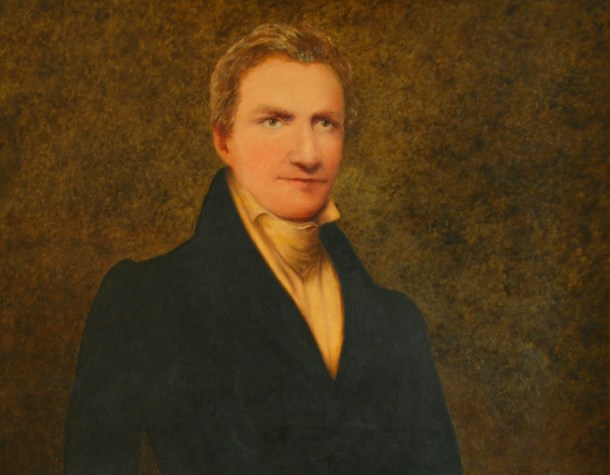
Matthew Lyon was a marked man. During his brief but tempestuous career in national politics, he had made loads of enemies. Now, in 1798, they seemed to have him cornered.
It was the severest form of political payback. Lyon was an outspoken critic of the Federalist Party, which dominated Congress and held the White House under President John Adams.
These were fraught times: The nation was girding for possible war with France and the Federalists would brook no dissent. To quash opposition, the Federalists had just passed the Alien and Sedition Acts, which created a raft of new punishable offenses.
The laws regarding aliens gave the federal government the power to arrest, imprison and deport foreigners. The new sedition law criminalized making “false, scandalous, and malicious” comments about federal officials.
The new law was aimed at the Federalists’ staunchest opponents, ardent Democratic Republicans, people like Matthew Lyon. He would become the first person tried under the sedition law.
Unbeknownst to Lyon, a federal circuit court had convened in Rutland, where a grand jury investigated whether Lyon had violated the sedition law. The jury, which was overseen by both a U.S. and a Vermont Supreme Court justice, handed up three indictments, each related to the publishing of anti-Federalist letters in newspapers.
Lyon learned in early October that a court officer was in his hometown of Fair Haven, looking for witnesses, and planned to arrest Lyon the following day.
“I had told him, if the court wanted me, he need bring no posse, he might come alone,” Lyon later wrote. “I would go with him, there should be no resistance.” The officer “accepted my word and honour as bail to meet him at Rutland court-house the next morning about nine o’clock.”
Riding the 15 miles from Fair Haven to Rutland to turn himself in, Lyon surely pondered his chances of beating the charges. Any hope dissolved when he entered the courtroom. Upon viewing the jury, Lyon wrote, he saw that jury members “were selected from the towns which were particularly distinguished by their enmity to me” — towns that were Federalist strongholds.
Lyon had no lawyer, nor was one provided to him. U.S. Supreme Court Associate Justice William Paterson said that, since he had no lawyer, Lyon had the right to postpone the trial until the court met the following May. But that hearing would be in Windsor. Lyon decided to take his chances in Rutland; in comparison, Windsor was crawling with Federalists.
Lyon said he didn’t know a lawyer he could trust in Rutland, so he sent a messenger to two lawyers in Bennington, asking if either man would represent him. The messenger returned with word that neither man would be able to represent him: one was tending to his sick wife, and the other was preparing to serve in the state Legislature’s upcoming session.
So Lyon represented himself. Israel Smith, chief justice of the Vermont Supreme Court, was observing the proceedings and agreed to assist Lyon, even though Lyon had defeated him in the congressional election two years earlier.

The district attorney began the trial by showing the jury a letter Lyon had written to Alden Spooner, publisher of the Vermont Journal, a Federalist newspaper in Windsor. In the letter, Lyon rebuked President Adams and his administration for violating the public trust.
Lyon’s language is rather convoluted, but gets his point across: “(W)henever I shall, on the part of the executive, see every consideration of the public welfare swallowed up by a continual grasp for power; in an unbounded thirst for ridiculous pomp, foolish adulation, and selfish avarice; when I shall behold men of real merit daily turned out of office, for no other cause but independency of sentiment; … and men of meanness preferred for the ease with which they take up and advocate opinions … when I shall see the sacred name of religion employed as a state engine to make mankind hate and persecute one another, I shall not be their humble advocate.”
The problem for the prosecution was that Lyon had written the letter on June 20 and it bore a July 7 postmark, which was a week before Adams signed the sedition act into law. But the letter wasn’t published until July 31. It hardly seems a coincidence that it was a Federal newspaper that had held off publishing the letter until after the sedition act became law.
The second and third charges involved Lyon’s publishing of a letter by Joel Barlow, an American expatriate living in France, in his elaborately named newspaper The Scourge of Aristocracy and Repository of Important Political Truth.
Barlow, who was pro-French, criticized the United States’ actions toward France, singling out a “bullying speech” by Adams and the “stupid” response from the Senate. Barlow said the proper response for Congress would have been to consign Adams to “the mad house” for his speech, but “(i)nstead of this the senate have echoed the speech with more servility than ever George the third experienced from either house of parliament.”
In his defense, Lyon challenged the constitutionality of the sedition law, because it violated the First Amendment’s protection of free speech. Judge Paterson rejected Lyon’s claim, stating that the question was outside the scope of this court. Lyon then argued that he lacked the “bad intent” required for conviction under the acts. Finally, he argued that he couldn’t be convicted because what he had written and published had been true.
To prove his last point, Lyon asked Paterson, who had dined with President Adams, whether he had noticed any “ridiculous pomp and parade.” The judge said he had seen no excessive formality. Then Lyon asked whether he had witnessed “more pomp and servants there than at the tavern at Rutland” where Paterson was lodging.
The Aurora, a Jeffersonian newspaper in Philadelphia, reported the exchange: “The judge, conscious that there was some difference between the table at Braintree (Adams’ home), and the humble fare of a country tavern, with the privileges of half a bed, made no reply, but smoked a cigar.”
The jury took only an hour to convict Lyon. In sentencing Lyon, Justice Paterson noted that the sedition law called for more lenient punishment than judges could mete out under common law. Still, ignoring Lyon’s claims of poverty, the justice fined him $1,000 and ordered him jailed for four months.
Lyon was shocked. He’d expected a fine, but not one quite so stiff. And he never thought he’d be imprisoned.
Lyon was dragged off to a cold cell in Vergennes, from which wrote a widely published letter complaining about conditions at the jail.
That, the Federalists must have thought, was the end of Lyon. But his name stayed on the ballot, and his newfound celebrity as a political martyr helped make him a folk hero and win him reelection to Congress. When he left jail, Lyon rode back to the capital in Philadelphia. People in towns along the way were said to have flocked to the roadside to watch him pass.
The sedition part of the Alien and Sedition Acts expired in 1800. Some of the restrictions on foreigners in the alien acts are still in effect.
Decades after Lyon’s conviction, his heirs petitioned Congress to repay the cost of the fine, plus additional expenses the congressman incurred due to his imprisonment. In 1840, after years of appeals, Congress finally acquiesced, agreeing to reimburse the full cost. Plus interest.
