

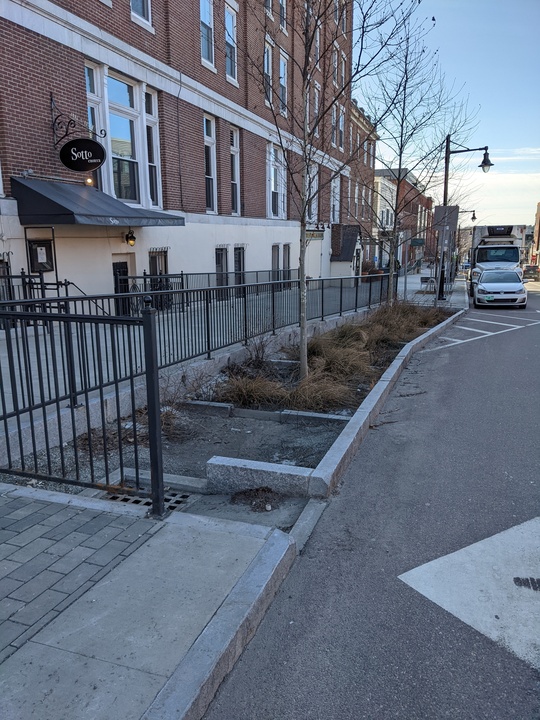
A runoff collection garden on St. Paul Street — the type that Burlington officials say they would add to Main Street if voters pass a $25.9 million TIF bond — is seen on Feb. 24, 2022. Photo by Jack Lyons/VTDigger 
A parking lot owned by the city of Burlington at the corner of Main Street and South Winooski Avenue is seen on Feb. 24, 2022 Some 20 to 25 feet below it, a centuries-old sewer would need to be replaced before development can occur on the lot. Photo by Jack Lyons/VTDigger
BURLINGTON — To finance a series of upgrades along Main Street in the coming years, city officials are asking voters to support a $25.9 million bond — the fourth question on the ballot — in the March 1 election.
Their pitch? It would have no projected impact on the property tax rate — something made possible through a complex fiscal mechanism called “tax increment financing,” or “TIF.” The system allows Burlington to pay for the improvements using tax dollars from new development generated by the upgrades instead of from existing properties.
The catch? To get enough money to pay off the loan, the city needs to attract a certain amount of development in its “TIF district” — the defined area where the mechanism can be used — within the next decade and a half. If it doesn’t, voters could potentially be on the hook for paying some of the bond back.
Given the TIF district’s success in an existing project, that outcome is unlikely, said Brian Pine, Burlington’s community and economic development director.
When the city started its downtown TIF district in 2011, its taxable value was $172 million. Since then, it has grown 60% to a value of $280 million, Pine said.
That rate of roughly 6% growth per year far outpaces the 1% rate the district needs to pay off the bond, according to Pine, leaving the city with a significant surplus in TIF tax revenue.
By 2036 — when the TIF district is set to close — the city hopes to see more than 200% growth, with a final value of $375 million, Pine said.
Not all of that added tax value goes toward the city. Under Burlington’s TIF model, 25% of the new tax revenue generated through development goes toward the state education fund.
But where has the 60% growth coming from? Much of it stems from new developments that have sprouted up along St. Paul Street, where the city completed upgrades in 2018. On that north-south thoroughfare into downtown, the city expanded sidewalks, added runoff retention areas and built pedestrian-friendlier crosswalks.
If the proposed bond passes Tuesday, city officials plan to embark on similar projects along Main Street from its intersection with South Union Street to its terminus at Battery Street. In alignment with the city’s “Great Streets” blueprint, Main Street would get expanded bike lanes, more places for pedestrians to sit and parallel instead of diagonal parking.
The infrastructure work would also tackle a century-plus-old relic sitting deep beneath downtown: the “ravine sewer.”
In the late 1800s, Burlington covered up a natural ravine that divided the city’s downtown from what is now considered the Hill Section. Topped with redstone brick, the ravine sewer then acted as a conduit into Lake Champlain, near the bottom of Maple Street, according to The Burlington Free Press.
More than 150 years later, the structure is still there, 20 to 25 feet underground, according to Department of Public Works engineer Laura Wheelock. The sewer runs from a city-owned parking lot at the corner of Main Street and South Winooski Avenue toward the King Street dip.
For development to occur on top of that parking lot area — which is part of what officials call the “Gateway Block” — the city first needs to relocate or rebuild the sewer, Wheelock said.
With repairs being made to the streetscape, some residents have wondered in public meetings whether improvements made near their building will cause property taxes to rise. But Wheelock said the assessed value of a building fluctuates more when changes are made inside, not on its streetfront.
“That’s not really what’s driving property values at the moment,” she said.
