

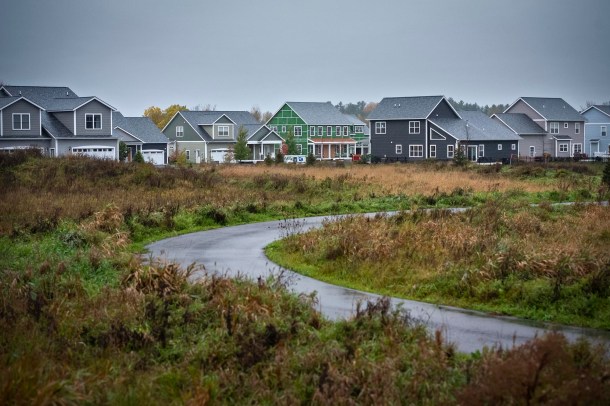
Less than a month after the South Burlington City Council blocked development on swaths of land in the city’s southeast quadrant, the competition to occupy two of the body’s five seats has become a sort of referendum on that decision.
Two incumbent candidates who voted to enact the regulations — Meaghan Emery and Tim Barritt — face challengers who opposed the zoning amendments, Chris Trombly and Linda Bailey.
Emery and Trombly are squaring off for a two-year term on the council, while Barritt and Bailey are competing for a three-year seat.
In interviews with VTDigger, three of the candidates said they are running on more than just the land use regulations. Yet they also acknowledged that the zoning amendments are a top issue in the races. Barritt did not respond to multiple interview requests.
The City Council passed the regulations in a 3-2 vote earlier this month, setting aside roughly 1,000 acres for conservation in the city’s more rural southeastern corner.
A three-year effort that was unanimously approved by the Planning Commission, the zoning changes encouraged development to be concentrated in the city’s “priority areas” and called for any development in the southeast quadrant to be planned in clusters that conserve “open space, natural resources, scenic views and agricultural uses.”
Emery, who voted for the regulations, said the measures were a balanced way to address two emergencies facing the city: a climate emergency and a housing one.
Allowing more development in the southeast quadrant would endanger wetlands that are important to the city’s ecology, Emery said, and worsen the city’s “tax revolt,” where wealthier homeowners tend to reject the city’s school budget.
“It’s a big picture. There are many moving parts,” Emery told VTDigger, comparing the focus on developing the southeast quadrant to a “fetish.”
To help meet the city’s housing goals, Emery proposes that the council work with local affordable housing nonprofits to boost the city’s residential stock rather than rely on private developers.
“The private developer — as much as they’re integral to our economic base — they are not able to solve this housing crisis because we are growing. We are desirable,” Emery said. “We are seeing locals being outbid by people moving in from California and the private developer … they’re not gonna stop the bidding war.”
But to Trombly, Emery’s opponent, the regulations only served to exacerbate the city’s housing shortage.
“The new regulations remove 350 housing units in our wealthiest section of town at a time of a housing crisis. That just doesn’t make a lot of sense,” said Trombly, who chairs the city’s affordable housing committee.
Trombly also countered Emery’s assertion that South Burlington schools are at capacity and need to be expanded, saying the only major work the buildings need is deferred maintenance projects.
The two agree, however, that South Burlington needs more housing for the young workers who take jobs at the city’s fast-growing technology companies.
But when asked about Trombly’s approach to adding more housing, Emery’s criticism toward her opponent — and for how local media has framed their race — was withering.
“What I am most concerned about, is the black eye that … my city, that I love, has gotten,” Emery said, “and it’s because of newcomers who run for office who are blind to the manipulation and the forces at work there to advance interests that are not in the best interest of our city.”
Trombly, who moved to the city three years ago, said he did not appreciate Emery’s rhetoric and has tried to run a positive campaign.
“To make exclusionary statements that, ‘You’re not qualified because (of) how long you lived here’ … I don’t know. We should be at a time where we’re bringing more voices to the table, not discouraging them,” Trombly said.
Bailey, who is taking on Barritt for the three-year council seat, has painted herself as one of those new voices. A first-time political candidate, Bailey said she hopes to shake up the council’s makeup since she — like Emery — lives in the Chamberlin neighborhood near Burlington International Airport. Barritt and three other councilors live in the southeast quadrant.
Bailey said she opposes the new zoning regulations because they were not vetted well enough and could lead to unforeseen consequences — a notion city officials dismiss. More broadly, the nine-year resident of South Burlington wants to make it easier to build housing in the city.
“I think that it would be a good plan to look at all of this and try to see, ‘How can we still make good, honest, solid houses and solid neighborhoods’ but not be quite so complicated and expensive,” she told VTDigger.
Bailey also expressed concern about who would benefit most from the southeast quadrant zoning amendments. If the city adds more open space in an area that’s less accessible to residents from more densely populated neighborhoods, it essentially becomes a “private park,” she said.
The campaigns to unseat Barritt and Emery have galvanized southeast quadrant residents. One group, called “Voices of the Environment,” launched a political action committee and has raised more than $8,000 to support the two incumbents, according to a disclosure it filed Sunday.
The group — whose top contributors live in southeast quadrant developments near Vermont National Country Club — has spent nearly $7,000 so far, most of it on advertisements in The Other Paper, South Burlington’s community weekly.
The group is registered under Noah Hyman, a southeast quadrant resident who lives on a 33-acre parcel off of Dorset Street, according to city property records. The homestead sits near land that was conserved through the zoning regulations.
Emery and Trombly lamented the group’s efforts to sway the race, saying that the controversial vehicles for campaign finance are not a good match for local politics.
“I don’t know that that’s a net gain for our community,” Trombly said. “It seems to be introducing a negative tone to our elections.”

