


Before the start of this school year in August 2021, Gov. Phil Scott’s administration proposed a way for students to return to classes without masks: Schools should only mandate masks, the state recommended, when their Covid-19 vaccination rate among students was below 80%.
“We’ll have more vaccine clinics in schools, leading up to and after classes start. We hope this inspires parents to do the right thing and sign their kids up,” Scott said at the time.
That plan was never enacted. Shortly after he made his announcement, Covid cases were propelled higher by the Delta variant surge, forcing officials to delay that part of their guidance to schools and instead continue to recommend masking for all students, regardless of vaccination rates.
The state has extended that delay each month since then — until now. On Tuesday, Scott said he would tell schools to return to that original mask guidance Feb. 28, citing the waning Covid cases and hospitalizations statewide as well as the high vaccination rate across Vermont’s general population.
At least seven other states have moved to end mask mandates in their schools, including some led by Democratic governors in the Northeast.
“Given our nation-leading vaccination rate, no place in America is in a better position to make these changes than Vermont,” Scott said.
Scott said he doesn’t yet know how many schools have hit that 80% threshold. About 60% of 5- to 11-year-olds and 77% of 12- to 17-year-olds have received at least one dose of the Covid vaccine, according to the Department of Health.
But Scott also teased the possibility of further reducing the state’s masking guidance for schools in the coming weeks. “The 80% guidance will be the first phase in a process,” he said.
“In the very near future, if all goes to plan, we intend to recommend lifting the mask requirement recommendation altogether,” he said.
Just as schools could opt to not follow Vermont guidance on mandating masks, schools can decide to continue their mask mandate despite state guidance, Secretary of Education Dan French said.

Scott cited the need for kids to return to normal as justification for the upcoming change.
“The ongoing strain on our kids’ mental health is far outweighing the risk from Covid amongst this age group,” he said on Tuesday.
He said at a previous press conference that he talked to one parent who said their daughter had never seen the full faces of their friends at school.
“I thought, how sad is that? That they’ve been in school now for two years. They don’t know what their classmates look like or the expressions on their face,” he said. “And it’s a big part of this social interaction.”
He also said “many public health experts” have been advising schools to move away from mask mandates. A group called the Urgency of Normal, led by a group of doctors, has advocated for an end to mask mandates. The governor’s spokesperson cited an op-ed quoting the group when VTDigger contacted his office.
But many other public health experts continue to support school mask mandates. The Centers for Disease Control and Prevention still recommends them. The American Academy of Pediatrics recently reiterated its support for school masking.
In recent weeks, an open letter expressing support for masks in schools has amassed hundreds of signatures from doctors, public health officials, researchers and other experts.
One of the signatories was Anne Sosin, a policy fellow of health equity at Dartmouth College who has criticized the Scott administration’s response to the virus since the Delta surge began. She called the decision “premature.”
“(It) threatens to reverse the progress that Vermont has made in ensuring safe and stable in-person education,” she said.
She said she’s confident Vermont will get to a point where it’s safe to relax mitigation measures, but “data should guide decision making, and the data doesn’t yet support a shift in guidance.”
The state is still reporting about 260 Covid cases a day, and more than 50 people were hospitalized with the virus as of Thursday. That’s far below the record of more than 1,800 cases per day set during Omicron, but far above the less than 20 cases per day at the low point last summer, with single-digit hospitalizations.
Dr. Harry Chen agrees. The former Vermont health commissioner and current chair of the Vermont Covid vaccine advisory board said a lot could change in the next two weeks and beyond that.
Chen’s major concern, he said, is that Scott set a “certain” date of Feb. 28. “It just basically says, ‘Rather than the numbers and looking at the status (of Covid at that time), let’s just change things by the end of February,’” he said.
Sosin said the vaccination threshold set by the state guidance would not be enough to prevent Covid transmission. She pointed to recent evidence from Massachusetts where a highly vaccinated high school reported an explosion in cases ahead of the December 2021 holidays.
She also said a recent study published in the Journal of the American Medical Association that modeled Covid transmission in elementary schools found local case rates would need to be much lower to limit transmission, even with a highly vaccinated student body.
As to Scott’s stance that kids need to get back to normal, Sosin said, “I would say that Covid, not the mitigation strategies employed to control it, is what is preventing a return to normalcy.”
“Covid caused widespread disruption in our schools over the last several months, and we shouldn’t delude ourselves into thinking that removing mitigation strategies is going to return us to a pre-pandemic situation,” she said.
Although many have claimed that masks are harmful to children’s development, she said that pediatricians with expertise in the subject have argued the data does not support that claim.

Dr. Rebecca Bell, the president of the Vermont chapter of the American Academy of Pediatrics, said via email, “there are no compelling data that I am aware of that show masking is harmful to child development or psychological well-being.”
Recent studies have found that children can still infer emotions from people wearing masks, that infants recognize words spoken through masks and that masks do not interfere with preschoolers’ language development. The CDC also cited research showing that masks do not affect childrens’ heart rate or oxygen levels.
Asked about the evidence showing that masks were causing harm, Scott’s spokesperson Jason Maulucci said via email, “The leadership team made it clear this decision was based on numerous factors, and the anxiety and fear that’s built over two years of a pandemic, not boiled it down (to) one cause.”
He also cited the governor’s examples at the press conference of schools that have taken other strict measures to limit transmission in schools, such as preventing children from talking to each other in the cafeteria or limiting their interactions at recess.
“Children are at very low risk of poor outcomes from Covid, yet they remain one of the only populations left regularly experiencing mandated restrictions,” he said.
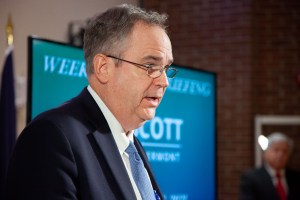
Asked at the press conference if state officials were targeting any guidance at the schools taking those measures, French said, “We were trying to approach this in a general way. Certainly we hear instances of these things.”
Some children do find masking to be “difficult and cumbersome,” Bell said. “We should be thoughtful about when and why we require masking.”
But at this point, she said she is recommending school officials follow the Vermont Department of Health guidance on universal masking, rather than the Agency of Education guidance.
“If (the Department of Health) changes its masking guidance for the general public based on trends in cases, hospitalizations, and (intensive care unit) capacity, then schools can mirror that guidance,” she wrote.
As a former school board member, Chen said he’s concerned about the pressure placed on school officials to make the decision about ending mask mandates.
“I think it’s an unnecessary burden to be put on school boards,” he said.
“Obviously, this coronavirus has thrown us many curves and will continue to throw us curves, so I think it’s just important that we try to kind of embrace it, acknowledge the science, but also acknowledge that there’s a lot we don’t know,” he said. “And to the extent that we can keep it focused on the science and not on politics, it would be a benefit to us in the end.”
