

Editor’s note: This story by John Lippman was originally published in the Valley News on Feb. 16.
WHITE RIVER JUNCTION — A project to build a low-income housing residence next to a planned shelter for the homeless has hit a setback this week that has one of the partners “assessing” a plan that was meant to help relieve the paucity of labor-class apartments in the Upper Valley.
The Hartford Planning Commission at its meeting on Monday denied a proposal by nonprofit Twin Pines Housing Trust to build 18 one-bedroom apartments for low-income tenants on a parcel of land to be acquired from St. Paul’s Church on Route 5 in White River Junction.
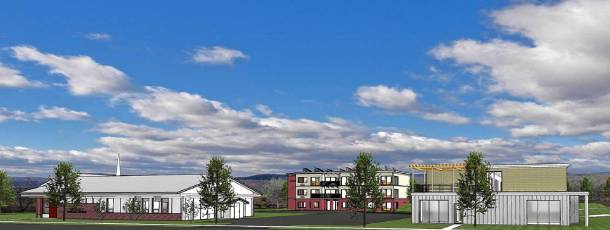
As unveiled last December, the apartments would be co-located with a building with 20 emergency shelter beds and social support programs run by Upper Valley Haven, which also would acquire a parcel of land from St. Paul’s adjacent to its anchor facility on Route 5.
“We’re both surprised and disappointed by the commission’s decision,” Andrew Winter, executive director of Twin Pines Housing, said Tuesday. “This just came down. We’re assessing our next steps on the project,” which he might include seeking a rehearing before the commission.
At the Monday planning commission meeting, six of the board’s seven members voted down Twin Pines’ proposal, saying it did not comply with all the criteria of a planned development, in particular those requiring the preservation of trees and “natural topography.”
Perhaps most critical for determining whether Twin Pines will eventually build at the St. Paul’s location, the commission also turned aside the nonprofit’s request for a “density bonus” that would allow it to exceed current zoning to add four additional apartments — bumping the total from 14 to 18.
At Monday’s meeting, the commission did, however, approve a boundary line adjustment and subdivision of St. Paul’s property that are meant to pave the way to transfer each of the parcels to The Haven and Twin Pines.
The Haven has not yet submitted its plans for the building it plans for the parcel to be acquired from the church, which would have the dual purpose of providing offices for the Haven’s staff and space for social service programs.
“That will be taken up at a future date,” said Michael Redmond, executive director of the Haven.
When the plan was announced in December, the three nonprofits trumpeted it as an innovative way to address the crisis in both low-income, below-market-rate housing and beds for people without a home.
The upshot of the proposal would be to expand the Haven’s “campus” on Route 5, where makeshift cots are set up to accommodate the influx of displaced people, especially during the cold winter months.
The Haven and Twin Pines also see co-locating their respective buildings as a way to foster inter-agency cooperation for vulnerable populations, such as a person who initially arrives at the shelter getting on a priority list for an apartment in Twin Pines’ low-income housing if they are working and can pay the rent. (The state manages the “coordinated entry list” that moves homeless people out of shelters and into apartments, and Winter said state officials had given their OK for the “priority” concept for Haven-Twin Pines residents.)
Leslie Black, chair of the planning committee at St. Paul’s, said that given shelters for homeless people are a “hot-button issue,” she was bracing for pushback on that front but was “quite surprised, really,” over objections of residents to Twin Pines’ low-income housing proposal.
“This is 18 people with jobs who have to keep their lives together to stay in the apartments,” she said. “We’re not talking about people just sauntering in off the street to live in the building.”
One of the objections expressed by area residents was that Twin Pines’ plan to have a flat roof on its apartment building would be out of character with the neighborhood, which includes many single-family homes with pitched roofs.
Winter said a flat roof would facilitate the installation of solar panels.
On Tuesday, Winter said that being able to co-locate a Twin Pines low-income housing apartment building with the social services and shelter offered by The Haven made the St. Paul’s site on Route 5 “an ideal location.”
“If we go elsewhere, we lose that,” he said.
Still, Winter said he is not yet giving up.
“This is a disappointment,” acknowledged Winters, who had a visibly pained expression on his face in the video of Monday’s meeting as planning board chairman Bruce Riddle polled the five other members — a sixth was not present — and each echoed “no” in succession. “But this is just the first round.”
