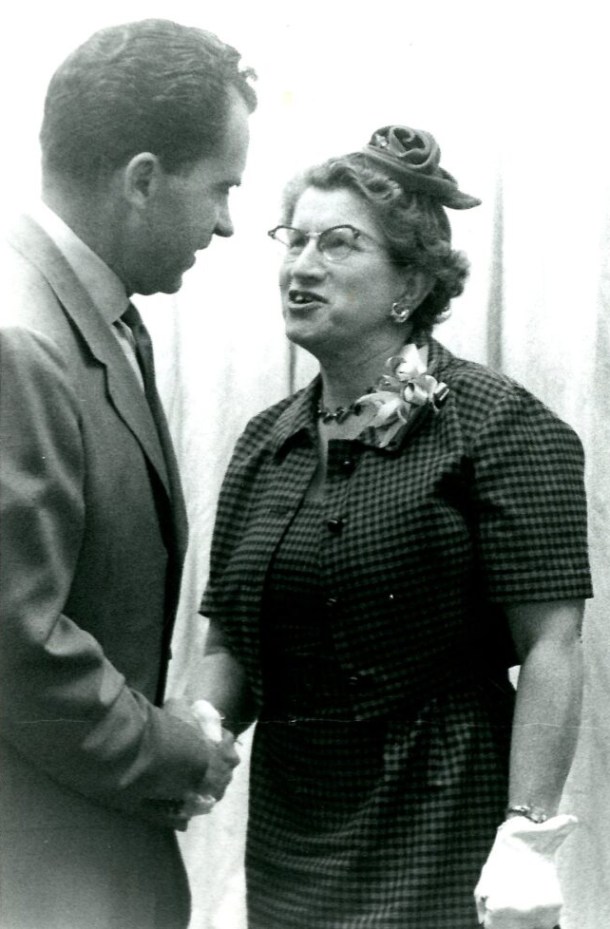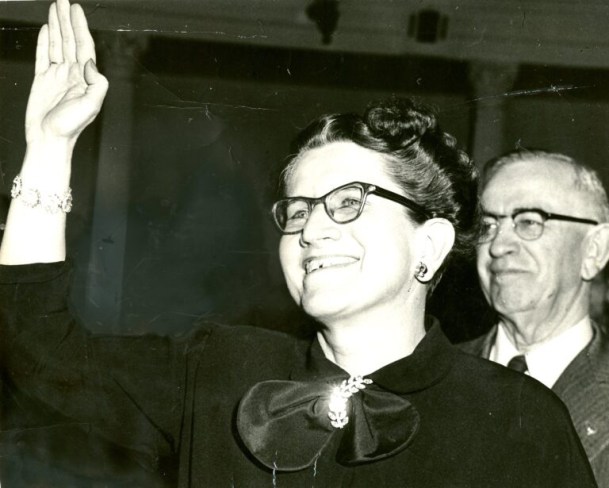
Three prominent women politicians are currently running for Vermont’s lone seat in the U.S. House of Representatives. If one of them wins, it would be, remarkably, the first time the state has sent a woman to represent it in Congress.
Things aren’t much better for women among the top offices at the state level. In Vermont’s 243-year history, 165 different people have served in the highest state offices of governor and lieutenant governor. Only four of them have been women, including current lieutenant governor Molly Gray, who is among those running for Congress.
At the time Gray ran for lieutenant governor in 2020, it had been almost 30 years since the last time a woman, Lt. Gov. Barbara Snelling, had served in one of those offices.
Madeleine Kunin is still the only woman to be elected governor of Vermont, serving from 1985 to 1991. When Kunin ran for lieutenant governor in 1978, she had to look back another 24 years to Consuelo Bailey, the previous woman to win election to that office.
And when Bailey ran, well, she had no woman to look to for a precedent. It was men all the way back.
What gave Bailey the idea that she could do what hadn’t been done before?
When Bailey was born in 1899, women couldn’t even vote. But, she would go on to win votes from many Vermont women, and men, to become one of the state’s most powerful politicians.
Consuelo Bailey began life as Consuelo Northrop, one of three daughters in a prominent farming family in the Franklin County town of Fairfield. She was related, through her father, to Peter Bent Brigham, a Franklin County native who bequeathed his fortune to found a Boston hospital that still bears his name. Her father, Peter Bent Brigham Northrop, served as a state representative.
The Northrops don’t fit any stereotype one might have of rural farm families at the turn of the century. The family valued girls’ education, even renting a house in St. Albans so their daughters could attend the local schools. The sisters all attended the University of Vermont. Consuela graduated Phi Beta Kappa in 1921.
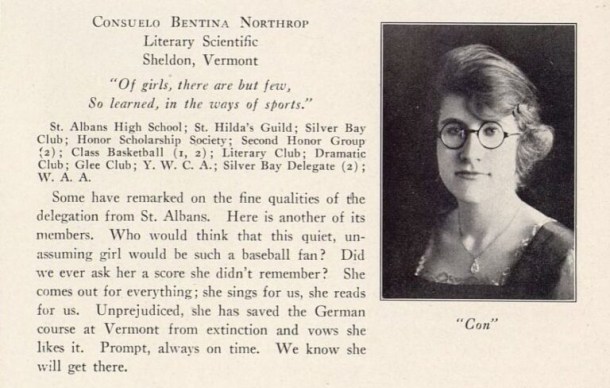
Peter Northrop had a special relationship with Consuelo. He projected his dreams onto his middle daughter, who he called his “only boy.” Peter had wanted to attend law school, but health and financial issues got in the way. After Consuelo graduated from UVM, he urged her to go. She was one of 25 women among a class of 1,000 at Boston University School of Law.
Burlington’s prosecutor
Consuelo returned to Burlington in 1925, passed the bar exams, and soon won appointment as city grand juror when the previous grand juror retired. The job meant she would act as Burlington’s prosecuting attorney.
In 1926, she took her first stab at public office, running for state’s attorney. It proved tough sledding at times. She remembered an elderly voter asking whether her hair was bobbed in the fashion of more liberated women of the day. Consuelo took off her hat to show that her hair wasn’t short. “If it was, I wouldn’t vote for you,” he explained.
Consuelo found herself being judged for things more permanent than her hairstyle. One night she stopped by a farmer’s milking parlor to ask if he would vote for her. “Nope. Court’s no place for a woman,” he said, “and you’re too young anyhow.” She was only 27, after all. But she won despite the obstacles of youth and gender.
Two months into her first term as state’s attorney, Consuelo was called to her first homicide scene. She entered the farmhouse where the crime occurred and looked down “at the small body of a woman, lying face down on the floor in what seemed to me at the moment an ocean of blood.” The local men who had crowded into the farmhouse that night seemed less interested in the body on the floor than the scene they expected this state’s attorney lady would make when she saw it.
But Consuelo disappointed her audience by quietly going about her job. She never got the chance to try the killer, the woman’s husband, as he was deemed insane and packed off to an asylum.
Later that year, however, she became the first woman to prosecute a murder case in Vermont. She got the defendant, a rumrunner accused of killing a federal agent, convicted of second-degree murder. As an ardent supporter of Prohibition, she must have been especially pleased with the verdict.
On to the Legislature
Despite her successes as state’s attorney in Burlington, she saw her future in state government in Montpelier. She ran for and won a state Senate seat from Chittenden County as a Republican. At the time, she was one of only 13 women in the Vermont Legislature and the youngest woman ever elected to the state Senate.

After serving one term, she left the state Senate and worked for seven years as executive assistant to Ernest Gibson Sr., a U.S. senator from Vermont.
While on Gibson’s staff, she began to work for the national Republican Party, becoming a national committee member in 1936. For the next four decades, Consuelo served on committees drafting GOP platforms and organizing national conventions. She was even a speaker at one convention.
In 1941, she married Henry Albon Bailey, a prominent lawyer and Republican politician. When the city of Winooski broke off from the town of Colchester in 1923, Henry Bailey had become the city’s first mayor. For years, the couple practiced law together at Bailey & Bailey.
Consuelo Bailey returned to the Statehouse in 1950, this time winning a House seat. She wasted little time trying to move up the ranks. Upon winning reelection in 1952, Bailey decided to push for the office of speaker of the House. She had two months between Election Day and the start of the legislative session, when the new speaker would be selected by lawmakers. During that time, she planned to travel the state to meet personally with 243 of the 245 state representatives to ask for their vote.
The only legislator, other than herself, who she didn’t have to lobby was her sister Frederika Northrop Sargent, who held the seat once occupied by their father.
U.S. Rep. Charles Plumley told Bailey, who was a distant cousin, that she had no chance of winning. But U.S. Sen. George Aiken viewed things differently. Seeing her car pass by one day in the midst of a snowstorm, Aiken decided she was working hard enough to win. Aiken’s instincts proved correct.
Recalling her campaign for House speaker, Bailey wrote in her autobiography “Leaves Before the Wind”:
“The members of the 1953 House, unlike today’s reapportioned Legislature, were mostly farmers, housewives, country lawyers, doctors, ministers, village grocers, teachers and town officials. At that time Vermont had 377,747 inhabitants, and our government operated on a more neighborly and intimate basis than it does today. I could and did call the members by their first names. I had sought them out scattered as they were over the state’s 9,528 square miles and had driven five thousand miles in the process. But like everything in life worth doing, it was worth the necessary effort to accomplish the objective.”

Her election made national news. Life magazine declared in a headline: “Vermont Ladies Are Taking Over,” even if they still held barely 20 percent of House seats. A secondary headline read: “Bring Out Flowers, Hide the Spittoons.”
“Under Mrs. Bailey’s strong gavel and firm gaze,” Life wrote, “the House pays proper attention to business and furthermore the menfolk mind their talk and manners. Of the women’s performance, one of their grizzled male colleagues has paid the ultimate tribute: ‘They ain’t any worse than men.’”
The magazine hinted that Bailey might have a great future in politics: “There are many, however, who are sure her speaker’s job is merely a waystop. Her hometown of Fairfield was the birthplace of President Chester A. Arthur.”
Tireless campaigning
After serving for two years as speaker, Bailey saw a chance to win the lieutenant governor’s race. She again campaigned indefatigably, traversing the state, giving speeches, knocking on doors and winning cow-milking contests against her rivals.
In the end, the strain of campaigning made life almost surreal. One day, Bailey noticed the name of an old friend from the GOP in the obituaries. She found time in her campaigning to attend the service. When it was over, she wrote, “I saw the lady whose funeral I thought I was attending come down the aisle!” In her exhaustion, she had misread the obituary.
On Election Night, Bailey posed for photographs at her home with her husband and sister. The photographers snapped shots of her playing the organ and doing housework. She found it funny. Her nonstop campaigning had kept her from doing either for a long time.
Her election again attracted national attention, which was understandable: Consuelo Bailey had just become the first woman ever elected lieutenant governor in the United States.
The Worcester Telegram in Massachusetts wondered what would be her next step, asking in a headline: “Will Vermont’s ‘Connie’ Bailey Become First Woman Governor In N.E.?”
But it was not to be. Bailey never tried. The state wasn’t ready for a woman governor, she later said. Consuelo Bailey, who had shown how far a woman could go in Vermont, could go no further.
Correction: This column has been updated to recognize Barbara Snelling’s role in Vermont history.