

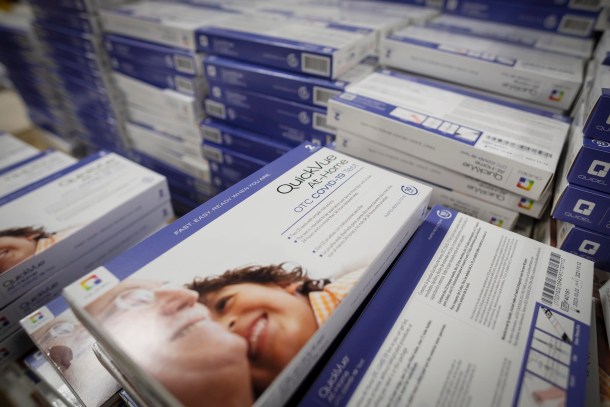
About 350,000 at-home antigen tests are on their way to Vermonters’ mailboxes as part of a state pilot program in partnership with Amazon and the National Institutes of Health.
Readers have written to VTDigger to ask how the antigen tests would hold up if left for an afternoon or overnight in cold weather. Some antigen test kits, such as the QuickVue one sent through the pilot program, specify that the tests should be stored above freezing temperatures.
“We encourage people who have questions about storage and transport conditions to consult the test manufacturer’s instructions for use or the product insert,” Jason Maulucci, a spokesperson for the governor’s office, said via email.
At a press conference Tuesday, Health Commissioner Mark Levine said there are worries about tests being exposed to cold temperatures, although he emphasized the concern was for “prolonged” periods of time.
“We’re trying to get a better handle on what that means exactly, ‘prolonged,’ and how much work (manufacturers) have done to understand it,” Levine said. “They’ve tried to give us an indication that this is not something we should be overly concerned about.”
Information from the QuickVue test manufacturer appears to back that up. Although the FAQs page for the tests says the kits should be stored at 59°F to 86°F or 15°C to 30°C, “Quidel has performed studies that demonstrate the product performs as expected under different temperature conditions (i.e., heated and frozen conditions) encountered during shipping.”
The Food and Drug Administration’s instructions for the tests say that they were studied at room temperature, which suggests that you should probably allow the test components to fully thaw and come up to room temperature before using them.
MinnPost, a nonprofit news outlet in Minnesota, has compiled a range of manufacturer responses for other brands of antigen tests you might pick up at the pharmacy or order online. None of the manufacturers said that the tests should be tossed if they have been exposed to cold weather.
[Looking for data on breakthrough cases? See our reporting on the latest available statistics.]
Tim Lahey, an infectious disease expert at the University of Vermont Medical Center, said via email that until data shows otherwise, “we should expect they work and focus on that most important message.”
“It’s kinda like someone said, ‘What if you were hanging upside-down from a coconut tree when you had your rapid antigen test done, would it still work?’” he wrote.
A “compulsively careful” scientist might say that it has not been tested yet under those conditions, but “if a skeptic came along and said, ‘Those tests don’t work where it’s cold,’ when push came to shove the answer is, ‘Prove it,’” Lahey said.
Correction: An earlier version of this story misspelled Jason Maulucci’s surname.
Get the latest statistics and live updates on our coronavirus page.
Sign up for our coronavirus email list.
Tell us your story or give feedback at coronavirus@vtdigger.org.
Support our nonprofit journalism with a donation.
