


Disease can have incredible impacts on the path of history. It can alter civilizations, even destroy them. Sometimes its effects are less momentous, though just as real.
Such was the case when an epidemic helped Vermont start to make its name in the world of winter sports.
An outbreak of smallpox, the often-deadly disease, struck Montreal in February 1885. As the disease spread, city officials’ efforts to vaccinate the population and isolate the infected were met with protests and even rioting.
Vaccination opponents called doctors “charlatans” and claimed that the vaccines were intended to poison children. Montreal was supposed to host a winter carnival in February 1886 that would draw crowds of at least 25,000 from Canada and the United States.
Still unable to contain the outbreak, officials decided to cancel the carnival.
The crisis north of the border gave civic leaders in Burlington an opportunity. The city was in the grip not of a deadly disease, but of a winter sports craze. Just the year before, in 1885, a group of prominent area residents had banded together to form the Burlington Coasting Club.
“Coasting” was what today we would call “sliding” or “sledding.” Riders used anything from small sleds to giant “traverses,” capable of carrying as many as 15 riders. The club’s goal was to promote a range of winter sports, including “Coasting, Toboggan Sliding, Snow-Shoeing, Ice Skating and Curling.”
Details about the club and its winter carnival are contained in an intriguing article by Betsy Beattie that appeared in the 1980s in Vermont History, the journal of the Vermont Historical Society.
The club was founded in an attempt to legitimize a sport that some in town viewed as a public menace. “Coasters” frequented many Burlington streets, taking advantage of the steep slopes down to Lake Champlain, and often made their breakneck runs well after dark. City officials worried about the deep ruts the sleds left in the snow-covered roadways and feared that sleds would collide with pedestrians, sleighs or one of the city’s new horse-drawn trolleys.
Their concerns were well founded. Only the large traverses had any real safety equipment, and its efficacy was debatable at best. The traverses were sometimes equipped with a crude headlight and a gong to warn bystanders of their approach. The rest of their safety equipment consisted of hand and foot rails, a steering mechanism and brakes, though how quickly they could stop is unclear, since the largest sleds could reach speeds of more than 60 miles per hour.
A coasting confession
During the winter of 1884-85, Mayor Urban Woodbury banned coasting on Burlington’s streets. In February 1885, the state’s attorney for Chittenden County declared he would prosecute anyone caught violating the ban. He failed to follow through on his threat just days later, however, when a local man admitted to the mayor that he had been coasting.
People were no doubt stunned that the person who confessed was Dr. William Seward Webb, owner of a great estate in Shelburne, son-in-law of the Vanderbilts, and the cream of Chittenden County society.
We don’t know what motivated Webb to admit his complicity in this controversial sport. Perhaps, as a leading citizen, he was embarrassed that his behavior might set a bad example. Or maybe he thought the anti-coasting rules were silly and wanted the public to know that coasting was a sport, if not of kings, then of Webbs and their friends, which was as near as Vermont came to royalty.
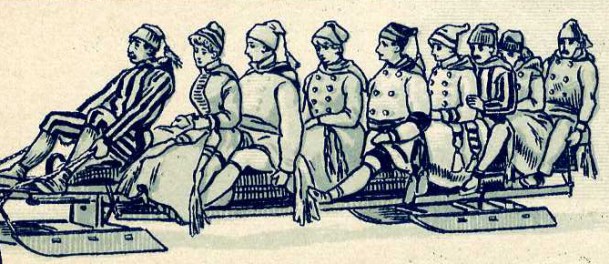
Webb followed up his apology not by abandoning the sport, but by formalizing it. He helped found the Burlington Coasting Club, and became its president. The club’s other offices were filled by a University of Vermont professor, a prominent lawyer and state senator, a bank president and a leading manufacturer. Members of the business and professional class — lawyers, storeowners and the like — made up the club’s membership. The high status of club members squelched any opposition from Burlington officialdom.
The coasting club set to work, lining Main Street with torches to light the route at night, and arranging for spotters to monitor the course and warn passersby of oncoming sleds. The club also built a toboggan slide at the junction of St. Paul and Howard streets and purchased toboggans for free use by members and rental by the general public.
To foster a club identity, organizers required that, while sledding, members wear the club’s uniform, which consisted of a red sash, woolen tuque, and a badge that depicted a toboggan with the club’s initials overlaid.
Five-day carnival
The next fall, Burlington Coasting Club members began planning a gala event, a five-day winter sports carnival to be held in February 1886. In addition to the predictable events of coasting and tobogganing, organizers scheduled ice hockey games, skating races and “a fancy skating tournament” at a newly created rink; ice boating, sleighing and trotting races on the lake; fireworks; snowshoe races; a club dinner, and a grand carnival ball.
The carnival was blessed with perfect weather. A warm spell that had threatened the event ended with colder weather and light snow. Winter sports enthusiasts, who had been disappointed by cancellation of Montreal’s festival, crowded into Burlington for the festivities.
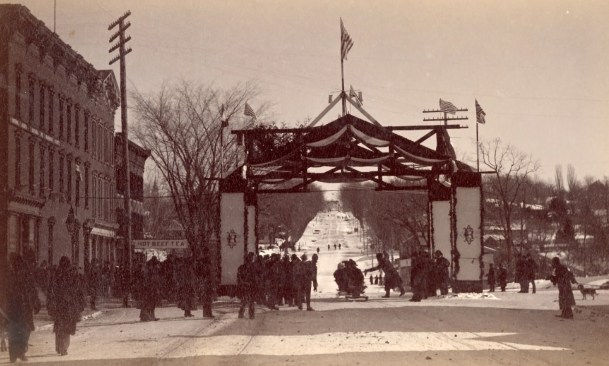
A large traverse sled crosses the finish line during Burlington’s winter carnival of 1886. The elaborate finish line was emblazoned with the initials of the Burlington Coasting Club, which helped organize the festival. To the left of the finish line is a sign for a vendor selling “Hot Beef Tea.” Photo courtesy of Silver Special Collections Library, University of Vermont 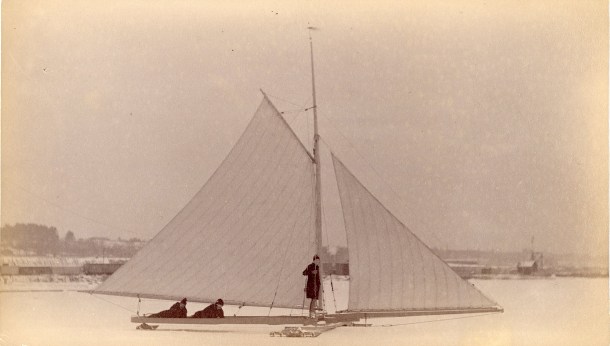
Ice boat races were one of the events at Burlington’s winter carnival. Photo courtesy of Silver Special Collections Library, University of Vermont 
Burlington attracted people from across the Northeast and Quebec for its Carnival of Winter Sports in 1886. Photo courtesy of Silver Special Collections Library, University of Vermont
“Burlington tonight is all one vast blaze of electric lights, Chinese lanterns, and houses illuminated as though they were on fire,” reported one New York City paper. “The air resounds with revelry and fun, the streets are literally jammed with people, and the sport is wilder than anything ever seen in Montreal, Orange, or even Albany.”
The thrilling coast down Main Street became a major attraction; a reported 1,000 riders an hour zoomed down the course.
Others flocked to the lakeshore to watch the iceboat and horse races, or to skate on the rink, which was lit at night by torches.
The carnival also featured what is believed to be the first-ever international ice hockey game. Playing on a rink set up between two docks on the Burlington waterfront, the Montreal Amateur Athletic Association team beat the local Van Ness club team 3-0.
Burning bright — for one year
Burlington reveled in all the attention. The event seemed to signal the city’s entrance into the big time, as luminaries from around the East Coast and Quebec turned up.
“(A) more brilliant assembly was never seen in Burlington, hundreds of well-known society people from other cities joining in the promenades and dances and the beauty and chivalry of our own city being fully represented,” gushed the Burlington Free Press.
The Boston Transcript reported that “the magnitude of its success surpasses even the Club’s wildest dreams. Burlington was made on purpose for a winter carnival.”
The festivities gave every indication of becoming a major annual event. The next year’s carnival also ran smoothly, despite uncooperative weather. A thaw again hit just before the opening, but this time didn’t lift in time. And though a decent crowd turned out, the event somehow lacked the luster of its first year.
The Boston, New York and Montreal socialites who made the first year so grand were mostly missing. Montreal’s smallpox epidemic had finally ended — though not before killing more than 3,000 people in Montreal and another 3,000 elsewhere in Quebec, and leaving an estimated 13,000 permanently scarred by the pox — and the city’s winter carnival in 1887 attracted much of the glitterati.
After that, the Burlington Coasting Club couldn’t muster the enthusiasm to host another carnival. The events put heavy demands on club members’ time, and if the event wasn’t going to match the glow of the first year, they decided they had better things to do.
Membership dropped precipitously. Even Webb, who had been so instrumental in starting the club, seems to have lost interest and did little to help organize the 1887 event.
Coasting and tobogganing proved something of a fad. Within a few years, the Burlington Coasting Club became defunct. If the club failed to establish a Burlington winter carnival as a major social event, it had at least shown that Vermont could draw visitors in winter, though it would take another half-century, and the creation of ski areas, to fulfill that promise.

