

Federal funding for Vermont Everyone Eats, a pandemic food assistance program connecting people with locally sourced restaurant meals, has been extended to April 1.
Everyone Eats emerged in response to more Vermonters dealing with food insecurity and the challenges restaurants and food suppliers faced with economic shutdowns, said Jean Hamilton, the program’s statewide coordinator.
“There’s this real exchange of values that goes through multiple members of the community,” Hamilton said. “We continue to hear again and again how meaningful it is to receive the help that they’re getting and know that by receiving that help they’re actually able to help someone else out.”
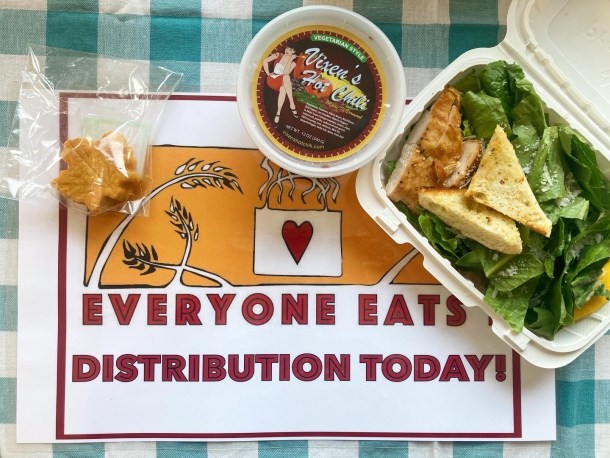
The main framework of the program is the same throughout the state. Those seeking food assistance are given restaurant meals that must be sourced from at least 10% local ingredients, which the program buys at $10 each. So far, Everyone Eats has distributed almost 2 million meals, providing $20 million of revenue for local restaurants.
The idea is that by requesting a meal, people are creating some supplemental revenue for the restaurants providing it. People picking up meals are getting a nutritious meal, made by a local chef at a restaurant in their community, and that restaurant is also getting $10 per meal. Although the program mandates at least 10% of their ingredients come from local farms, though the average is 37%, Hamilton said.
“Right from the beginning I think what has stood out to everyone as really unusual and exciting about the program is the way that it breaks down silos and really brings in different sectors together to scratch our heads and solve bigger systemic problems, but also to help one another in a reciprocal way,” Hamilton said.
The statewide program runs out of 15 different hubs that cater to different regions of Vermont. The hubs are run by local organizations that have already spent time building connections and trust in their communities, which Hamilton said puts them in the best position to organize the program in their area.
“The power of Everyone Eats is decentralized throughout the state, so each hub that runs Everyone Eats runs it in a unique way that works best for their community,” said Meghan Wayland, food access coordinator for the Center for an Agricultural Economy, which runs the hub that serves Hardwick, Caledonia and surrounding towns.
Sue Minter, executive director of Capstone Community Action, Everyone Eats’ central Vermont hub, said this makes a huge difference for the people they serve, many of whom are unable to cook a balanced meal from the produce and shelf-stable products food shelves provide.
“They don’t have a kitchen. They’re living in hotels unhoused,” Minter said. “So these ready-made nutritious meals have been unbelievably critical.”
However, Everyone Eats is in no way limited to the most vulnerable populations. Unlike state-run programs, there are no income caps. The only requirement is needing food assistance. With a $15 an hour wage, some participants make too much money for government food relief programs such as food stamps, Wayland said.
Everyone Eats can also take away shame some might feel going to a food shelf, Hamilton said. Burlington-based Localvore has created a digital voucher program that allows people to order Everyone Eats meals through the company’s app and pick them up like a normal take-out order. In turn, the restaurant is reimbursed by the program.
Everyone Eats is able to help so many people because of the funding it has received, Hamilton said. After making a proposal to the House Commerce Committee, the state Legislature approved $5 million of the federally funded Covid-19 relief money through the CARES Act to help start Everyone Eats, she said.
“Because of our close partnerships with so many of the state agencies and state coalitions that had come together during Covid, including the mass feeding taskforce, we were able to actually get FEMA funding for the program, so that’s how the program has been funded since July of 2020,” Hamilton said.
Since then, Southeastern Vermont Community Action, which administers the program, has been contracted by the Agency of Commerce and Community Development, and then the state is reimbursed by the Federal Emergency Management Agency. Hamilton said FEMA has continuously given Everyone Eats money because it is a critical part of Vermont’s emergency fund through the pandemic.
Since the program was operating in 3-month contract extensions throughout the year, it was unclear how it would be funded in the long term. But now, Everyone Eats is set for the rest of the winter.
“Restaurants can be a part of the solution, and communities should be a part of the solution, not just the tireless hard working heroes who have staffed our food shelves and meals on wheels for decades, but how can we lift this issue up in a way that removes the stigma and acknowledges that there are many, many reasons why we experience various kinds of vulnerability, and if we remove the shame from that we can actually take care of each other,” Hamilton said.
