


SOUTH BURLINGTON — As electric aircraft maker Beta Technologies plans its rapid expansion at Burlington International Airport, a handful of nearby businesses are concerned that local officials may sideline their future operations to make way for Beta.
The tenants — all of whom work in “general aviation,” the sector of flying that includes charters, flight schools and private planes — say they have no bone to pick with Beta, whose success they salute.
But they do find fault with the airport for, in their eyes, not being transparent about how Beta’s expansion could affect “The Valley,” Burlington’s hub for general aviation.
Unease about the airport’s openness with tenants was on full display at a Burlington City Council meeting last month, when some general aviation businesses told councilors they weren’t made aware of whether an agreement between Beta and the airport would affect their leases.
The tenants eventually received assurance from Nic Longo, the airport’s acting director of aviation, that the agreement wouldn’t affect any aviation-related businesses. But the initial pushback by some general aviation tenants was enough to spark frowning comments from a handful of councilors.
“I would just encourage you to make sure you involve the other stakeholders in general aviation as the Beta expansion moves forward so we don’t have this sort of confusion,” Councilor Mark Barlow, I-North District, told Longo at the meeting Nov. 8.
After the meeting, some in the general aviation community banded together to write a resolution for the council, proposing a “general aviation task force” that would balance the interests of Beta with those of smaller companies that fly at the airport.
Councilor Ali Dieng, I-Ward 7, initially planned to introduce the resolution at the council’s Dec. 20 meeting, but now plans to introduce it Jan. 10. The extra time will allow him to include the perspective of more people in the aviation community and Mayor Miro Weinberger’s administration, he said.
“I didn’t want a resolution that’s one-faceted,” Dieng told VTDigger, and he wants the finalized resolution to pass unanimously.
In an interview with VTDigger, Longo said the task force would be unnecessary, since it would seek to accomplish something that was already laid out in the airport’s recently completed master plan, which covers the period through 2038.
As it developed the master plan, airport management sought input from the general aviation community, Longo said, but the businesses that are now pushing back against the airport’s decisions did not participate in the process.
Yet Eric Chase, owner of Mansfield Heliflight, contends that the airport was never proactive in reaching out to his company.
“They never called up and said, ‘Hey, Mansfield, how can we help you and how do you want to contribute to the master plan?’ That’s never happened,” Chase said.
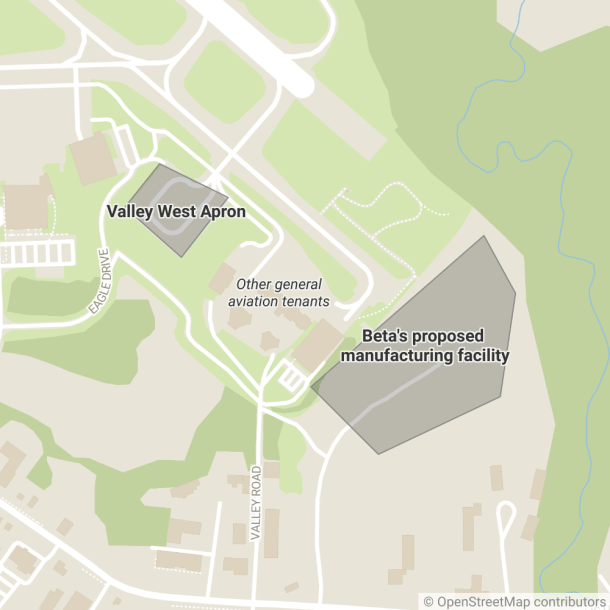
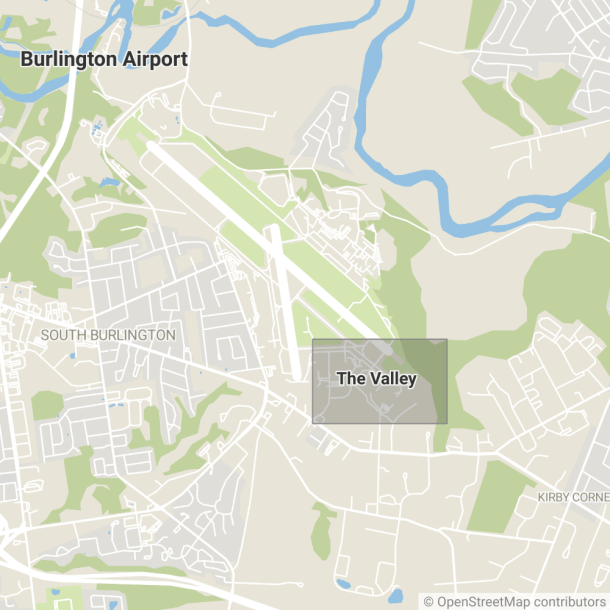
As it expands, Beta is eyeing two parcels of land that straddle The Valley.
One parcel would host the company’s planned 270,000-square-foot manufacturing facility. While Beta and the airport are still negotiating that lease, the agreement councilors approved Nov. 8 allowed crews to start clearing the land in preparation for the building’s construction.
The other parcel is called the “Valley West Apron,” which essentially functions as an equipment parking lot right now. Beta hopes to develop the area within the next year as a “cultural and training center,” where future pilots could learn to fly and members of the public could visit to learn more about the company, said Blain Newton, its chief operating officer.
From where they sit in between the two parcels, some in the general aviation community think the airport is handing itself over to one entity.
“Pretty much in one swoop, they’re taking the last two remaining pieces that are currently in usable shape for general aviation,” said Chris Weinberg, a pilot and general aviation advocate who gave VTDigger a tour of The Valley on Wednesday.
Longo contends that there’s more room for the airport to expand on its northern side, near Kirby Road. But general aviation stakeholders question why that area isn’t being set aside for Beta, instead of a spot where general aviation could potentially be relocated.
With the rumble of trucks moving land for Beta’s manufacturing facility as a backdrop, Weinberg hailed general aviation as an essential part of the airport.

“It serves a multitude of purposes,” Weinberg said. “I think the most important are jobs and education. … You probably have upwards of 100 students” who are learning to fly or operate on aircraft through Vermont Flight Academy, Vermont Technical College and Burlington Technical Center — all of which have a presence in the Valley.
Newton, the Beta executive, said his company shares the goal of prioritizing general aviation.
“Our business plan and our growth depends on an incredibly strong and robust general aviation community,” he told VTDigger. “We’re going to need north of 7,000 pilots and trained technicians to work on our aircraft in the fleet by the end of the decade.”
“Those folks don’t just materialize; they come through a general aviation path,” Newton said.

Likewise, Longo said he is committed to maintaining a healthy general aviation community at the airport.
But Chase isn’t so sure. The permits that Beta secured with South Burlington for its manufacturing facility show overlap with Mansfield Heliflight’s current lease, which doesn’t lapse until 2027, he said.
“We’re still concerned that we’re going to have to fight about it,” Chase said. “We shouldn’t have to fight about it. As far as we’re concerned, we’ve already done everything that we were supposed to do.”
Chase said he’d be open to the possibility of renegotiating his company’s lease with the airport if Longo asked him about it. But that step hasn’t been taken yet, he said.
“We’re not opposed to negotiating or talking with people,” Chase said. “But we’re certainly opposed to people assuming our property.”

