

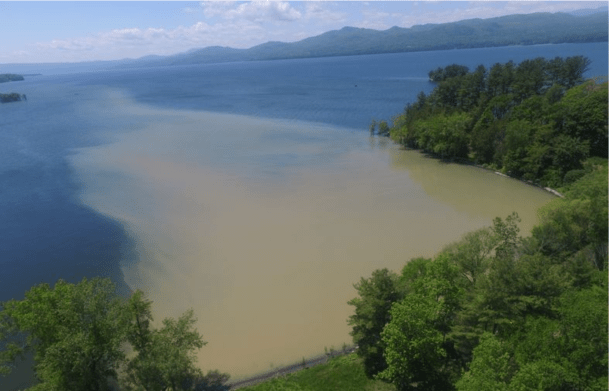
In Addison County Superior Court this week, a family that lives part time on the shore of Lake Champlain said runoff from a neighboring farm is sending rivers of brown water through their property and into the lake.
Vicki and Dennis Hopper have brought a lawsuit against Vorsteveld Farm, alleging that the farmers have made changes to the land in recent years that have caused much more runoff than they have ever seen.
The dairy farm — one of the largest in the state, according to its website — is located uphill from the Hoppers’ property in Panton, northwest of Middlebury.
Located on around 2,400 acres of land, the farmers grow crops, milk 1,400 cows, and keep between 800 and 1,000 young stock, according to court documents and testimony from Jans Vorsteveld on Friday.
A trial for the civil suit began Wednesday and was scheduled to end Friday, but due to testimony that ran out the clock, it will resume in the beginning of January.
The Hoppers, represented by Rob Woolmington and Merrill Bent of the Manchester-based firm Woolmington, Campbell, Bent & Stasny, rested their case Friday. James Foley and John Mazzuchi, attorneys representing the Vorstevelds from the Middlebury-based firm Lynch & Foley, began calling witnesses Friday afternoon. Judge Mary Teachout is presiding over the case.
The trial is playing out as environmental groups urge the Agency of Agriculture to strengthen Required Agricultural Practices, a set of rules designed to ensure that farm management does not contribute to pollution in Lake Champlain and other water bodies. Climate change, the groups say, means heavier precipitation may cause more runoff, and measures should be taken to prevent it.
Farmers have said they are already strapped and need financial support if they’re going to make additional changes to their operations.
Meanwhile, state Sen. Chris Pearson, D/P-Chittenden, plans to introduce legislation during the upcoming session that would direct the Agency of Agriculture, Food and Markets to update the practices due to climate change. In an email, he said he intends for the bill to be a conversation starter with the agency.
“I can’t say I am dedicated to pushing this, but I do think it’s important we have this discussion,” he said in an email to VTDigger.
The Hoppers are asking the court to declare that the changes on the Vorsteveld farm have created a “continuing trespass and/or private nuisance,” according to a complaint filed in the case.
Asking for a preliminary and permanent injunction, the family wants the court to mandate a new management plan for the Vorsteveld farm.
Those changes would “restore the volume, location, duration, velocity and quality of water flowing onto the Hopper Properties” to its state prior to changes made by the farmers.
The request for an injunction is unusual, Foley said. Farm management typically is regulated through various state and federal agencies not by lawsuits between neighbors, and he said the case could set precedent in that way if the farmers lose.
“There’s no concession here that anything the Vorstevelds are doing is improper,” Foley said in an interview with VTDigger.
The Hoppers’ objections come from several alleged changes the Vorstevelds have made on their property: the installation of tile drainage and the removal of vegetation from their farm.
Removal of the vegetation “reduced the capacity of the fields to retain sediments and increased erosion on the Hopper Properties,” according to the complaint.
Tile drains remove water from fields using a collection of underground pipes. The system “changed the natural and preexisting flow by conveying large volumes of water through the pipe network directly to road ditches and to new drainage outlet points,” the complaint said.
Approximately 15 million gallons of “liquid waste from farm operations, including manure,” are applied to the land each year, the complaint said.
Attorneys for the Hoppers — who are from Texas but live in Vermont from May until November — presented the courtroom with a series of drone photos showing large plumes of brown sediment splaying into Arnold Bay, located just south of the Ferrisburgh town line on Lake Champlain, and White Bay, the next bay to the south.
Rainstorms cause the plumes, several members of the Hopper family said during testimony.
The Vorstevelds have a nutrient management plan with which they comply, Foley said, and are beholden to regulation from the Agency of Agriculture, Food and Markets as well as the Agency of Natural Resources.
In forthcoming testimony, the courtroom should hear from “lots of people who are going to testify that these guys are extremely good at what they do. They’re on the leading edge of innovation,” he said.
Jans Vorsteveld testified Friday that some of the suggested management strategies, such as letting a corn field go to pasture, “wouldn’t pay the bills.”
“Farming is not a pretty undertaking, nor is any real business,” Foley said. “There’s a difficult side of every business to watch or endure or become aware of.”
However, according to the complaint filed by the Hoppers, water running through the property and into the lake contains “high concentrations of nitrate, phosphorus, total suspended solids and other pollutants” and “very high levels of e-coli — at times close to levels found in sewage before treatment.”
“It’s rare that I find a case where the facts presented are so diametrically opposed, so black and white, so different on either side,” Foley said.
Editor’s Note: Rob Woolmington is vice president of the Vermont Journalism Trust Board, the parent organization of VTDigger.
