



When Leonard Howard added his name to the Brattleboro Fire Department’s on-call support list in 1987, he was one of three dozen locals ready to assist at the sound of an alarm.
Today, Howard is the town’s fire chief. He heads a 28-member department in a newly expanded $6.35 million station. The support roster, however, has not kept up with the times.
“When I joined, we had more than 30 people on call,” Howard said. “Today we have three.”
That means when Brattleboro firefighters need help with a big blaze, they must seek mutual aid from nearby communities that are facing their own staffing challenges.
Just this week, Brattleboro had to call nine other departments (from nearby Dummerston, Guilford, Putney, Westminster, Wilmington and the New Hampshire communities of Chesterfield, Hinsdale, Keene and Walpole) to gather enough firefighters to deal with a three-alarm apartment house fire.
“The call people just aren’t there,” Howard said. “Life’s too busy, and it’s too much of a commitment.”
The Brattleboro chief is not alone in his assessment. Some 150 miles north, the town of Williston recently made national news when local firefighters responding to an emergency could not find on-call replacements, leaving their station empty for almost an hour.
Such predicaments are threatening to become less the exception and more the rule.
“It’s not just a local issue; it’s state and national,” said Peter Lynch, a former Brattleboro firefighter turned chief of training at the Vermont Fire Academy in Pittsford.
Compounding the staffing problem is a lack of understanding of its exact size. Although the state has a Division of Fire Safety, a firefighters’ association and a union for professionals, none track local numbers.
“Most fire departments in Vermont are volunteer fire departments; however, career fire departments provide protection for a larger share of the state’s population,” is the extent of information available on the state’s website. “Volunteers are concentrated in rural communities, while career firefighters are found in larger communities.”
The National Fire Department Registry lists 204 local departments in Vermont, with 95% staffed by volunteers (compared with 85% in the country) and only 5% employing professionals.
The most recent Vermont Fire Academy strategic plan estimates the state has more than 5,000 volunteer and career firefighters, although that number was set before the Covid-19 pandemic and did not specify how many are active or simply sitting on a call list.
As a result, facts and figures must be gleaned community by community. Brattleboro’s 21 paid firefighters, for example, field about 2,600 calls a year. The good news: That number dipped in the initial months of the pandemic and resulted in only two total-loss blazes this past year.
“We’ve had small fires,” Howard said, “but the reason they’ve stayed small is because of fire prevention, our rental inspection program and early detection.”
On the flip side, emergency medical services now account for about half of all of the fire department’s dispatch requests.
“We’re called the fire department, but we really should be called the all hazards department,” Howard said. “We cover a lot of different things.”
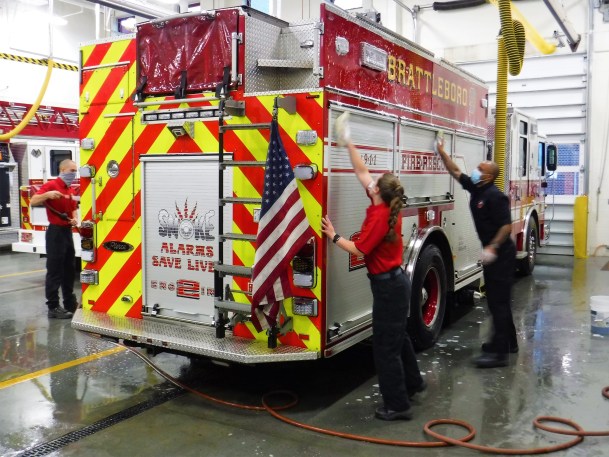
Increasingly, just as in a lot of other towns, Brattleboro is receiving more calls from nearby communities for mutual aid — some 85 this year alone.
“Typically it used to be for major incidents,” Howard said, “but now we’re getting calls for a routine car accident or fire alarm sounding because somebody else can’t go.”
“A few years ago, a department would go to a fire and have maybe one other department on the scene,” Lynch said. “Now much of the time, four or six or seven departments have to handle the same size situation because most of them are having real issues recruiting people.”
The state Department of Public Safety is actively working on solutions, although “it’s not just one issue that’s creating this problem,” Lynch said.
The population, for example, is aging. According to the National Volunteer Fire Council, members under the age of 30 dropped from about 133,000 in 1987 to 90,000 in 2017. In contrast, those 40 and older rose in the same period from 164,000 to 176,000.
“Departments are finding it difficult to attract younger members due to a range of reasons, including increased demands on people’s time, longer commuting distances to and from work, the prevalence of two-income households, and increased training requirements,” the council said in a recent report.
Vermont does not require volunteers to have any specific level of training, although career and on-call personnel who require state Firefighter 1 certification need almost 200 hours.
Some communities are addressing the on-call shortage by relying more on professionals. Brattleboro, seeking to diversify its department, has used the process to hire two women and three people of color.
But recruiting and retaining career employees can be as challenging as finding support staff. Brattleboro firefighters work 24-hour shifts (with 48 hours off in between) for annual salaries ranging from a starting $46,000 to as much as $59,000. Such Vermont pay is 6% higher than the national average but well below that of neighboring Massachusetts, which is 37% higher than the national average.
“We’re not recommending any staff increases this year,” Howard recently told local leaders, “but I can assure you they most likely will be coming in the future.”

