

Vermont’s Climate Council is gearing up to release the state’s first Climate Action Plan on Wednesday.
A draft of the council’s initial plan shows an emphasis on vehicle electrification and weatherization, among other policy recommendations. An agenda for a council meeting, to be held Wednesday, includes a discussion of the draft and an opportunity to modify it before councilors take a formal vote on its adoption.
Charged with developing pathways to implement the Global Warming Solutions Act — the state law enacted in 2020 that legally requires Vermont to reduce emissions — the 23-member council has been racing to pull a plan together by the Dec. 1 deadline.
The state must reduce greenhouse gas pollution to 26% below 2005 levels by 2025, 40% below 1990 levels by 2030, and 80% below 1990 by 2050.
Pathways, designed by the council to guide the state toward meeting the reduction requirements, suggest many policies that would require legislative action to implement. The Legislature is expected to take action on their recommendations during the coming session.
Among the suite of recommended policies, the council backs measures to electrify vehicles across the state, weatherize 90,000 additional homes by 2030, implement efficiency standards for rental homes and administer a clean heat standard.
The draft references the Transportation and Climate Initiative Program, or TCI-P, a multi-state cap and trade climate initiative that crumbled recently when Connecticut and Massachusetts backed out, citing lack of support from other states and rising gas prices. Transportation is the largest source of greenhouse gas emissions in Vermont, and the program was hailed as an effective strategy to cap emissions and provide funding for clean transportation projects.
“The Council remains committed to this approach as a realistic and cost-effective way to meet the emission reduction requirements in the GWSA, and includes in this plan the action to join TCI-P when a viable regional market exists,” the draft says.
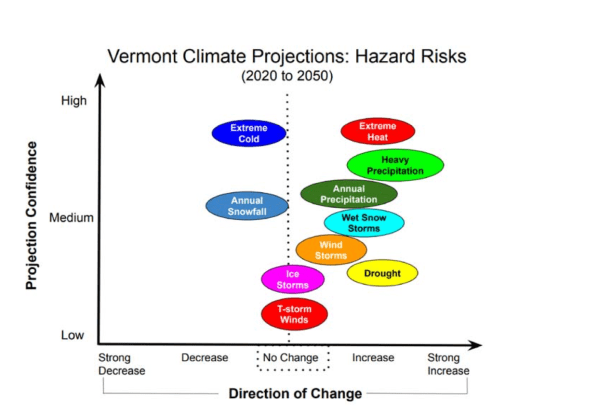
The document also includes recommendations to bolster Vermont’s communities against the impacts of climate change.
The Legislature also will be evaluating recommendations from the latest Comprehensive Energy Plan, published last week, which works in tandem with the Climate Action Plan to establish mechanisms for meeting the reductions. The energy plan, however, “is not a climate change plan nor a comprehensive look at Vermont’s non-energy (greenhouse gas) emissions or climate adaptation needs,” a draft of the Climate Action Plan says.
Elena Mihaly, vice president and director of Conservation Law Foundation Vermont, said the environmental organization is excited about a number of items in the draft plan, though she said they’ll continue to watch closely as the council’s recommendations make their way through the legislative process.
The draft plan recommends changing the state’s Renewable Energy Standard — a rule that requires electric distribution utilities to get a certain percentage of their electricity from renewable or carbon-free sources — from 75% to 100% by “no later than 2030.”
Mihaly lauded this change, but said she hopes the bodies charged with carrying it out focus on carbon-free sources rather than renewables, as some renewables still produce carbon emissions.
“There’s so much in the plan that is kind of banking on electrification as a means to reduce carbon pollution,” she said. “Ratcheting up our standard to 100% is a really important step.”
The draft plan also recommends more accurately measuring carbon emissions to account for impacts that take place out of state. For example, emissions are released when the fuel used in Vermont is extracted from the earth, then transported to the state. The draft also accounts for the social cost of carbon, which measures the impact of carbon emissions on future generations.
Finally, Mihaly said the Conservation Law Foundation applauds the proposed Just Transitions rubric that guides all of the recommendations included in the plan to be implemented in a way that prioritizes low-income, at-risk and marginalized Vermonters.
Correction: Ellen Mihaly’s title has been updated to reflect a recent promotion.
