

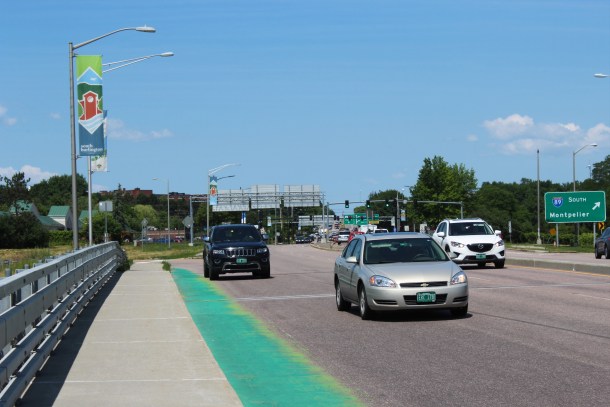
By car, it’s simple to travel between Burlington and South Burlington. Drive up Main Street from Burlington’s downtown or lakeside, past UVM and a small strip mall, past the Interstate 89 intersection, and you’re in South Burlington.
For bicyclists and pedestrians, it’s a different story — busy intersections without stoplights, narrow sidewalks and when they approach I-89, multiple lanes of traffic with fast-moving cars.
A new bridge should take a lot of the risk out of that trip for pedestrians and bicyclists.
The city of South Burlington expects to receive almost $9.8 million in federal money to design and build a foot and bike path over the I-89 intersection, officials announced in a press release Friday.
The money will come from the U.S. Department of Transportation’s grant program for Rebuilding American Infrastructure with Sustainability and Equity.
The project “will have an enormous positive impact on cyclists,” said Richard Watts, a University of Vermont professor of public policy, energy policy and transportation and an avid proponent of alternative transportation.
The I-89 junction is the busiest intersection in the state, according to the Vermont Agency of Transportation, and it’s a particularly dangerous one, said Joe Segale, the policy, planning and research director for VTrans. Drivers are moving on and off the interstate and shifting quickly between city driving speed and highway driving speed.

“The traffic there is moving really fast,” Segale said, and pulling pedestrians and cyclists off the road and onto the new bridge is “inherently safer.”
State goals for encouraging alternative transportation use reach far beyond Burlington. The new bridge will deal with “a particularly acute problem” at the I-89 intersection, Segale said, “but we are thinking about increasing accessibility all over the state” for walkers, runners and bicyclists.
Many bicycle and footpath projects are driven at the local level, Segale said, but VTrans provides between $3.2 million and $4 million in federal and state funds every year for municipalities to build or improve bicycle and pedestrian paths.
Many say diversifying safe and accessible transportation options could help the state play its part in combating climate change
“Transportation is Vermont’s largest source of greenhouse gas emissions,” said U.S. Rep. Peter Welch, D-Vt., in Friday’s press release. “To do our part to combat climate change, it’s critical that we find ways to cut down on emissions while improving quality of life for Vermonters.”


To encourage people to use nonmotorized methods of transportation, roads have to be just as accessible to pedestrians, runners and cyclists as they are to cars, Watts said.
“We have built a system that privileges drivers at the expense of all other users,” he said.
The project is still in its earliest stages, and a lot of work remains to be done, said Paul Conner, planning and zoning director for South Burlington. The city needs to seek bids for a consultant, start designing the project and apply for construction permits.
With so much up in the air, there is no specific timeline for the project yet, but the federal grant is cause for celebration, Conner said.
“The award of this grant has moved the bridge from being a concept to a very real project that we can begin working on full-steam,” he said.
