


Amid record-high virus spread, Vermont Health Commissioner Mark Levine has a message for people who are “simply done” thinking about Covid-19: “The pandemic isn’t over yet.”
“Thanks to the vaccines, our lives have changed dramatically since last year,” Levine said. “But this virus continues to evolve and fight back every step of the way.”
The virus is spreading at high levels in Vermont communities, threatening to deliver poor outcomes, Levine said, particularly for unvaccinated people, high-risk Vermonters, and those who are aging or have underlying health conditions. It’s also a threat — to a lesser, more manageable extent — to those who are fully vaccinated, he said.
Speaking at Gov. Phil Scott’s weekly press conference on Tuesday, Levine gave a list of suggestions for people trying to host a safe Thanksgiving gathering. The state reported higher Covid-19 case rates in the weeks after Halloween, suggesting that holiday gatherings may pose a risk for the near future.
Among Levine’s suggestions:
- Have “the talk” with other members of your party to see if they are fully vaccinated, or if they may need additional safety measures because they are high-risk. Precautions could include wearing masks when not eating.
- Keep the gathering small, because more people and more households mean a higher chance of exposure.
- Get tested before you gather. Levine suggested getting a free PCR test no later than Monday, then ordering rapid antigen tests for the days before and day of Thanksgiving.
- If you have any symptoms, “make the hard but right choice to skip dinner and stay home.”
- Get tested five to seven days after the holiday gathering, even if you’re vaccinated or don’t have symptoms.
- Remember that the Covid booster and flu vaccine each take two weeks to be effective. Plan your holiday schedule accordingly.
The seven-day Covid case average has risen 16% in the past week and 64% in the past two weeks, said Mike Pieciak, commissioner of the Department of Financial Regulation.
Vermont now has the sixth-highest case rate in the nation, according to The New York Times. Cases nationwide have increased 11% over the past seven days.
The state forecasts that Vermont cases will either stay flat or increase in the coming month. Pieciak said the state wound up on the high end of last week’s forecast.
[Looking for data on breakthrough cases? See our reporting on the latest available statistics.]
Pieciak said one encouraging sign is the low Covid rate among older Vermonters. Even as cases have spiked, cases among people 65 and over have declined 2%. He theorized that the high booster rate among that population could be responsible for the lower numbers.
He said the fewer Covid cases among older people could be why hospitalizations have not increased as dramatically as cases have. Vermont continues to report one of the lowest rates of hospital stays in the nation, with 59 people currently in the hospital with the virus and 16 people in intensive care units.
Asked about the lack of state restrictions for Covid, Scott said hospitalizations and ICU use in Vermont are the “real number” to pay attention to, rather than simply the number of new cases. He said the hospitalization numbers reflect the success of the state’s strategy to emphasize vaccinations.
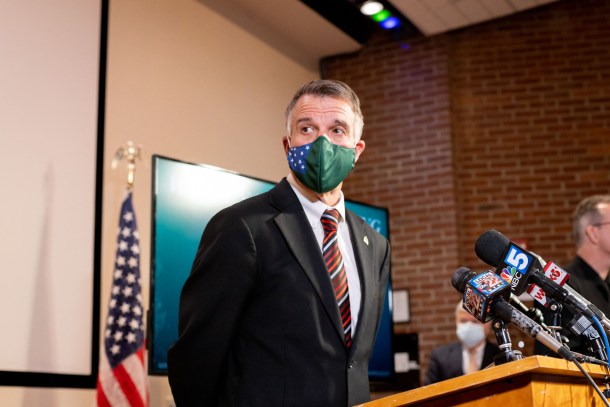
The governor responded to questions about his decision to call the Vermont Legislature back to consider one additional Covid precaution: giving Vermont towns and cities the ability to impose mask mandates if they choose.
Scott said nothing has changed in his position that mask mandates are ineffective, but he recognized the need to compromise with the Legislature, whose leaders have been pushing for a statewide mask mandate.
“It was an opportunity to meet them where they are, and to give them something so that we can move into the session seamlessly and try to get the work done for the people,” he said.
He said he would veto any additional Covid restrictions the Legislature passed. The power to impose mask mandates would apply only until April 30, 2022, and municipalities would need to vote to renew them every 30 days.
“I don’t believe that we need to impose any mandates at this point in time. We don’t have a state of emergency (and) I’m not going to enact my emergency powers to do so,” Scott said. “So, that would be what I’d have to do and I’m not willing to do that.”
He said he’s offering an “olive branch” to allow the Legislature to take action if it chooses.
Scott reiterated his top recommendation for combatting the virus: Get vaccinated, or get the booster shot of the vaccine if you are fully vaccinated.
About a quarter of Vermonters over age 18 have received an additional dose of the vaccine, including 55% of people 65 and older.
Nearly 16,000 children between 5 and 11 years old have either received a dose of the vaccine or made an appointment, said Mike Smith, secretary of the Agency of Human Services. A total of 44,000 Vermont children in that age group became newly eligible at the beginning of the month.
Schools putting test-to-stay in place
Eighty-one schools have conducted at least 2,600 antigen tests in the past week under the state’s new “test-to-stay” program, which gives schools the chance to keep unvaccinated kids in school when they’ve been exposed to the virus, said Education Secretary Dan French.
He said 51,000 test kits are on order. In total, 35 supervisory unions and 17 independent schools have enrolled in the program.
But he said that many schools are still struggling to staff the program. Some have turned to nonmedical school staff to conduct the tests.
The state reported a record-setting 256 cases among K-12 students and staff in the past week. It’s unclear how much of that increase could be the result of increased testing, since the state doesn’t report the number of tests conducted in schools.
The state has also adjusted its contact tracing guidance with a new stipulation: Vermonters should take a more active role in telling their close contacts if they’ve been exposed to the virus.
Smith said the state employs 150 full-time contact tracers, but with the rapid spread of the Delta variant, “we need to do better.”
Levine said that if you test positive for Covid, you should immediately quarantine and inform your contacts about your positive test result. “You may not receive a call from a contact tracer as quickly as you can do these actions,” Levine said.
“We still plan to use our traditional contact tracing approach, but have it concentrate on outbreaks and vulnerable populations such as those living in congregate settings,” Smith said.
Details about what to do if you test positive are available on the Department of Health website.
Get the latest statistics and live updates on our coronavirus page.
Sign up for our coronavirus email list.
Tell us your story or give feedback at coronavirus@vtdigger.org.
Support our nonprofit journalism with a donation.
