

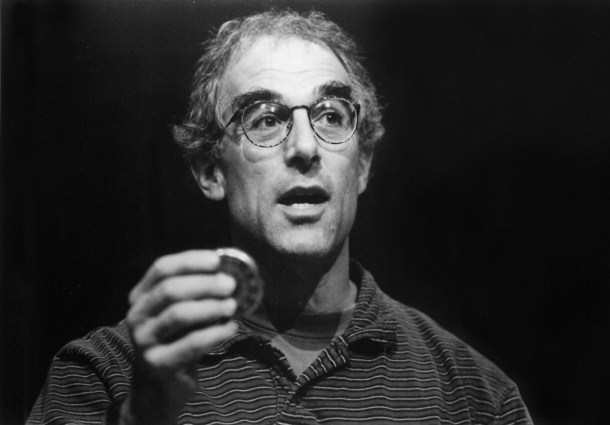
Larry Gordon, the Marshfield resident known for creating community choruses in Vermont and reviving the shape note singing style around the world, died Tuesday at UVM Medical Center, where he’d been in a coma since a Nov. 1 bicycle accident.
Gordon, 76, was taken off life support earlier in the day and had been breathing on his own, according to Sinead O’Mahoney, one of the workshop leaders of Village Harmony, the nonprofit Gordon founded. His former partner, Patty Cuyler, confirmed his death Wednesday morning.
“Generation after generation of teenagers went through his (music) camps and were transformed by the experience of singing together,” said Peter Amidon, a Brattleboro-based choral arranger and director of the Guilford Community Church choir. “Larry got them to become lifelong singers.” Amidon’s two sons, both professional musicians, are among them.
Gordon brought shape note singing to Vermont in the early 1970s, according to Mark Dannenhauer, a Shutesbury, Massachusetts-based photographer and videographer long associated with Bread and Puppet Theater. He recalled Gordon introducing the emotionally visceral a cappella music in the puppeteers’ living quarters when Bread and Puppet was in residence at Goddard College’s Cate Farm. The theater troupe’s founders, Peter and Elka Schumann, took to it enthusiastically, Dannenhauer said. Their 1972 performance of Stations of the Cross was the first time shape note singing surfaced in a Bread and Puppet production and in the years since it has been a frequent element in the group’s performances.
A gathering was held Tuesday afternoon at Gordon’s home in Marshfield and other vigils took place in Brattleboro, Boston, Western Massachusetts, New York, Washington, D.C., the San Francisco Bay area, Seattle, England, Germany and South Africa, according to Suzannah Park, chair of Village Harmony’s board of directors. Some 200 people sent notes to be placed in Gordon’s casket before cremation, according to Park.
A Facebook page titled “Love for Larry Gordon” has drawn more than 900 members, several of whom have shared links to recordings they made honoring Gordon. The musical tributes came from members of Trendafilka, a New Orleans-based polyphonic singing group; a cellist named Sarah Birnbaum Hood who recorded the four-part harmony of a song on four different cello tracks; a church in Corsica; and Bongani Magatyana, a South African musician who leads Village Harmony workshops.
Many shared videos of shape note singing, which is often referred to as Sacred Harp music after an 1844 songbook of the same name. Usually done in four-part harmony and unaccompanied by instruments, shape note singing began in New England and spread throughout the U.S., remaining particularly strong in the South.
“He was the Johnny Appleseed of shape note music,” said Dannenhauer. “Everywhere he went, he took shape note music with him.”
Dannenhauer sat in a camping chair at the Brattleboro gathering for Gordon Tuesday afternoon but took a break from the singing to recall Gordon’s involvement in the music. For years, beginning in the late 1970s, he said, busloads of Southerners journeyed north in the fall to take in the foliage and also to participate in what was initially a Vermont Shape Note Sing but eventually evolved into a New England Shape Note Sing.
“He had a lot to do with forging relationships with the (shape note) singers from the South,” said Dannenhauer. “There was definitely a culture clash between the older, more conservative singers from the South and the less formal, younger crew that was doing the revival in the North.”
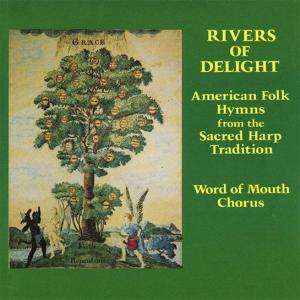
Gordon also brought Vermonters down south. He formed the Word of Mouth Chorus in the mid-1970s, which toured the American South in 1978. That same year, the chorus recorded the album “Rivers of Delight — American Folk Hymns from the Sacred Harp Tradition” for Nonesuch, an alt-classical label. In addition to its shape note repertoire, the Word of Mouth Chorus sang Balkan, Medieval and Renaissance numbers.
One alumnus of the chorus, Andy Christiansen, posted on Facebook that he was a 20-year-old Vermont farm boy who “was blown off my feet by blasts of sacred harp music so much more vital and propulsive than the stodgy music” he sang in chorus when he was a student majoring in music at Lawrence University in Appleton, Wisconsin.
Larry Gordon attended high school in Portland, Oregon, where he sang in a chorus and a madrigal singing group. During his time at Swarthmore College, he was active in Students for a Democratic Society. After moving to Boston in the late 1960s, thanks to his SDS connections, he became friends with Sam Clark, who built a house in Plainfield.
Gordon visited Clark and later joined him in the creation of what became the New Hamburger Commune in Plainfield. Gordon helped build the commune’s first house and went on to build two others. He moved to the commune in 1970 and spent 15 years there.
It was another Boston friend who moved to Vermont, a fiddle player originally from North Carolina named Allan Troxler, who introduced Gordon to shape note singing.
Gordon was employed as a music teacher at Hazen Union High School in Hardwick and in 1988 he managed to transport a group of students to Georgia and Alabama for a Sacred Harp convention. The students sang at concerts on the way down and on the way back to Vermont.
The experience led to the formation of Village Harmony in 1989. Gordon put together a small ensemble of singers from several central Vermont high schools, which performed a concert and then went on a 10-day tour. In 1990, the first Village Harmony summer camp took place, inaugurating a tradition of weeklong rehearsal residencies followed by performing tours.
What began as one camp in Vermont grew. Gordon expanded the operation until eventually there were adult camps as well as teen camps in Europe, as well as the United States, and in the Republic of Georgia and South Africa. Participants stay in the homes of the community members who are hosting them.
Joanne Schultz, a Goddard student who joined the Word of Mouth Chorus in 1974 and went on to become a member of the Bread and Puppet touring troupe, remembered Gordon as “a quirky, very smart guy who had this understated, low-key style and yet was a fantastic organizer.”
In addition to his work with community choruses, Gordon was instrumental in starting the Plainfield Food Co-op and the Cherry Hill Cannery in Berlin, which made applesauce, apple butter, jams, jellies and pickles.
“He told me, ‘I’m a person who likes to start things,’” said Schultz.
Corrections: An earlier version of this story misspelled Schultz’s last name, misrendered part of a quotation from Dannenhauer, inaccurately described where Christiansen spent his youth and misidentified the Republic of Georgia.
