


The faculty at Brattleboro Union High School believed this fall’s biggest problem would be coaxing 600 students to wear masks.
Then came a headline-grabbing TikTok challenge to vandalize bathrooms.
And a handgun found in a student vehicle parked at the school.
And graffiti threats about “killing you all” that spurred more than half of all ninth- through 12th-graders to stay home the Friday before a recent holiday weekend.
“High school should be a place for learning — where I’m not afraid to walk through the building,” junior Magdalena Keppel said at a resulting public meeting that drew 100 people. “I feel like I can’t focus on my education. Instead, I’m having conversations with my classmates about escape routes.”
Educators statewide and nationally are reporting spikes in youth misbehavior spurred by a return to classrooms after a year and a half of pandemic-prompted remote learning.
“For the first time ever, I raised my voice and yelled at my students,” Addison Central teacher Fawnda Buttolph was quoted by The Washington Post. “The kids are in charge and they know it.”
But even amid such circumstances, Brattleboro’s problems — which also include newly revealed claims of past teacher sexual misconduct — have been eye-popping.
“The first month of the school year has been extremely difficult,” interim Windham Southeast School District superintendent Mark Speno said. “It seems like we’ve had a different situation arise every other day that has led to lots of anxiety.”
Some of that fear has been stoked by unsubstantiated rumors and social media posts, as well as school board meetings where parents have wondered openly about whether to tuck rope into the backpacks of students with second-floor classes.
“That was a real experience for me,” Molly Stoner told educators. “I hear my kid say, ‘I see a couple fights a day,’ so when I juxtapose that with hearing the school is safe and these things are pranks, it’s just challenging.”
Three weeks after the “killing you all” threat came and went without incident, the school community is noticeably calmer — and contemplating the bigger picture.
“In order to change our school culture, everybody — students, teachers, administrators and parents — needs to be actively involved,” Speno said. “It’s not one thing you can just check the box and we solved it. The first thing we have to do is acknowledge the problem and then put energy towards correcting it.”
Increase in physical aggression
Educators begin by noting that high schoolers from Brattleboro and neighboring Dummerston, Guilford, Putney and Vernon learned entirely online during the spring semester of 2020 and in person only about once a week during the past academic year.
Incoming freshmen, for their part, spent three-quarters of their middle school career in front of a home computer — and now, reunited, are accounting for two-thirds of all fights.
“We have seen an increase in physical aggression among a few students,” Principal Steve Perrin emailed parents, “though the rumor of ‘daily fighting’ is simply not correct.”
Freshmen aren’t the only ones with issues. Even before school opened this fall, leaders faced the resignation of the former superintendent, followed by publication of a local newspaper essay charging a retired teacher had sexually exploited teenage students during his tenure from 1971 until 2004.
Just as officials received calls to hire an independent investigator for the past case, they learned an 18-year-old student had parked a vehicle on school grounds with a gun inside.
“All students and staff remained safe while the process of securing the firearm took place,” Perrin said in an email to parents on Sept. 24.
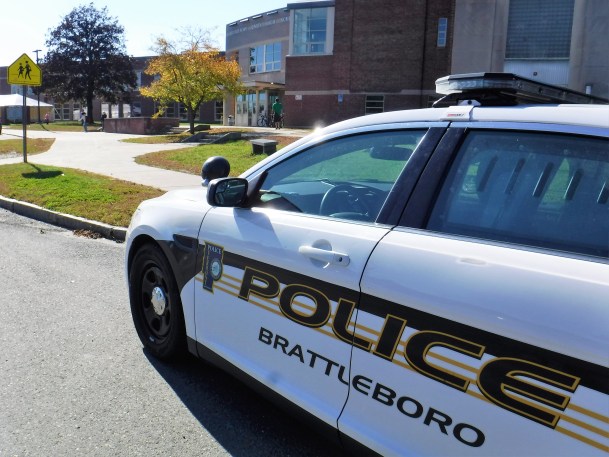
Brattleboro police have given the unidentified male a juvenile citation to answer to disorderly conduct and weapon charges in family court.
“I don’t believe there was ever a general threat for the school or to people in general at the school,” a police spokesperson told the press.
School leaders cited larger issues.
“The majority of our students have not seen a ‘normal’ year since they were in middle or elementary school,” Perrin emailed parents. “Some of our students are struggling with how to interact with each other outside of social media.”
Proving the point, students vandalized bathrooms as part of a TikTok challenge in September and wrote “killing you all” graffiti threats in the same areas in October.
In response to the latter, administrators used video from hallway surveillance cameras to identify and interview potential suspects and witnesses and analyzed the handwriting with the help of police.
“We are confident that this is not a credible threat to harm people at our school,” Perrin emailed parents a day before more than half of the student body stayed home Oct. 8.
‘Please do not hide the reality’
Three weeks later, teachers are spending more time monitoring hallways as administrators work to hire a dean of students to focus on conflict resolution and restorative justice and a safety officer trained in de-escalation techniques.
The latter position is not to be confused with an armed, uniformed resource officer. Leaders have suspended that post this academic year to study reports it makes some feel less safe rather than more.
Students, meanwhile, are being prompted to discuss the recent incidents during advisory periods. But introductory questions such as “what does safety look, sound and feel like?” aren’t necessarily sparking interest in young people who’d rather know what administrators aren’t telling them.
“I think as high schoolers we can deal with the bigger truth,” Keppel said.
Some 375 students and supporters signed an online petition asking for more transparency about specific threats.
“We are left in the dark about events that concern our immediate safety,” the petition said in part. “Please do not hide the reality of these dangerous situations.”
In response, leaders say they can’t reveal certain information because of laws protecting student confidentiality. They are telling ninth- through 12th-graders what they can during school and sharing the same facts with families through email. But, as seen on social media, what’s said in person is often twisted by the time it appears online.

“Students start rumors or hear things and then it circles in a whole game of telephone,” Keppel said. “It can be very destructive.”
The principal understands.
“I’m trying very hard to communicate quickly and accurately with everybody,” Perrin said. “But I am never going to be as fast as a Twitter feed.”
Some faculty members are taking to social media to tackle misinformation.
“Our kids understandably have a ton of anxiety,” science teacher Dan Braden wrote in one public Facebook post. “We can hopefully be calm and accurate in our discussions of what’s going on — with our kids and with each other.”
A few parents, for their part, are questioning if the school is sharing too much.
“It’s interesting watching this progress with so much communication,” Lisa Ford said. “I wonder if it’s more effective or if it brings on more anxiety.”
As leaders continue their investigation of this fall’s threats, students who spoke at a recent school board advisory committee meeting said they just wanted accountability.
“There needs to be clear consequences,” freshman Jasmine Akley said, “because our parents are making us stay home for other kids’ behavior.”
