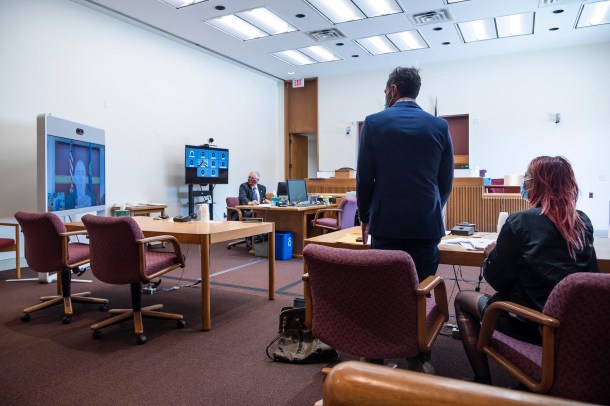
BURLINGTON — A state judge declined for the third time Thursday to halt the closure of a South End encampment, saying that campers had not proved they had legal standing for the court to step in at that time.
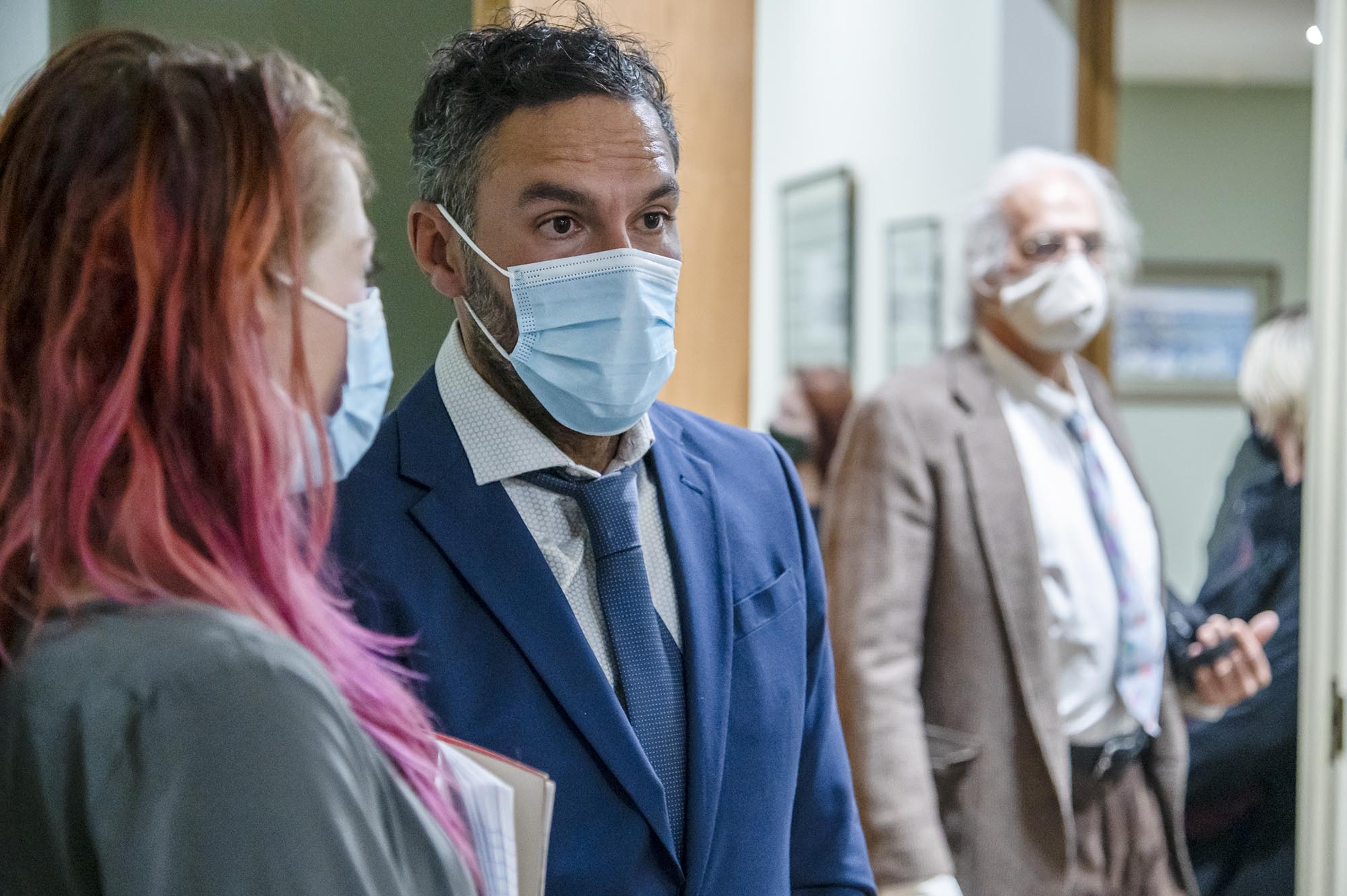
At a hearing in Chittenden Superior Court, Judge Samuel Hoar told Alexus Grundy and Grey Barreda — two residents of the Sears Lane camp — that their motion for an injunction against the city of Burlington was not immediately successful.
Still, Hoar held back from deciding on the case, saying that he hopes to rule on whether the campers have legal standing by Friday evening.
In their complaint against the city, Grundy and Barreda argued the city’s reasons for disbanding the encampment fell short of the conditions that — according to city policy — justify a camp’s removal.
But at the hearing, Burlington City Attorney Dan Richardson said that the campers do not have adequate grounds to sue the city.
Since a policy does not give people rights in the same way that an ordinance or law does, Richardson said, campers cannot get relief from their removal based on whether or not the city adhered to its policy.
The campers — who represented themselves without a lawyer — did not seem prepared to defend their legal standing in the matter. When Hoar asked Grundy and Barreda to produce evidence that the city’s policy “has the force of law,” Grundy offered to provide photos of items the city had cleared from the encampment.

In response, Hoar led the campers through a brief summary of Richardson’s argument.
“Before the court even gets into the question of whether that policy has been violated, the court has to determine whether there is some legal obligation in that area. Because otherwise, what the court is doing is it’s inserting itself into a political process,” Hoar told the campers.
“Mr. Richardson’s point — and it’s a good one — is that you folks have the burden of establishing that you have a legal right here, that the court is then bound to enforce,” Hoar said.
When Barreda’s response did not address the legal standing he had to sue the city, Hoar switched tactics and began to question both sides in an attempt to draw out potential evidence.
“Recognizing that you folks are not represented by an attorney, [and] therefore may not have the same familiarity with the concepts that Mr. Richardson has been discussing … so you may not know what evidence you might have,” Hoar told the campers, “I’ll be asking you questions.”
Hoar then asked the campers about when they first arrived at Sears Lane and whether they received any indication that the city was officially welcoming them to stay there.

Barreda told the judge that he arrived at the encampment roughly two months ago and was told by another camper where he could park his car. Grundy said that she had been at the camp for about two years and that representatives from government agencies knew she had moved there since she was a minor at the time.
If Hoar rules that the campers have legal standing to sue the city, he said, the court will schedule an evidentiary hearing, at which point the campers could argue that the city violated its policy.
The city maintains that it followed the relevant policy, which states that camps can be disbanded in emergencies if there is “any immediate health, safety, or ecological concern where significant harm has occurred or is likely to occur.”
In an affidavit filed in response to the campers’ first attempt at stopping the closure, Burlington Fire Chief Steven Locke said conditions at the camp were unsafe. In his testimony, Locke pointed to numerous code violations and fire hazards that officials discovered at the site, as well as an incident when a camper allegedly pointed a pellet gun at firefighters.
At the beginning of the hearing, though, Barreda argued that the city should have treated each camper’s dwelling as an individual encampment. If that were the case, Barreda said, the city would have violated its policy by removing campers who did not take part in actions the city called harmful or dangerous.

But Richardson rejected the notion that the policy applied to individual campers instead of entire encampments.
“There is nothing in the policy itself that requires the city to make individualized findings of ‘You’re violating the law, but you’re not,’” he said.
In addition, Richardson said certain issues found at the encampment — such as ecological damage to the site — cannot be remedied by kicking out specific individuals.
In remarks after the hearing, Barreda took solace in the fact that he and Grundy had their day in court and that the result of the proceedings was not yet decided.
“This is how due process works,” Barreda told reporters. “The court is acknowledging we have a voice.”