


As the clock wound down on the first half of Burlington’s homecoming football game Friday night, a hot pink feather drifted across the track. The SeaWolves were up 21-14. But instead of the traditional navy and white school colors covering the crowd, rainbow and glitter reigned supreme.
Meanwhile, a group of students and teachers lined up in the high school parking lot. Nervous laughter and the sound of heels scraping on the pavement filled the air. A few younger kids peered between parked cars at the group.
“That guy is so pretty,” one chimed.
“They look like celebrities,” said another, before an adult ushered them towards the field.
The halftime buzzer sounded and the rainbow-clad crowd in the bleachers began to chant.
“Drag ball, drag ball, drag ball,” they screamed, waving red, purple, blue and yellow balloons.


The group of roughly 30 people started walking toward the field. Some wore dresses and heels; others donned suits with facial hair painted onto their chins and upper lips. Advisers from Burlington and South Burlington high schools’ Gender-Sexuality Alliance groups — which collaborated to organize the event — led the charge: Andrew LeValley, of Burlington, was decked out in a Marie Antoinette-style wig and a ruffled plum dress, while Erin Randall, of South Burlington, donned masculine face paint, a suit and tie. Her hair was slicked back off her face.
As Burlington Principal Lauren McBride waited near the field, her walkie-talkie crackled: “They’re coming out, and they look fabulous.”
“We got kings, we got queens, we got in-betweens,” an announcer’s voice boomed on the speakers. “We need you to give it up for all these performers.”
Cheers quickly turned from clapping to deafening screams. A pop song blared from the speakers as LeValley walked and vogued for the crowd, followed by a queen in a long emerald green dress and a crimson wig.

The first-ever drag ball at Burlington High School was met with enthusiastic support, with many saying that the community’s response exceeded expectations.
“Most of the people in the crowd were not from my school — I was surprised by all of it,” said Claudia Schoenfeld, a senior at South Burlington High who provided tech support for the event. “Even though the supportive people [in the crowd] might not be going to my school, they still exist, they are still there.”
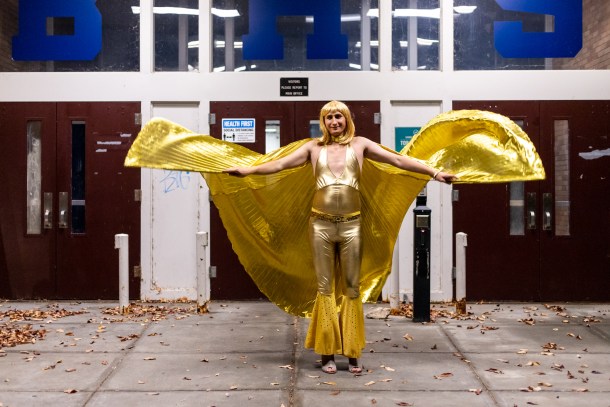
Matthew Claeys, a Burlington paraeducator, wore an entirely gold outfit, complete with a wig and cape, for his first time in drag. He named his drag character Stardust.
“There was a degree of just letting go, and saying who am I gonna be as a queen? And when I adopted Stardust I was like gold smiles, throwing out kisses,” Claeys said.
Still, some students said they had concerns before and after the event about potential backlash. Schoenfeld said she went into the show feeling apprehensive because of recent hateful verbal attacks at area athletic events, including reports of racist and transphobic slurs at a girls volleyball game between Burlington and South Burlington. She said a friend made a grim joke ahead of time: “What hate crime do you think is gonna be committed tonight?”
Others said they hoped that educators and community members would support LGBTQ+ students in deeper ways beyond the drag show.
“I’m glad that they’re showing support, I really am,” said Aria Batten, a member of Burlington High School’s Gender-Sexuality Alliance. “I just wish it wouldn’t be at something as unambiguous as this, because anyone can say, ‘Oh yeah I support this,’ and then not do anything else.”

Preparations
The event featured an array of community members. Everyone who walked in the show signed up ahead of time and spent weeks or days putting together their drag characters.
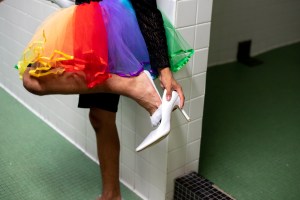
The day before the show, Batten and Thomas Sutton, another member of Burlington High School’s Gender-Sexuality Alliance, expressed excitement that perhaps the art of drag would be better understood by the community after the event.
Sutton walked in the show, while Batten provided tech support.
“Just dressing in drag does not innately connect to the way your identity shapes,” Batten said. “You can still be a [cisgender and heterosexual] man and do drag, but it can open gateways to doing gender expression.”
She noted that several of her friends began wearing skirts and dresses in their day to day lives after exploring drag.
The event was Sutton’s first time trying drag. He said he put a lot of time into crafting his character with the help of his mom and sister.
“It took a while for me to find a dress that actually fit me, but I found a pretty killer one. It’s bronze and sparkly and I’m gonna have this octopus handbag and a cop hat,” Sutton said.
Batten chimed in: “Coptopus!”

Sutton said he looked forward to his first drag performance and enjoyed building his character.
“It is scary to do it, and I worry about being accepted and stuff. But also, the first time I wore a dress I looked awesome in it. It’s fun and if people weren’t hating on it and worried about what this means, I think more people could have fun with it,” he said.
Although they were excited for the show, Sutton and Batten said they wished more teachers had signed up.
“If we had the majority of the teachers doing this … they are the leaders at this school really,” Sutton said. “I feel like that would have been very powerful to just flood it with teachers as well as students. That would encourage more students to be comfortable doing that.”
One teacher who supported the event early on was Daniel Gavin, who started at Burlington as a German language teacher this year. Like Sutton, this was his first time doing drag. He built his character from the feet up, he said, because he had trouble finding shoes that fit.
While Gavin has experience wearing skirts and dresses from participating in theater, he said the experience of creating a drag character felt profoundly different.
“I’m not taking on another character, like in theater. I’m actually being me, but I’m expressing a different side of me, so that was the most amazing and surprising part,” he said.
Gavin chalks up the lack of teacher participation to teachers being busy and perhaps just missing the memo. He said he expects more engagement if the event happens again next year.
Fears of backlash
While the event ran smoothly, with teachers and students saying they felt supported and uplifted by the community, some students remained worried about the weeks ahead.
Em D’Andrea, a freshman at Burlington High School, did not walk in the show but wore a pride flag as a cape in a show of support for the event. In the dressing room after the show, she said she was “definitely worried about bullying at school. Kids are really mean.”


Ash Greenip, a Burlington freshman who walked in the show, agreed. “In general I feel like it’s opening a lot of people up to bullying because of just how vulnerable doing a drag show is,” they said.
D’Andrea pointed to the fact that hate crimes have risen nationally in recent years, despite a more general societal acceptance for LGBTQ+ culture.
“I tend to notice, even if I’m not a part of the event, after things like this, the rate of being called slurs gets much higher,” D’Andrea said. “Homophobes feel threatened when we have power, so they lash out.”
D’Andrea said just the other day she and her friends were standing around talking when another student directed a homophobic slur their way.
“I feel like the school doesn’t talk enough about actual human rights issues. They’re just like, ‘the gays are fun! And rainbows,’” said D’Andrea. “Yeah, Pride parades are fun, but we never talk about the serious issues in school like we do with the civil rights movement.”

Greenip said that while they enjoyed participating in the event, they wished students had more say in how the event went off.
“The support isn’t really supportive. All the songs they played were very stereotypically gay. Like if they’d just played ‘Piano Man,’ everyone would have been happy, because that’s what LGBTQ culture is and not just how straight people see it.”
This is something Greenip hopes their peers, and the community at large, will begin to understand about queer identity.
“Our identities aren’t everything about us. Like, they are important to us, that’s why I feel hurt when people misgender me, that’s why it sucks when I get harassed about my identity, but we’re people too,” they said. “I don’t just go home after school and sit in a chair in my rainbow filled room just covered in unicorns, like no. I go home, I do homework, I read, I have hobbies. Like, I’m a person.”
While Gavin, the German teacher, was optimistic that the community would be supportive, he emphasized the importance of talking with students about the event.
“How do we keep this going?” he said. “And if there is any hate that we experience … we need to talk about it afterwards and process it as a community.”

Correction: Earlier versions of this story misstated Claudia Schoenfeld’s name. A quote from Schoenfeld has been clarified.
