


Does Vermont’s Global Warming Solutions Act leave enough room for the state Climate Council to treat climate resilience with the same urgency as emissions reductions?
With the deadline for the Climate Action Plan fast approaching, the council is debating that question.
The council is struggling to determine whether measures to protect Vermonters from climate change impacts should be funded and weighed as heavily in the forthcoming plan as the dramatic emissions reductions required by law.
The 23-member council is charged with carrying out the 2020 Global Warming Solutions Act, which requires the state to reduce greenhouse gas emissions and prepare for the impacts of climate change. The state’s first Climate Action Plan, a document that will guide the state toward meeting the targets, is due Dec. 1.
The Legislature is expected to act on the council’s recommendations next session.
Language in the act sets quantitative, legally binding goals for greenhouse gas emissions reductions. Language about resilience and adaptation is more vague, prompting discussion and some tension among council members about how to weigh the two priorities.
Adaptation and resilience refer to efforts to mitigate the impacts of climate change on human health, infrastructure and the natural world. This can mean weatherizing homes, implementing creative agricultural methods to ensure a consistent food supply, or building retaining walls to account for rising sea levels, among many other things.
The Global Warming Solutions Act speaks to “all the necessary components of climate policies,” said Jane Lazorchak, the act’s project director, but it doesn’t give all of those components the same weight.
“The strength of the Global Warming Solutions Act is in its language around emission reduction,” she said.
Another council member, Lauren Oates, said that part of the challenge lies in a struggle to measure outcomes of climate adaptation and resilience action.
“The metrics around those spaces aren’t necessarily as well known or documented as they are around something as easy as … counting carbon dioxide in and out. It makes our ability to elevate those strategies … more challenging,” Oates said.
Some council members, Lazorchak said, see the act as a mandate to cut greenhouse gas pollution. Other councilors interpret the act differently: Though resilience and adaptation are harder to measure, they believe the act asks for equal treatment of the issues.
Lazorchak said there’s broad agreement that the council needs to strike a balance. Emissions reductions can be costly, and the impacts of climate change have already arrived, she said.
“That tension — I live that on a daily basis,” she said. “I feel that with councilors.”
The Climate Council has eight weeks left to produce a report, which will be enacted on Dec. 1 and updated regularly thereafter. To that end, councilors are currently attending multiple meetings each week, which often last for several hours. Many do so in addition to other full-time jobs.
Legislators have acknowledged the vast and unwieldy task with which the council is charged. Meanwhile, members of the public and a lengthy list of stakeholders are watching to see what the council chooses to prioritize.
Overflowing bathtub
On Aug. 9, the United Nations Intergovernmental Panel on Climate Change issued a report that found that all regions of the world are already facing changes caused by human-produced greenhouse gases. Unless there are “immediate, rapid and large-scale reductions in greenhouse gas emissions, limiting warming to close to 1.5°C or even 2°C will be beyond reach,” the report said.
Vermont is a member of the U.S. Climate Alliance, a group of 25 states that has committed to cutting emissions at the rate recommended by the Paris Agreement.
That commitment spurred the Global Warming Solutions Act, which requires Vermont to reduce carbon emissions to around 7.38 million metric tons by 2025, then 5.18 million metric tons by 2030, according to the Energy Action Network. By 2050, the state must only emit 1.73 million metric tons of carbon dioxide equivalent.
The state emitted roughly 8.6 million metric tons of carbon dioxide equivalent in 2018, the last year of available data, according to the Energy Action Network.
In addition to the numerical targets, the act builds in legal accountability that allows citizens to sue the state if it doesn’t meet the emission targets.
The act does require the state to keep Vermonters safe from the impacts of climate change: It says the council must “build resilience to prepare the State’s communities, infrastructure, and economy to adapt to the current and anticipated effects of climate change.” But it lacks the same specificity and accountability for these issues that it gives to emissions targets.
Rep. Sarah Copeland Hanzas, D-Bradford, who co-chairs the Climate Solution Caucus, believes that adaptation, resilience and emissions reductions are all interconnected. She doesn’t think there should be a debate around prioritizing one type of action over another. Instead, she hopes the council will tackle these challenges all at once.
“If we are in a bathtub that is overflowing with — in this case — carbon emissions, we have to do several things simultaneously,” said Hanzas. “One; we have to shut off the spout by reducing emissions. Two; we need to find ways to sequester carbon, so we need to open up that drain. And three; we need to create lifeboats, so communities and businesses and Vermont families are protected.
“And if we don’t do all three of them it will be a losing battle.”
Adaptation and resilience are hard to measure, but their urgency has become more pronounced recently as heatwaves, fires and floods have swept the country this summer, sometimes destroying homes and wiping out power grids. The past few years have also shown an increase in fatalities related to extreme weather events.

Emissions-cutting measures — often called “mitigation” — aren’t always separate from resilience and adaptation. Placing a solar panel on a house, for example, reduces fossil fuel usage and can give the household more control over its own energy supply.
Sen. Chris Pearson, D-Burlington, who co-chairs the Climate Solutions Caucus with Hanzas, is concerned that councilors may use the dueling priorities as an excuse not to take swift and strong action in the Dec. 1 plan.
“I’m keeping my eyes and ears open to comments that people make to try to not act,” said Pearson. “The whole point of this was to hopefully remove the ‘should we act’ question, this is about how we should act. There is broad political support for this.”
Otherwise, he agrees with his co-chair Hanzas. These priorities should not be in conflict, Pearson argued, but in concert.
“We will not be doing justice to the challenge if we’re only reacting to the on the ground implication that’s already here,” he said. “We’ve got to be working to prevent more events as much as possible through emissions reduction, while also mitigating negative impact.”
A group of councilors have been pushing for equal consideration and funding for these priorities.
Plans for resilience
The council has five subcommittees, and one of them, called Rural Resilience and Adaptation, presented its recommendations for the Climate Action Plan on Sept. 28.
Erica Bornemann, co-chair of the subcommittee and director of Vermont Emergency Management, began by presenting big-picture messages that are most important to subcommittee members.
She said, through their work, those involved with the subcommittee are impacted every day by climate change.
“Adaptation to those events really needs to accelerate, and we are driven by that urgency,” she said.
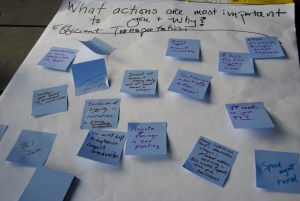
Proposed actions include expanding local community and civic networks that could take on resilience planning, investing “proactively and strategically” to enhance local infrastructure, supporting institutions as they transition away from fossil fuels, changing land use policies and ensuring access to safe housing. Under each of these proposed actions, councilors have proposed myriad additional strategies.
Oates supports the actions proposed by the committee because she feels adaptation and resilience are urgent. She said she believes these propositions will receive broad support.
Oates underscored her commitment to such adaptive measures in an interview with VTDigger. She said climate action that does not include adaptation and resilience is “not a way to comprehensively address climate change.”
“The impacts we’re experiencing in Vermont already, the impacts that we know will be exacerbated over the next several decades regardless of how well and how quickly we can reduce our emissions, are already here,” Oates said.
The issue came up in a Sept. 7 steering committee meeting, when council members were debating a proposal that outlined the drafting process for the Climate Action Plan, which Oates helped author. Whoever writes the plan, the proposal said, should “promote equal treatment of adaptation, mitigation, sequestration, and building resilience.”
The proposal eventually changed, but the issue sparked a broader conversation among councilors during the meeting.
One council member, Jared Duval, executive director of the Energy Action Network, said he had a potential concern about treating the issues equally — particularly with respect to sequestration. He suggested replacing “promotes equal treatment” to “promotes substantial inclusion” of sequestration, adaptation and building resilience.
“I want to make sure that in our attempt and in our responsibility to address adaptation and resilience, that that does not become a way that we take attention away from what is in the act — the very first thing listed, and the most present legally-binding requirement — which is, this has to add up to a plan that meets gross emission reduction requirements.”
Chris Campany, who also helped draft the proposal, said work on elevating adaptation strategies might be “something we need to do in the Legislature next session.” Campany, the executive director of the Windham Regional Commission, spoke of recent flooding in southern Vermont, and said adaptation and resilience are existential “life and safety issues.”
“In my world, we can go negative emissions tomorrow, and for everybody living in Vermont right now, we’re still going to be dealing with the same issues,” he told the steering committee. “I’m going to keep beating that drum. I’ll also keep beating the drum of needing to reduce emissions.”
Duval appeared to agree, nodding and giving a thumbs up.
Drop in the bucket
Sue Minter, co-chair of the Just Transitions subcommittee — tasked with ensuring that all impacts of the Global Warming Solutions Act impact residents equitably — has engaged in mitigation and adaptation work throughout her career. She served as the state’s Agency of Transportation Secretary and the state’s recovery officer after Tropical Storm Irene.
Activism often focuses on emissions reductions, rather than resilience and adaptation issues, she said. Sometimes, in government circles, she said, it’s easier to think about protecting society than it is to consider changing it.
“I think that is what has frustrated activists over a period of time, whereby they’ve observed — and kind of started to discount, perhaps — [resilience and adaptation strategies] as a fallback position,” she said.
While the state has already taken some measures to adapt, the lessons learned from Irene, for example, are a “drop in the bucket in terms of where we need to go,” she said. She believes the Climate Action Plan will begin to fill that bucket.
“It will be, for the state, the first time these issues have really been constructively and strategically analyzed and presented,” she said. “So this is new and critically important, and the fact that it will be an element of the plan is a great step forward.”
Tensions might emerge, however, when the council must decide what issues to prioritize and fund, she said.
Oates said the tensions from the last several months “are really just indicative of that hard work that goes into trying to build coalitions. She emphasized how difficult cohesive action can be in a virtual meeting format.
“I think that has created a space that has not necessarily yielded more organic conversation that is necessary for that coalition building,” she said.
It’s unclear exactly what the plan due on Dec. 1 will look like. Some legislators have suggested it may not be comprehensive.
“I don’t think anybody thinks they’re gonna come to us with a complete plan,” said Pearson. “I think it will be the beginning of a multi-year strategy.
But others have expressed more urgency in putting an actionable plan out quickly.
Hanzas said this decade is essential in climate action, and she wants to see transformative action progress. “I am interested in looking at all of the pathways and strategies that the subcommittees put forward and figuring out how we can move them as aggressively as possible,” she said.
