


BURLINGTON — Vermont’s lone congressman and junior senator are throwing their weight behind a state constitutional amendment to ensure abortion rights in Vermont.
Their support of the state constitutional amendment comes as a congressional act to do the same on a national level sits on shakier ground.
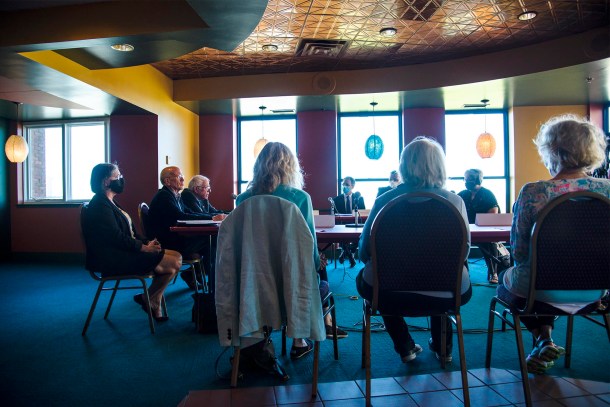
U.S. Rep. Peter Welch, D-Vt., and Sen. Bernie Sanders, I-Vt., attended a roundtable discussion Monday morning in Burlington with a group of abortion rights advocates, who are working to push the constitutional amendment — Proposal 5 — across the state Legislature’s finish line next year. The proposal, also known as the Reproductive Liberty Amendment, would amend the state’s constitution to ensure Vermonters have access to abortions.
The amendment carries a new sense of urgency in the state since the U.S. Supreme Court allowed new restrictions to take effect in Texas, which dictate that abortions are not allowed after six weeks of pregnancy. Abortion rights advocates are calling that an outright ban because many people don’t know they are pregnant by that time.
Abortion rights advocates also have their eyes on an upcoming Supreme Court case that could neuter Roe v. Wade, the case that affirmed abortion as a right in 1973. Mississippi is requesting that the now more conservative bench overrule Roe v. Wade and allow a state law that essentially bans abortions after 15 weeks of pregnancy to take effect.

Welch called the new Texas laws “staggeringly dangerous,” not only for compromising the rights of people who want abortions, but also for incentivizing Texans to sue others in the state for providing abortions or helping people to obtain them. A successful lawsuit pays $10,000 to the person who filed the suit.
“It essentially creates a vigilante mob enforcement mechanism where there’s a financial incentive provided to people who oppose the right of a woman to choose,” Welch said.
Sanders said he applauds the state Legislature’s effort to affirm abortion rights in the Vermont Constitution. He also had a message for men at Monday’s meeting: Abortion rights are not a women’s issue; they’re a human rights issue.
“I want you all to be thinking about how you would feel if the government, state government, federal government, told you what you have to do with your own body,” Sanders said. “You would say this is outrageous, this is unacceptable, this is a denial of my basic rights.”
David Carle, a spokesperson for U.S. Sen. Patrick Leahy, D-Vt., declined to comment on Proposal 5, citing Leahy’s “longstanding policy of not commenting on business pending before the Vermont Legislature.”
“[Leahy] has always been a champion of women’s reproductive rights and the protections provided under the landmark Roe v. Wade decision,” Carle said.
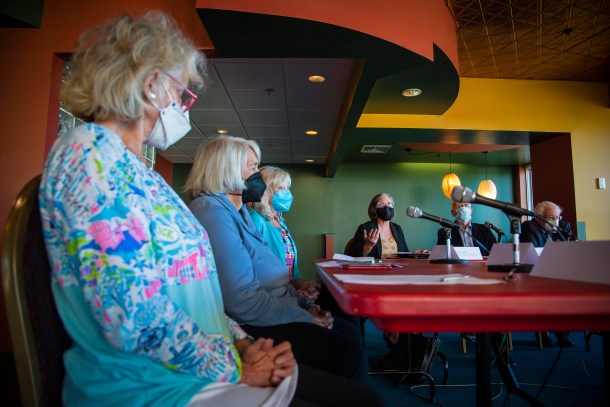
Welch and Sanders on Monday also discussed their support of the congressional Women’s Health Protection Act, a bill that would protect the right to abortion care across the country.
Welch said the bill may come up for a vote this week in the House. He said he thinks it is expected to pass in his chamber, but it won’t do so easily.
As for the Senate, “it’s going to be a struggle,” Sanders said. “There are some Democrats who may not support it. There are a few Republicans who will.”
“Whether we get the votes or not is not clear at this point,” he said.
And if Roe v. Wade is destabilized by the Mississippi case now headed to the Supreme Court, advocates at Monday’s roundtable say it’s important for Vermont to act.
Proposal 5 was first passed by the Vermont Senate and House in 2019, and again by a freshly elected Senate last session. State Rep. Anne Pugh, D-South Burlington, told attendees that the amendment currently sits in the House Human Services Committee, which she chairs.

Pugh said she expects the amendment to pass easily out of her committee for a vote in the House. If the amendment is approved in the House, it is likely to come to Vermonters for a vote in November 2022.
Kalin Gregory-Davis, a medical student at the University of Vermont, told people at Monday’s roundtable how restricting abortion care affects people, based on her experience working in Texas for an abortion fund after House Bill 2 was passed in 2013. That bill made abortions after 20 weeks of pregnancy illegal in Texas and instituted new regulations that abortion clinics had to meet, causing a considerable number of clinics to close.
Gregory-Davis, who is also the president of the board of directors for the advocacy group Medical Students for Choice, said she saw up close the “devastation” that restrictions on abortion access can cause.
“I saw people traveling upwards of 15 hours to get the care they needed,” she said, often to New Mexico.
She said she met a low-income mother seeking an abortion so that she could take better care of the three children she already had. She encountered a 12-year-old girl who sought an abortion after she was raped by her mother’s boyfriend. She assisted another woman who had cancer and needed an abortion because her chemotherapy treatments were making her baby sick.
“All of these patients were traveling for hours and hours, piecing together what little funds they had for food, lodging,” Gregory-Davis said. “And this was all for a procedure that could have been less than 10 minutes.”
Despite its champions in the state, the Vermont reproductive rights amendment is expected to encounter pushback.
Mary Hahn Beerworth, executive director of the Vermont Right to Life Committee, told VTDigger in early September that members of her advocacy group expect to begin “energizing their base” when the Vermont constitutional amendment comes to a vote in the House.
She thinks the amendment includes “highly irresponsible language” that would not protect unborn fetuses.
Some also anticipate that anti-abortion groups outside of Vermont may try to influence the vote through advertisements or other campaigns.
But Sanders said he isn’t worried about those potential efforts.
“People can do whatever they want in terms of advertising. But I think what makes Vermont an extraordinary state is our belief in freedom and liberty,” Sanders said. “We have absolute confidence that voters in the state are going to overwhelmingly support the right for a woman to control her own body.”
Corrections: An earlier version of this story misstated the process for amending the Vermont Constitution and mischaracterized the U.S. Supreme Court’s actions related to the Texas abortion law.
