

If Britain was threatened, at least it knew Vermont had its back. That might seem like cold comfort, given that the country was facing an existential threat from Nazi Germany, whose military was devouring countries across Europe. Support from a lightly populated, landlocked state on the other side of the Atlantic hardly struck fear into Nazi hearts.
Vermont’s small size, however, belied its influence in getting the United States to offer Britain and other allies vital material support in their time of need.
Hoping to avoid a second major war in two decades, European leaders had opted for a policy of appeasement when Germany annexed Austria in the spring of 1938, followed a year later by the seizing of Czechoslovakia. But when Germany invaded Poland on Sept. 1, 1939, Britain and France had seen enough. They quickly declared war on Germany, as did several closely allied governments, including Australia, New Zealand, Morocco and Tunisia.
But the United States remained neutral.
Germany continued its assault on Europe, invading France, the Netherlands, Belgium and Luxembourg in May 1940, and leaving Britain as the last major European power to oppose the Nazi regime. Britain was set to be next for Germany to attack.
In September, the German air force began the nighttime bombing of London and other British cities. The campaign, which the British press referred to as the Blitz, would last more than eight months and kill more than 40,000 civilians.
The American public was divided about how, or even whether, to respond. On one side were the isolationists, who didn’t want to get involved in what they viewed as a European conflict; on the other were the interventionists, who believed that America would inevitably join the war and thought it best to do so while Britain remained free.
The U.S. government looked for ways to aid the British without violating the Neutrality Acts, which Congress had recently passed to keep America out of a second world war. The acts forbade American citizens from either giving cash or providing military supplies on credit to countries at war. Though Britain needed war materiel, it lacked the cash to buy it outright.
In direct opposition to the Neutrality Acts, the administration of Franklin Roosevelt proposed the controversial Lend-Lease program, which would primarily supply Britain, but also the Soviet Union, China and other allied countries.
Many members of Congress, particularly Republicans, feared that Lend-Lease would quickly drag the United States into war. Republican Sen. Robert Taft of Ohio warned that the proposed program would “give the president power to carry on a kind of undeclared war all over the world, in which America would do everything except actually put soldiers in the front-line trenches where the fighting is.” The Roosevelt administration countered that Lend-Lease was perhaps the last chance to keep the United States out of the war.
In late 1940, Vermont’s congressional delegation, Republicans all, broke with their party and firmly supported the Democratic president on this issue.
It was unusual, to say the least, to see Vermonters supporting Roosevelt. (Vermont would be one of only two states to vote against him in all four of his presidential elections.) Among Vermont’s members of Congress, Rep. Charles Plumley of Northfield was the least enthusiastic supporter of Lend-Lease. He backed amendments that would have limited the program, but it was widely assumed he would ultimately support Lend-Lease, which he did.
Vermont had a bigger impact in the Senate, where the Constitution provided the state two of the then-96 seats, despite its small population. Vermont’s senators were among the strongest supporters of Lend-Lease. Warren Austin, a former Franklin County state’s attorney and mayor of St. Albans, went as far as suggesting he would support the United States entering the war, if it came to that. “(A) world enslaved is worse than war,” he declared.

And Vermont’s other senator, Ernest Gibson Jr., was one of the most supportive members in the entire Senate. Gibson, however, was a short-timer. He had been appointed to fill the seat of his father, who had died in office. Gibson chose not to run for the seat in his own right. He left the Senate before Lend-Lease came up for a vote.
But Gibson found a position championing the cause of Lend-Lease. He accepted the chairmanship of the Committee for the Defense of America by Aiding the Allies. The name itself contained the essential argument that the United States’ interests were inextricably linked with those of its allies.
Gibson’s Senate seat was filled by the man who had appointed him to it: Gov. George Aiken. But Aiken had serious doubts about Lend-Lease. During his time as governor, Aiken developed a reputation for mistrusting the intentions of the federal government and wanting to limit its power. He had scored points with Vermont Republicans, which at the time was to say most Vermonters, by opposing federal efforts to develop hydroelectric power in the state and to move Vermonters off land the federal government deemed “submarginal.”
Aiken feared that Lend-Lease was another example of federal overreach with serious ramifications. He supported Britain in its struggle with Germany but warned that approving Lend-Lease would authorize the president “to put our country not only into Britain’s war, but into every and any war on the face of the globe that he thinks should be our war too.”
The Lend-Lease program enjoyed strong support from Vermont’s newspaper editors, business leaders and newly elected Gov. William H. Wills. Aiken and members of the America First Committee, the main isolationist group, tried to use those endorsements against the program. They argued that a plan backed by the elite could push the country into a war that would be fought by farmers and blue-collar workers. It didn’t help their argument, however, that the American Legion in Vermont, with 4,000 members, had backed Lend-Lease.
On March 8, 1941, the Lend-Lease program, which had already passed the House, came up for a Senate vote. Aiken followed through on his promise to vote against it. Warren Austin and 55 other senators backed Lend-Lease, so Aiken’s vote wasn’t needed.
The vote aligned with popular opinion. According to a Gallup poll taken a month before Lend-Lease became law, fully 54 percent of Americans approved of it without qualifications and an additional 15 percent supported it provided that it didn’t draw the country into war. By then, however, the United States’ eventual involvement might have been inevitable. The government was already making preparations. Six months earlier, it had instituted the country’s first peacetime draft.
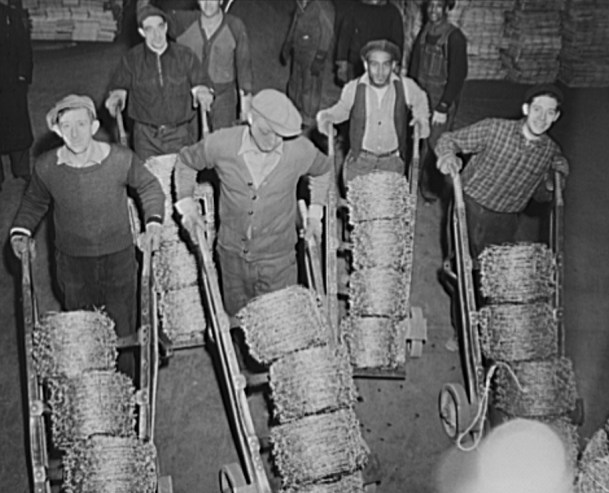
Workers push coils of barbed wire onto a ship in New York harbor as part of the Lend-Lease program. Photo via Library of Congress 
Personnel unpack and inspect revolvers shipped from the United States under Lend-Lease at an English ordnance depot. Photo via Library of Congress 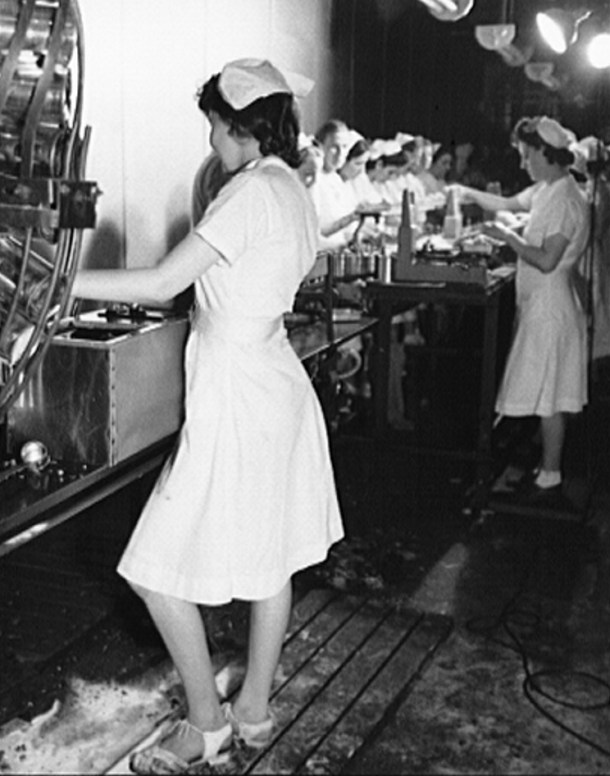
Assembly-line workers at a Kroger grocery and baking company plant in Cincinnati prepare tins of ham for shipment to the Soviet Union. Photo via Library of Congress 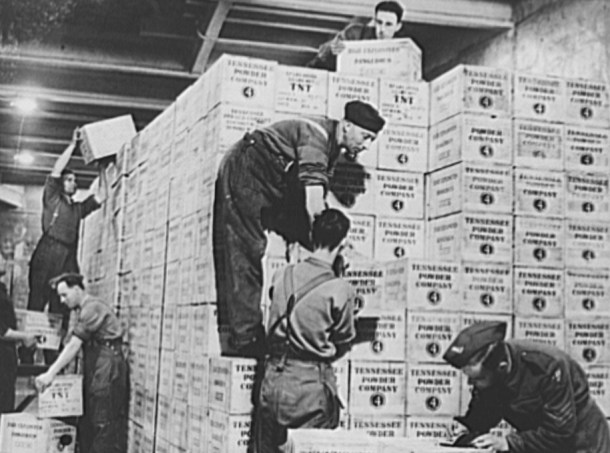
TNT shipped from the United States is stacked in a storage area located 100 feet underground somewhere in western England. Working in shifts, the staff handled materiel arriving from the United States 24 hours a day. Photo via Library of Congress
Eighty years ago, in September 1941, the Vermont Legislature declared that the state was already in “armed conflict” with Germany. Tensions were so high between the United States and Germany that the Legislature authorized a monthly bonus to Vermonters in the military. President Roosevelt had recently ordered service members protecting merchant ships to fire at any approaching German or Italian ships or planes, so lawmakers decided they deserved the equivalent of combat pay for being in harm’s way. The legislation prompted quips in the national press about the “London-Moscow-Montpelier Axis” and the “Vermont-German” war.
One nationally syndicated columnist, Henry McLemore, asked: “Just why did Vermont, without conferring with any of the other 47 states or the folk at Washington, throw down the gauntlet to the Nazis and the Fascists? Did Vermont feel that Hitler, with his chief supply of maple sugar cut off and forced to use jam and preserves on his waffles and pancakes, would be driven to his knees?”
However, McLemore, who wrote for Hearst newspapers, understood the Vermonters’ point of view: “They argue that when President Roosevelt (whom they never voted for) issued the ‘shoot-on-sight orders’ to the Navy, we got in the war right there. So, out of honesty if nothing else, they declared war. They don’t like hypocrisy up in these parts.”
When war came, Warren Austin continued to back the Democrats’ foreign policy initiatives. Partly as a reward for that support, President Truman selected the senator as the United States ambassador to the newly created United Nations in 1947.
Though his vote against Lend-Lease placed him at odds with the rest of the Vermont delegation, the ruling Democrats in Washington and opinion polls, Aiken’s stance didn’t hurt him politically. When the United States finally entered the war, he became a strong supporter of the cause. And he retained his seat for three and a half decades.
