


Six people have died this year as a result of motor vehicle crashes on Route 105, the most recent killing one person in Sheldon on Thursday.
These deaths, from five separate crashes, account for about 12% of all fatalities on Vermont roads in 2021 so far, according to state police data.
Officials said speed was likely a factor in most, if not all, of these incidents.
“The speed limits are there for a reason,” said Franklin County Sheriff Roger Langevin. “It just goes through our towns. It’s not the interstate.”
Vermont State Police said Thomas Finn, 71, of Enosburg Falls died Thursday after his car crossed the double yellow line and hit another car head-on. Finn was critically injured and later died at the University of Vermont Medical Center, police said.
On Sept. 10, a driver and passenger also died on 105 in Sheldon when their vehicle crossed the center of the road, went over an embankment and struck several trees, police said. Another passenger in the car was critically injured in the crash, which officials said was made worse by speed and a lack of seat belt use.
On Aug. 4, a motorcyclist died when his bike crashed into the back of a farm truck on 105 in Swanton at a high rate of speed, state police said.
On May 25, officials said a man died on 105 in Enosburg when his car crossed the center line and hit an oncoming box truck. Speed was believed to be a factor.
And on Aug. 6, a pedestrian died on 105 in North Troy in a hit-and-run, state police said. The man was found lying in the road early in the morning.
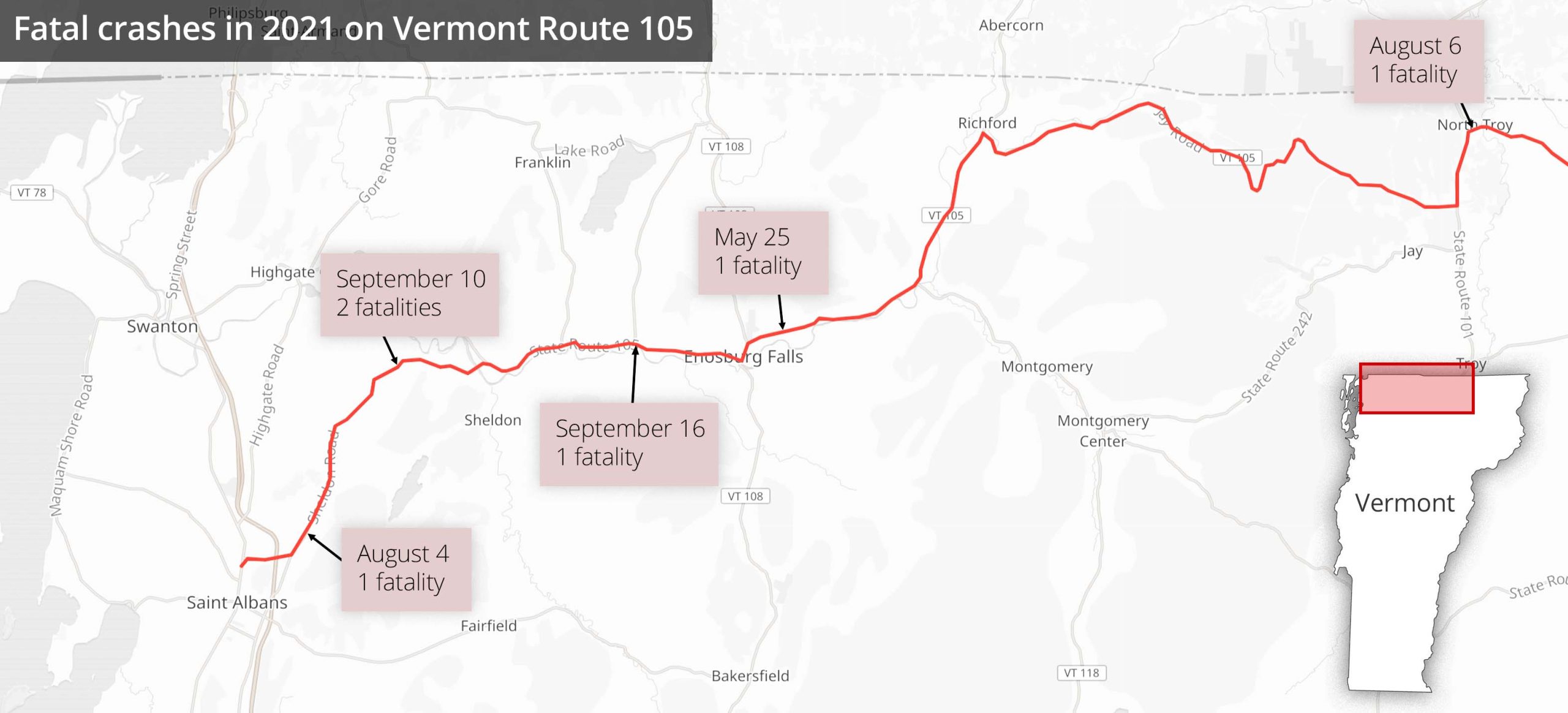
Route 105 runs across the state, between St. Albans and Bloomfield on the New Hampshire state line. The speed limit on most of the highway is 50 mph, though it drops when the road passes through town centers.
Langevin said Route 105 can be dangerous for drivers because it has a lot of curves and hills.
The sheriff’s department has received a number of calls and complaints about people driving recklessly on the road, he said.
“Some of these vehicles [are driving] in excess of 80 miles an hour on a 50-mile-an-hour road,” Langevin said, “and also passing at very inopportune times.”
On Aug. 3, a day before the fatal motorcycle crash in Swanton, state police said they stopped a driver who was going 85 mph in a 50-mph stretch of 105 in Sheldon.
Speed limits
Ian Degutis, a traffic engineer at the Vermont Department of Transportation, said speed limits are set by the state traffic committee. The decision for each stretch of road is based on an engineering study conducted by Degutis’ team at a given municipality’s request.
Local residents are also invited to offer input during the process.
Part of the engineering study involves figuring out the top speed for 85% of drivers on a given road, Degutis said. From there, the Manual on Uniform Traffic Control Devices recommends setting the speed limit within 5% of that value.
He said the team also considers factors about a road, such as its topography, crash history and pedestrian and bicycle use.
In many cases, Degutis said, changing the speed limit is not an effective way to reduce travel speeds on the roads.
“Most drivers will drive at a speed they perceive to be comfortable and appropriate,” he said. “And reducing the posted speed limit doesn’t have a large impact on their perception of that.”
Overall, Vermont traffic fatalities this year are at about the same level as this time in 2020, said Mandy White, manager of the data section in VTrans’ Operations and Safety Bureau.
As of Friday, there had been 51 fatalities on Vermont roads this year, White said. There were 49 fatalities as of Sept. 15 in 2020, according to state police data, and an average of 43 at that point over the past decade.
It’s often drivers’ decisions — speeding, not wearing a seat belt, driving distracted or under the influence — that cause crashes, not the road itself, White said.
“It’s their behavior,” she said, “that makes the roads safer.”
