

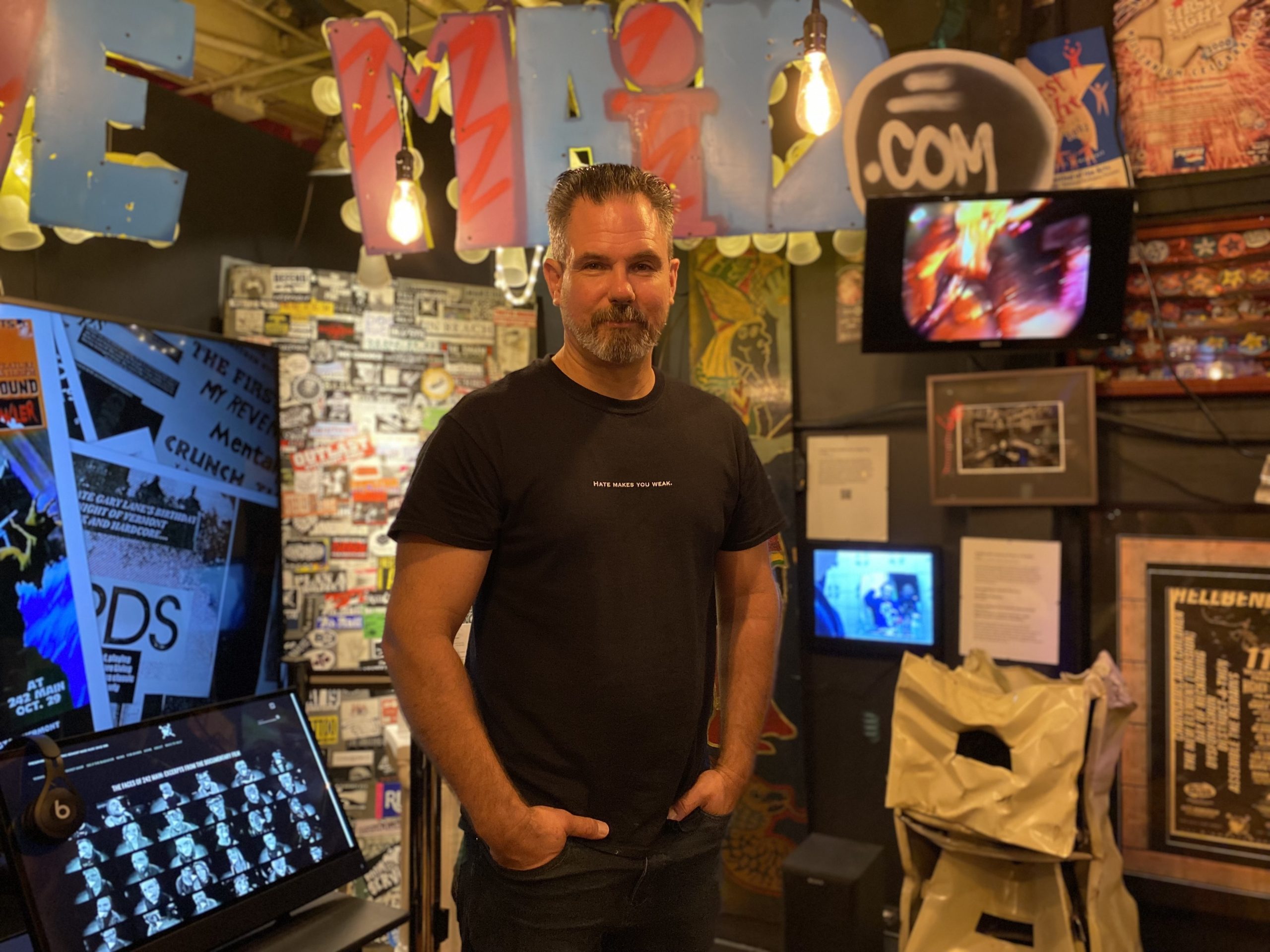
BURLINGTON — The dimly lit 16-by-21-foot space in the South Ends arts district is crammed with instruments once played by 20th-century musicians, posters of punk rock bands from before the term punk rock was coined and an iPad connected to headphones for listening to Vermont-made music.
The Tiny Museum of Vermont Music History opened to the public Friday evening as part of the city’s South End Art Hop, a weekend-long event with art, food and drinks dedicated to celebrating creativity and entrepreneurship in the neighborhood.
Although the Art Hop will come to an end on Sunday afternoon, the new museum at the corner of Howard and Pine streets is to become a permanent fixture in the community.
“I hope the museum will provide a sense of connectedness, a sense of the value of music in our society and a reminder of positive experiences as a community,” said James Lockridge, the brains behind the production.
The museum is a component of Big Heavy World, Lockridge’s 25-year-old nonprofit dedicated to supporting locally created Vermont music and musicians.
The museum takes up about half the basement-level room. The other half is a multi-use space that feels like it could be a relic of the past itself, with ’90s-style crushed velvet chairs, thousands of CDs lining the walls, and a “radio station” with a microphone, desk and computer set up against a wall.
A team of musicians, volunteers and friends joined Lockridge over three years to curate the artifacts and put the museum together, creating a multimedia experience archiving artists and concerts past and showcasing Vermont musicians currently at work.
“It’s a historical record, and history is important even in the music industry,” said Burlington-based music photographer Luke Awtry, who worked with Lockridge on a mural featured in the museum.
Between concert posters, instruments and relics from old venues, the small space is steeped with stories. On Friday morning, just a few hours ahead of opening, Lockridge walked slowly around the museum, explaining the history of a door covered in stickers; a table decorated with coins, keys and other pieces of metal; and a saxophone set on a platform in a plexiglass case.
Although many things in the museum were contributed or are on loan, Lockridge made an effort to purchase some artifacts, including the saxophone.
The gold wind instrument belonged to Big Joe Burrell.
“He was a beloved, legendary bluesman in Vermont for about 30 years,” Lockridge said.
Born in 1924, Burrell wound up in Vermont in the ’70s when he formed a well-known blues band ironically named “The Unknown Blues Band.”
“The inclusion of Big Joe’s instruments is a great thing for the tiny museum,” Lawtry said. “He had a huge impact here.”
“People might walk past that statue of Big Joe on Church Street and have no idea what Big Joe did or who he was,” Lawtry said about the statue that stands in front of Halvorson’s Upstreet Cafe. “Having his instruments in the museum increases visibility.”
Local “ambient-indie-soul” musician Ivamae, who has been working with Big Heavy World since 2016, is looking forward to stopping by the museum.
“I’ve seen it come to fruition over the years, so it’s exciting that it’s actually opening up. I’m excited to see everything put together in its final form,” she said.
Ivamae said Big Heavy World has played an important role in her growth as a musician in Vermont.
“They’ve just given me a voice as a local musician just starting out. They gave me a platform to play my music on the radio and talk about my process and artistry, which is such a treat,” she said.
The museum is an expansion of the Big Heavy World’s 2019 exhibition, “Vermont Music Far & Wide,” which was created for the Vermont Historical Society Museum in Montpelier.
From blues and folk to jazz and punk and everything in between, it features all genres of music, which according to Lockridge, is properly representative of the state’s music scene.
“Vermont should be known for the talent and diversity of its creative community and musical artists,” Lockridge said.
When asked to describe Vermont’s sound, Lockridge said: “That’s a dangerous question because other states or regions might be quick to decide the sound of their region, which is an exclusive way of approaching an art form that is so diverse.”
Lockridge said Big Heavy World and the tiny museum try to showcase artists who don’t benefit from traditional platforms of exposure.
“We have an open-door policy for Vermont-based artists making original music,” he said.
The museum provides a multimedia experience. Music that could be labeled soul, indie, instrumental or rock complements the visual components of the museum.
Although Lockridge is a lover of music, he said songs, or even concerts themselves, are not what draws him to this work.
“I’m involved in this because it’s possible to strengthen the community from within the context of music,” Lockridge said.
Helping young volunteers experience success and gain self-confidence and empowerment are what Lockridge finds most enjoyable and fulfilling, he said.
“My orientation to this is more about the people than the music,” he said. “Music is just the inspiring thread through all of it.”
