


Theodore Roosevelt was the man of the hour. A thousand people turned out on Sept. 6, 1901, at a political gathering in Vermont to catch a glimpse of the man and hear him speak.
Roosevelt had captured the nation’s attention with his dauntless courage, boundless energy, and persistent optimism. Just three years earlier, he made headlines when he resigned as assistant secretary of the Navy to serve in the Spanish-American War. He made more headlines for commanding the Rough Riders cavalry unit and braving gunfire during the victory at the Battle of San Juan Hill in Cuba.
Just a few months after the battle, in the fall of 1898, he was elected governor of New York. By the time he visited Vermont in September 1901, he was vice president of the United States. Vermonters were eager to hear from the man of the moment.
But events unfolding nearly 400 miles away would overshadow anything Roosevelt had to say before that crowd in Vermont. People who heard him speak soon cared little about what he had said; they were focused instead on what he might soon become.
On his tour of Vermont, Roosevelt had already made stops in Rutland and Burlington. Now he was attending the Vermont Fish and Game League’s annual dinner at the home of former Lt. Gov. Nelson W. Fisk in Isle La Motte.
Despite its name, the league was as concerned with politics as with wildlife. Its board was comprised of leaders of the state Republican Party, the only party that really mattered in Vermont at the time. In an era when governors served one-year terms, the dinner gave GOP leaders a chance to introduce the party’s gubernatorial candidate, who would inevitably be the state’s next governor.
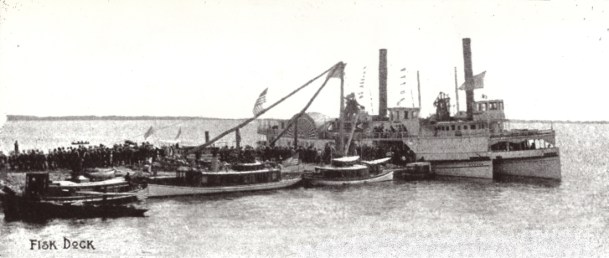
Roosevelt was in town to check in with political allies and lend gravitas to the event, just as President William McKinley had four years earlier. Hundreds of visitors reached Isle La Motte aboard the Chateaugay steamship and other smaller boats that tied up at Fisk’s dock. At about 1:30 p.m., the guest of honor and the roughly 1,000 guests sat down for dinner under a massive tent on Fisk’s lakeside property. (Among the attendees was famed American novelist Winston Churchill, no relation to the later British prime minister of the same name and at the time the more famous of the two men.)
After the meal, Roosevelt was elected an honorary member of the league and the St. Albans Glee Club performed a song written for the occasion. Sung to the tune of “Hot Time in the Old Town To-Night,” it began:
“Old Vermont has been a-fishing on the shores of Oyster Bay [where Roosevelt owned a home on Long Island],
For a gallant Soldier-Statesman to grace her festal day
Did you hear the swish of rod and line, as with her might and main
She landed safe her prize upon the banks of fair Champlain.”
Then Roosevelt and other dignitaries made speeches. “I am interested in all furred, finned and feathered inhabitants of the woods and waters,” the vice president declared. He was an avid outdoorsman and some of his happiest hours had been while hunting and fishing. Roosevelt said deer were a valuable resource for a place like Vermont. Dead, they were worth little; but alive, they were “bait for city sportsmen. They do not always hit the deer and leave a hundred times the worth of the deer in money.”

The most striking speech that day, however, may have been delivered by Jeremiah Curtin, a noted folklorist and linguist, who was said to be proficient in 70 languages. Curtin was a regular visitor to Vermont, having married a woman from Warren. He later wrote in his memoirs that he had not expected to speak that day, but when he was called on by the emcee to make a few remarks, he was not at a loss for words.
“This is a feast at which the host is a great state, represented by its leading citizens,” Curtin ad-libbed. “The guest of honor is the most widely known public man in America; the man most intimately known by the people; the heir at law of the White House; and millions of American citizens hope that in the future he will be the occupant of that mansion.”
Curtin was of course just being deferential to the vice president. He couldn’t have realized how soon his words would become true.
After the last of the speeches was completed, Roosevelt returned to Fisk’s house to rest briefly before he was to host an informal reception that evening. But that event would soon have to be canceled.
Dazed after the call
Lt. Gov. Fisk owned the only telephone on the island. At 5:30 p.m., it rang. The call was for Roosevelt. The caller was the wife of the president of the New England Telephone and Telegraph Co,, who relayed reports she had heard that the president had been shot. Moments later, a second call confirmed the news. Less than 90 minutes earlier, President McKinley had been shot while shaking hands with members of the public at the Pan-American Exposition in Buffalo.
John Barrett, former U.S. minister to Siam (now Thailand), was in the room when Roosevelt got the news.
“He was changing his clothes when called to the telephone,” Barrett told The New York Times. “As soon as he realized the meaning of the terrible news, a dazed expression followed by a look of unmistakable anguish came to his face, and tears immediately filled his eyes: He was plainly laboring under deep emotion, and asked (Vermont) Senator (Redfield) Proctor, likewise keenly affected, to make the sad announcement to the waiting crowd.”
Proctor dutifully went outside and, after quieting the gathering, said, “Friends, a cloud has fallen over this happy event. It is my sad duty to inform you that President McKinley, while in the Temple of Music at Buffalo, was this afternoon shot twice by an anarchist, two bullets having taken effect. His condition is said to be serious, but we hope that later intelligence may prove the statement to be exaggerated.”
With the announcement, the Vermonter magazine reported, “a moan of sorrow went up from the entire assemblage and many burst into tears.”
Soon, Roosevelt received word that doctors believed McKinley might survive. “(T)he vice president exclaimed with sincerest feeling: ‘That’s good — it is good. May it be every bit true,’” Barrett recalled, “and immediately he brushed aside those about him, hastened out on the veranda, and made the reassuring announcement himself.”
Despite the encouraging report, Roosevelt decided he should be with the president.
The vice president traveled to Burlington with Dr. W. Seward Webb, the owner of Shelburne Farms, aboard Webb’s yacht, Elfrida. En route, someone mentioned to Roosevelt that he might arrive in Burlington to the news that he was president. “Do not speak of that contingency,” Roosevelt responded, according to Barrett. “Our one thought and prayer is now for the president, and that he may be spared.”
Roosevelt sent a telegram to Buffalo at some point, perhaps using the telegraph aboard the Elfrida. He drafted the message on the back of a Rutland Railroad schedule. Addressed to the “Director of Hospital or House at which President lies Buffalo NY,” it read: “Wire me at once full particulars to Van Ness House Burlington Vermont.” He signed it, “Theodore Roosevelt Vice President,” as if to underscore that he was wishing the president well.
A prophetic remark
McKinley was still alive when the Elfrida docked in Burlington. From there, Roosevelt boarded a special train to Proctor, where he had left his baggage. He was accompanied aboard the train by Sen. Proctor, his son (and future Vermont governor) Fletcher D. Proctor, former Vermont Gov. John W. Stewart, and Percival Clement, president of the Rutland Railroad and another future Vermont governor.

At one point, Clement said to Roosevelt, “Col. Roosevelt, this is the most eventful night of your career. I am afraid you will be called upon to assume the responsibilities of the president’s office in a short time.”
“Oh, I hope not,” Roosevelt responded, “not that I fail to appreciate its importance, but I don’t want it to come that way.”
From Proctor, the vice president traveled to Buffalo. Several days after the vice president’s arrival, McKinley’s condition stabilized, and Roosevelt was urged to leave the president’s side, lest the public fear that McKinley’s life was in danger. So on Sept. 10, Roosevelt traveled to the Adirondacks for a brief vacation.
By Sept. 12, McKinley had regained enough strength to eat solid foods, a hopeful sign. Roosevelt must have been in a more relaxed mood the next day as he set off to climb Mount Marcy, the tallest peak in the Adirondacks. As he climbed, however, a guide from the club where Roosevelt was staying caught up to him with an urgent message: The president was fading.
Roosevelt fretted about what to do. At about midnight, Roosevelt decided he needed to get to Buffalo immediately. The nearest train station was ordinarily a seven-hour ride away in daylight. That night, the vice president raced through the wilderness in a horse-drawn wagon, changing horses along the way and eventually switching to a carriage. He reached the station at about 4:45 a.m.
He was greeted there by his private secretary, William Loeb Jr., who handed him a folded piece of paper. Roosevelt read it and “was visibly agitated,” the Boston Globe reported the next day. “Tears rose in his eyes and his lips shut tightly, but he said nothing.” Pocketing the note, Roosevelt “strode toward the special train, looking a worn and thoroughly lonely man.” McKinley was dead, and the new president was catching a train to Buffalo to pay his respects.

Corrections: Fletcher D. Proctor was the correct name of the former governor, and Roosevelt learned about McKinley’s death at the beginning of his train trip, not at the end.
