


Until recently, it looked as if Vermont’s immunization rates alone could shield the state from the country’s variant-fueled coronavirus surge.
“How to build a Delta immunity wall,” Eric Topol, a professor of molecular medicine at Scripps Research and an influential public health commentator, tweeted on Aug. 1, citing the Green Mountain State’s single-digit daily Covid-19 case counts and near-nonexistent hospitalizations.
Exactly two weeks later, pointing to rising breakthrough cases and hospitalizations, Topol had a different take.
“Here’s Vermont, the highest vaccination state (67% of total population) … indicating just how challenging Delta is and the need to gear up even when vaxxed,” he wrote.
Vaccines remain remarkably effective at protecting the immunized from hospitalization and death. Only 23 fully vaccinated individuals have been hospitalized with the virus since January, and nine have died, according to the Vermont Department of Health.
But breakthrough cases, once exceedingly rare, are rising rapidly in the Delta variant’s wake. Between Aug. 8 and Aug. 14, of 725 Vermont residents testing positive for the virus, 288 had been fully vaccinated, according to state data.
Hospitalizations have also been on the rise. Community transmission is now consistently considered “high” or “substantial” in a majority of Vermont’s counties, according to metrics from the Centers for Disease Control and Prevention. And 10 fatalities from the virus have been reported so far this month, despite earlier forecasts of six deaths, at most, in August.
Vermont’s nation-leading vaccination rate is “certainly a big accomplishment,” said Julia Raifman, an assistant professor of health law, policy and management at Boston University who has been tracking state responses to the crisis. “It is also absolutely not enough. Especially for children under the age of 12 who cannot be vaccinated.”
But Gov. Phil Scott’s administration has remained steadfast in its vaccination first — and last — approach to pandemic control. Despite the CDC’s recommendation that the vaccinated and unvaccinated mask indoors in areas of high transmission, the governor continues to suggest that only the unvaccinated ought to mask, and has said, again and again, that no additional broad-based measures are necessary.
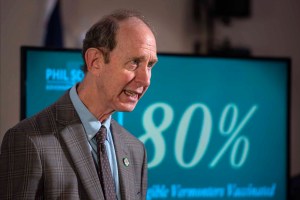
Mark Levine, the state health commissioner, echoed this in an interview Friday. Health officials are closely watching what is happening in Israel, Oregon, and Hawaii — all highly vaccinated areas with a surge in cases.
But for now, more restrictions are not necessary, he argued, and masking should remain a matter of personal preference.
“If you just feel like you're more comfortable because you're wearing a mask, we'd have no problem with any of that,” he said.
Levine also argued that attention to breakthrough cases “deflects attention” from what CDC director Rochelle Walensky has called the “pandemic of the unvaccinated.”
“They put so much focus on people who have developed a case who were vaccinated — as if that's a failure — that it will further ... impede the uptake of vaccines in places that really need to have more vaccinated people,” he said.
But Raifman — who thinks Vermont should be imposing an indoor mask mandate, and require vaccinations for school staff and eligible children — thinks that underestimates the public’s appetite for complicated truths.
“I think leaders should trust the public to understand that we're going to need several different strategies that all help prevent Covid and make it less likely, but none of them are 100% effective,” she said.
Annie Hoen, an associate professor of epidemiology at Dartmouth College’s Geisel School of Medicine, agrees that the state must do what it can to get as many people as possible vaccinated. The shots are still very good at preventing severe outcomes.
But breakthrough cases can still be transmitted to unvaccinated children, or immunocompromised people for whom the shots can be less effective, she said. And that’s why the state should be exploring further measures to lower the overall rate of transmission.
“It is very convenient for healthy, vaccinated people to decide that it is time to lift mitigation strategies and just live with this virus,” she said.
Vermont is not likely to max out its hospital ICU capacity, as has happened in low-vaccination states such as Alabama, said Timothy Lahey, an infectious disease expert at the University of Vermont Medical Center. But UVMMC, he said, has already reformed Covid-19 care teams and is reducing some elective care to deal with a surge in serious illness.
“What’s clear is that, despite Vermont’s high vaccination rates, hospitalizations and deaths have increased,” he wrote in an email to VTDigger.
Lahey said he’s returned to wearing a mask at the grocery store, and no longer dines out indoors. He emphasized that, as a vaccinated person, he felt well protected from serious illness. But he said he worried for the medically fragile person behind him in the grocery store line — and children still too young for shots.
“I would not have gone back to mask-wearing indoors if this was just a surge of cases. For me, the important signal is that there are more people in respiratory distress in the ICU,” Lahey said.
Given this sudden surge in hospitalizations, Lahey said he’d like to see the state more strongly encourage indoor masking for all. He said masking requirements should be on the table if indicators rise “at all” from where they are now.
There are no children currently hospitalized with the virus in Vermont, the health department reported Friday. But nationally — and regionally — pediatric hospitalizations are surging. Anne Sosin, a policy fellow at Dartmouth College’s Nelson A. Rockefeller Center for Public Policy, said that there’s little reason for Vermont to think that can’t happen here.
“Vermont children under 12 don't look different from Louisiana, or Florida children under 12. If we fail to employ adequate mitigation strategies in schools, we can expect the same results that we're seeing in other states,” she said.
Unvaccinated children face an “unprecedented threat” when schools open, said Liz Winterbauer, a consulting epidemiologist and public health instructor at St. Michael’s College and the University of Vermont.
Protecting the most vulnerable still requires a community-wide effort to keep cases low — at minimum, indoor masking, she argued. The state is also underutilizing testing, she added, and should make rapid at-home testing, which is too expensive for most Vermonters to use regularly, more accessible.
“We have a perfect storm — pandemic fatigue, an administration that won't pivot, and a more transmissible, possibly more severe variant. I'm very worried,” she wrote.

Get the latest statistics and live updates on our coronavirus page.
Sign up for our coronavirus email list.
Tell us your story or give feedback at coronavirus@vtdigger.org.
Support our nonprofit journalism with a donation.
